All posts by dvarisco

History Channeling “The Bible”

Hollywood loves making biblical movies and once in awhile there is one worth watching. Last night the so-called “History Channel” premiered a 10-part series with the novel title of “The Bible.” To cut to the chase, this is a really awful cinematic flop. It is definitely not worth watching, no matter what you think about the Bible as history. The first episode starts with Noah brandishing a Scottish accent in a leaky ark with pairs of animals, like giraffes, in the background. How giraffes migrated to Mesopotamia where Noah lived is, for historical accuracy, better left unmentioned. In between plugging up holes in the shittim wood, with water swirling in the air around the inside of the box-like ark, Noah tells the story of creation, day by day. We get a glimpse of Adam and Eve, but not with any full body frontal nudity. Our first sight of Adam is a guy literally caked with mud, not the dust of the ground. How Eve got there is left out. The bashed-in head of Abel is shown, but no one delivers the classic line “Am I my brother’s keeper?”

The story jumps from Noah to Abraham, who convinces Lot to drag his wife along as the “tribe” moves to the promised land. The actor for Abraham could have taken lessons from Mel Brooks, who had Moses down pat in History of the World, Part One. There is a lot of hugging, but for the most part God is absent from the life of Abraham. Why anyone would want to believe in this bullying absentee creator is a mystery. Then one day three messengers appear, one looking Asian and another looking African and all three with full body armor. When Abraham hears that wicked Sodom is about to be destroyed, he asks the messengers to save Lot and his family. Sodom is a steamy and seedy place with little evidence that the young looking Lot was actually made into a judge and sat at the city gate. Good King Melchizedek of Sodom, who was saved by Abraham, is left out of the cast. Nor is the command for Abraham to circumcise, the sign of the covenant and a rather important part of the story, included. Beyond the drunken street carousing in Sodom, Lot’s willlingness to send out his virgin daughter rather than give up the messengers he had given shelter to is missing. He hardly needed to offer his daughter, as in this film the Asian looking messenger is a martial arts specialist and slices his way through the streets with Lot and family, after letting Jehovah (it is hard to tell because God is off camera much of the time) blind the evil doers. Lot’s wife turns into a pillar of salt, a historical item one should probably take with a pillar of salt, but the incest of Lot with his daughters in the case is conveniently omitted. Continue reading History Channeling “The Bible”
A Viennese Tour to Egypt in 1912


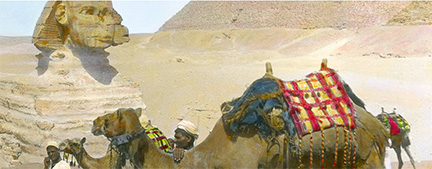
While in Vienna last week for a conference, I was able to visit the Museum für Völkerkunde and see several of the current exhibits there. One of these is entitled “Urania reist nach Ägypten:
Wiener Volksbildung und der Orient um 1900”
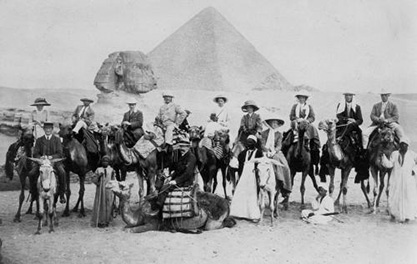
and presents an Austrian field trip to the Pyramids and Egypt in April, 1912. This was led by the President of the Urania institute, opened by the emperor Franz Joseph I in 1910. About 70 individuals went on the trip. some from the Hapsburg family. The exhibition includes a number of vintage photographs and touristic items like postcards and souvenirs, as well as the type of clothing the Viennese would have worn while touring Egypt.


1912 tour to Giza organized by Thomas Cook

Vienna Conference


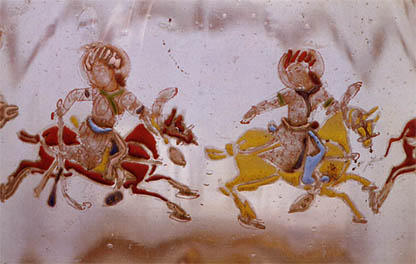
Rasulid polo players, ca. 1260-1270; Museum für Islamische Kunst, Berlin

This week I am participating in a conference in Vienna and will deliver a paper on Rasulid bureaucracy. Details on the conference are noted below. Anyone in or near Vienna is welcome to attend.

3rd International Conference of the Research Network Imperium & Officium: Land and Power in the Ancient and Post-Ancient World, University of Vienna, 20–22 February 2013

In addressing the theme of ‘Land and Power’ we wish to examine the power base of office-holding élites in pre-modern societies. As a tool of analysis we frame our questions in Weberian terms, distinguishing between exercise of power in a bureaucratic mode (ex officio) and power based on economic wealth and privilege in a patrimonial setting, with office being conferred as a consequence. Our focus will be on the interplay between economic power and bureaucratic rationality. In most pre-industrial societies, power and wealth was based on landownership and the control of food production: landownership as the basis of power of an office-holding élite is a recurring phenomenon in ancient states. We also seek to question whether such élites (especially in the periphery) were a force for cohesion or disruption from the point of view of the state, and to investigate the means by which the state sought to integrate and control office-holding élites, e.g. by the use of parallel and/or overlapping chains of command, or by co-optation through court offices and privileges.

Programme (provisional)

Wednesday, 20 February 2013

9–9.30 a.m. Welcome address by Jursa, Michael and Palme, Bernhard (Vienna)

Section 1: Elite Formation

Chair: Jursa, Michael

9.30–10 a.m. Garfinkle, Steven J. (Washington): Landownership and Office-Holding: Pathways to Privilege and Authority under the Third Dynasty of Ur

10–10.30 a.m. Kaiser, Anna (Vienna): Flavius Athanasius, dux et Augustalis Thebaidis

10.30–11 a.m. coffee break

11–11.30 a.m. Scheuble-Reiter, Sandra (Chemnitz): Military Service and the Allotment of Land in Ptolemaic Egypt

11.30–12 a.m. Paulus, Susanne (Münster): The System of Landownership in the Middle Babylonian Time (1500–1000 BC) Continue reading Vienna Conference

Those Priceless Sumerians


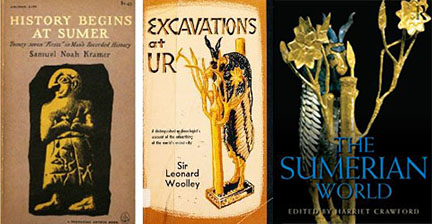
One of my favorite books of all time is Samuel Noah Kramer’s History Begins at Sumer. In my youth I was fascinated with the Sumerians. I have a paperback copy of C. Leonard Wooley’s The Sumerians, published by Norton in 1965 and also his Excavations at Ur, an Apollo Edition also from 1965. The first Woolley book set me back $1.75 back then and the second was a whopping $1.95. All three cost me less than a five-dollar bill. A few days ago I received an email from Routledge announcing a new book called The Sumerian World spread out in some 688 pages. Pagewise this is about the same as all three of the books mentioned above. It looks like a fine book and I only wish I was a millionaire so I could afford it. The price for this new tome is $220 for the hardback (the e-book is not yet announced).

I do understand the nature of inflation, but going from $5 to $220 in a little less than five decades strikes me as over the top for printed books. If I asked my librarian to order this book, I suspect the laughter would continue for at least several minutes. I am not sure how many millionaires out there have a profound interest in the Sumerians, but surely the price is no object for any of them. But somewhere there may be a 14-year old kid, like me in 1965, with a developing interest in the Sumerians or some other ancient people. I suspect he or she will have to stick with Kramer and Woolley and that is a shame. Brilliant and useful as those books are, we do know more about the Sumerians now than when these books were written (which was before 1965 in fact). But here is some good news: Wooley’s original 1929 Ur of the Chaldees is available free online at archive.org, as is a copy online of Kramer’s book.

But let’s allow Sir Woolley the last word, indeed the last words of his The Sumerians:

The military conquests of the Sumerians, the art and crafts which they raised to so high a level, their social organization, and their conceptions of morality, even of religion, are not an isolated phenomenon, an archaeological curiosity; it is as part of our own substance that they claim our study, and in so far as they win our admiration we praise our spiritual forebears.

Drone Strikes


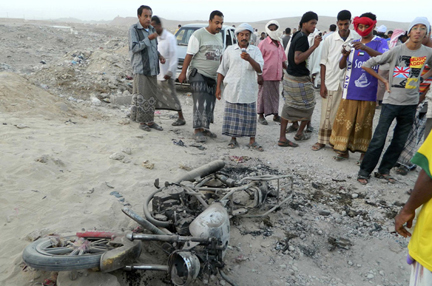
New America Foundation says that US drone attacks in Yemen have risen from 18 in 2011 to 53 in 2012 [Reuters]

[Drones are now at the top of the news cycle. This commentary was originally published in the January online edition of Anthropology News.]

The Error in the War on Terror

In 1978 I arrived in the Yemen Arab Republic to begin 18 months ethnographic fieldwork. At the time North Yemen, as it was called, was in full development mode. A protracted civil war after the fall of the traditional Zaydi imamate had ended only a decade before. Aid was pouring in from the United Nations, the United States, Germany, France, The Netherlands, Russia and mainland China as the country was in the throes of building itself up by its sandalstraps. Once settled in my field site, the beautiful spring-fed highland valley of al-Ahjur, I could not help but notice that just about everyone was armed, many with kalashnikovs. This was a tribal area, where the central government exercised little control, but I never felt safer in my life.

I felt safe because as a foreigner I was protected under tribal customary law. At this time the United States was well liked, often in contrast to the atheist communists of the Soviet Union who supported the socialist regime in South Yemen. This was before any hint of terrorism, before the Iran hostage affair and long before al-Qaeda. Osama Bin Laden had just turned 21 and was still in college. In this tribal area there was an honor code, exemplified by the Yemeni term qabyala, that required protection of unarmed guests, as it did women and children. In 2004, on a return visit to the valley, I found myself in the difficult situation of explaining why I did not support the U.S. invasion of Iraq. One of my Yemeni friends noted that he used to think that America was different, but now he believed that the U.S. president was as bad as his own, Ali Abdullah Salih. Continue reading Drone Strikes

iOrientalism: Fooling around with Arab princesses


The late Edward Said lamented the biased representation of the “Oriental” in his influential Orientalism, published 35 years ago. Most of the scholarly and voyeuristic tomes he critiqued are rarely read these days, although his intellectual nemesis Bernard Lewis is well represented in your local Barnes and Noble bookstore (in part thanks to a desire for selling books rather than seriously vetting them by some of the editors at Oxford University Press). Few students of the Middle East or Islamic studies these days have ever heard of Lord Cromer or William Muir or Raphael Patai, let alone would read and be influenced by their aged volumes. The ugly ethnocentrism, racism and sexism that once could be found in the broad (far too broad) discourse labeled “Orientalism” is still quite evident, although moreso in the media, political punditry on the right and rantings of career Islamophobes than by serious scholars. But we are now in the digital age and iOrientalism is now propelled through Facebook, Twitter and Youtube via iphones, ipods and their technological clones.

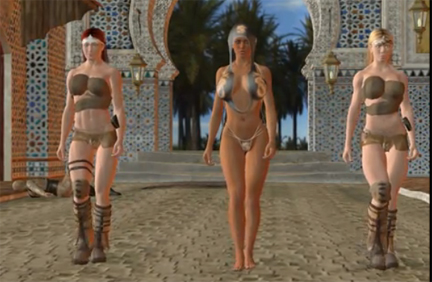
One Youtube video that recently appeared on a Youtube search that had nothing to do with the subject I was searching is a mock video-game fight between three hefty-bosomed and bursting-at-the-bra-straps Arab princesses and a swarthy Mike Tysonish evil guy. This appears to be a promo for Poser Pro Animation rather than a cultural statement per se. The three Arab princesses are so scantily clad that it is more the tile-glazed architecture and palm trees that orientalize than the costume or look. Of the three kung-fu trained ladies, one has red hair, one is a blond and the other is wearing what looks to me like the kind of aviator helmet worn by Amelia Earhart in the 1930s. The bully wears a leather waist band, but otherwise the shaft he was endowed with by nature is visible to the three princesses, but not to those of us viewing the video. Ironically, this parallels Said’s choice of the Gérôme’s painting that graced the cover of the original paperback of Orientalism: this features a naked boy with a snake wrapped around him and a group of grizzled Walnetto perverts staring at his organ, while we voyeuristic viewers can only see the glistening buttocks of the youth. Continue reading iOrientalism: Fooling around with Arab princesses

Mahdi madness comes to Mali


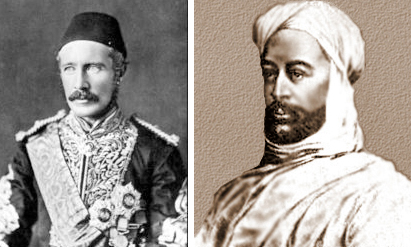
General Charles Gordon, left; Muhammad Ahmad, the Sudanese mahdi, right

The current crisis in Mali, which has now spilled over into neighboring Algeria, is the latest outbreak of mahdi madness on the African continent. In Islamic eschatology, the mahdi is a savior of the Muslim community near the time of the apocalypse. The British colonial empire faced several mad mullahs when they tried to rule Sudan. One such infamous mahdi was Muhammad Ahmad, who proclaimed himself the leader of the Muslims against the Turkish oppressors in the 1870s. On January 26, 1885 the Mahdists following Abdullah Taashi took control of Khartoum, slaughtering the entire British garrison, including General Charles Gordon, before a relief force could reach the besieged city. These were the days in which a mahdi could inspire an army, over 50,000 men in the case of the force that overran Khartoum. In 1898 Lord Kitchener led a British invasion force of over 8,000 men assisted by 17,600 Sudanese and Egyptian troops. The British gunboat diplomacy resulted in a resounding defeat for the Mahdists at the Battle of Omdurman. Kitchener lost 47 men with 340 wounded, while the the Mahdists suffered 9,700 killed, 13,000 wounded, and 5,000 captured.

The Sudanese mahdi and the mad mullahs the British encountered in 19th century Afghanistan were not pietist reformers, but leaders of jihad against the hated occupier, whether fellow Muslim Ottoman Turks or infidel Europeans. The current crisis in Mali is an echo of past mahdis, but with a modern twist. The twist is how we now define a never-ending war on terrorism. Western views of the entire region entrapped by al-Qaeda confuse the situation on the ground. Continue reading Mahdi madness comes to Mali

More of the Sham of al-Sham


Image source: alhadath.yemen

The demise of Bashar al-Assad continues its downward spiral with bodies strewn all over Syria in the process. What makes him hang on? Can he not see what just about every pundit outside of Syria and increasingly most Syrians see in blood red letters: mene mene tekel upharsin? Even vain Belzhazzar saw the gig was up in Babylon when those lines cracked his banquet hall. Or is he raving mad in the style of Nero, who plucked his lyre while Rome burned? Or is he just a chicken without a head, but who is still trying to bury his head in the sand?

He hangs on for a variety of reasons. First and foremost, because for the time being he can. Russia has not yet told him he has to go and the United States has basically given him leave to do whatever he wants to his own people except gas them. The military has not yet deserted him in sufficient numbers and they are, thanks to Russia, very well armed. Even the hint from the U.N. envoy Lakhdar Brahimi that Assad has been in power long enough is not likely to move the last of the pre-Arab-Spring dictators (not counting kings, sultans and emirs for life) into retirement.

The Syria of 2013 is not that conquered by Umar ibn al-Khattab, not that of Ayyubid Saladin, nor that run over by the Mongols, nor that ruled briefly at the end of World War I by Faisal of Arabia (patron of Lawrence of Arabia and vice versa), nor that which joined the ill-fated United Arab Republic initiated by Gamal Abd al-Nasser in the 1960s. But there are indeed historically-stretched fault lines. Continue reading More of the Sham of al-Sham