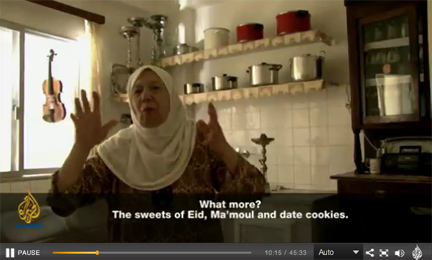
Al Jazeera has posted a wonderful Lebanese film by Mahmoud Kaabour about his grandmother in Beirut. This is well worth watching.
Al Jazeera has posted a wonderful Lebanese film by Mahmoud Kaabour about his grandmother in Beirut. This is well worth watching.
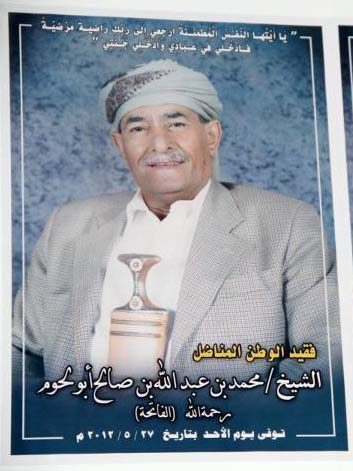
*يمن برس – متابعات
وصل جثمان الÙقيد المناضل الشيخ Ù…Øمد عبدالله ØµØ§Ù„Ø Ø£Ø¨Ùˆ Ù„Øوم إلى العاصمة صنعاء أمس الخميس والذي واÙته المنية ÙÙŠ Ùرنسا يوم الأØد الماضي.
وتم الصلاة على جثمانه ØµØ¨Ø§Ø Ø£Ù…Ø³ الخميس بعد نقل جثمانه من مطار صنعاء ÙÙŠ جامع مستشÙÙ‰ جامعة العلوم والتكنولوجيا، واوري الثرى ÙÙŠ مقبرة خزيمة.
الشيخ Ù…Øمد عبدالله ØµØ§Ù„Ù„Ø Ø£Ø¨Ùˆ Ù„Øوم من مواليد منطقة نهم، شمال العامصة صنعاء عام 1938ØŒ درس ÙÙŠ الكلية العسكرية ببغداد ÙˆØصل على دورات عسكرية متعددة.
وتولى عدة مناصب عسكرية ومدنية، Øيث بدأ Øياته العملية كبيراً للمعلمين ÙÙŠ مدرسة المدرعات، ثم قائداً لكتيبة المدرعات والمدرعات الاØتياطة، قبل أن يكون عضواً ÙÙŠ مجلس القيادة وقائداً للواء السادس.
وعين الÙقيد رØمه الله لاØقاً Ù…ØاÙظاً لمØاÙظة Øجة ثم سÙيراً مقيماً لليمن ÙÙŠ باريس وعضواً ÙÙŠ مجلس الشورى.
نسأل الله أن يتغمد الÙقيد بواسع رØمته وأن يسكنه ÙØ³ÙŠØ Ø¬Ù†Ø§ØªÙ‡ ويلهم أهله وذويه الصبر والسلوان, وإنا لله وإنا إليه راجعون.
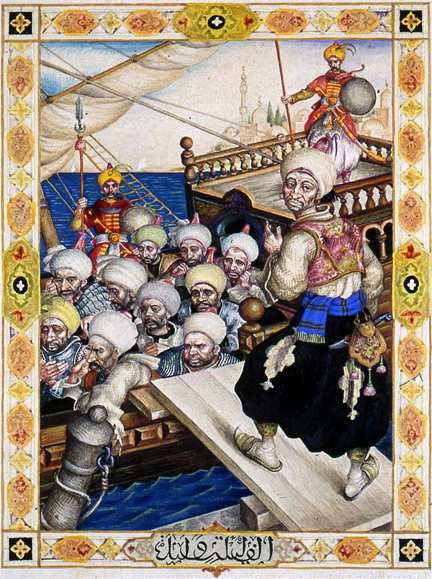
Sinbad’s Seventh Voyage by Arthur Szyk
[Webshaykh’s Note: This last semester I taught an Honors Seminar on the Arabian Nights. The last assignment asked students to write the 8th voyage of Sindbad, drawing on what happened in earlier voyages. I will post several of these here for your enjoyment. This is the second one I am publishing and it is by Marissa Priest. For the first by Taryn Teurfs, click here.]
The Eighth Voyage of Sinbad
By Marissa Priest
Before all the hairs of his beard could turn white, Sinbad the Sailor longed for one last voyage. Yet after all the turmoil of his past adventures, his wife was worried for his safety. Her concern only multiplied when their young son Hamza showed the same symptoms of wanderlust. Like his father, he longed to sail the seas to gather wealth and taste adventure. Despite her pleading, the two set off to begin the eighth voyage. First, Sinbad took his son with him to the docks to gather a reliable crew. They found plenty of honest and faithful men who were eager to set out with the fabled Sinbad. After gathering enough supplies, the men sailed out with no idea where they would find themselves.
Sinbad had chosen a mighty ship, but she was not strong enough to last the force of a great sea storm. As the great waves pounded across the ship, the men were tossed back and forth. Many were thrown into the sea to perish. Provisions flew off the ship and broke apart in the ocean. Sinbad was not afraid, but clung to the mast and instructed his son to do the same. Catching some rope that flew past him, Sinbad tied himself to the mast. Before he could secure his son, the ship capsized. The dominant water swept his son away, carrying him far out of sight. Despite his cries, Sinbad was subject to the ocean’s whims as well. Still bound to the now broken mast, he bobbed across the vicious water for days until being spat out on the shore of a foreign island. After untangling himself from the wet rope and shattered wood, Sinbad rose to study his new surroundings. Continue reading The 8th Voyage of Sindbad: #2
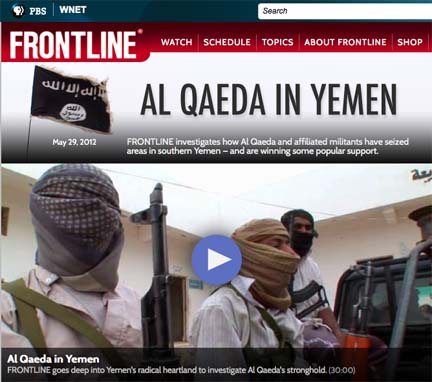
Frontline aired an interesting program on Al Qaeda in Yemen last night. It features the Iraqi journalist Ghaith Abdul-Ahad, who was able to visit the towns of Jaar and Azzam in southern Yemen, both as they were controlled by Ansar al-Sharia. It is clear from his reporting that some of the fighters are from outside Yemen, as he specifically mentions Somalis and Afghans. At the end of his report he visited Lawdar, where the local Yemeni tribesmen drove out the militants and are defending the town from them. The Yemeni tribes do not support either al Qaeda or Ansar al-Sharia, whose strict interpretation and high-handed ways go against tribal customary law. Although the government troops are currently suffering internal conflict, the days of Ansar al-Sharia are surely numbered. You can watch the program online.
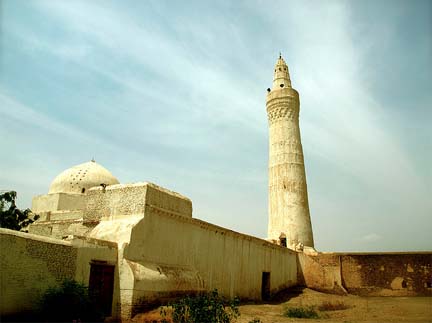
Haraz village
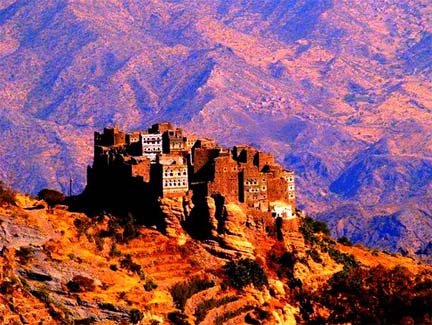
In celebration of the birthday of the Yemeni photographer Raiman al-Hamdani on Tuesday, here are two of his photographs from his FLICKR site.
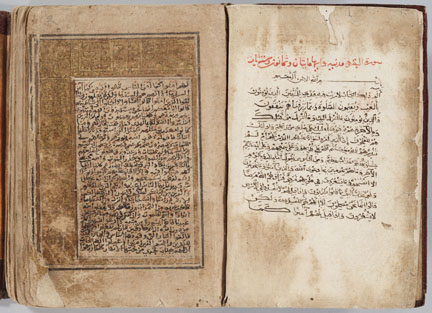
Burke Arabic MS 1, unsigned and undated (Iraq or Iran, before 1300 CE)
The following is a nicely done website about a Quran exhibition held at the Burke Theological Library of Columbia University in 2005 and curated by the historian Dagmar A. Riedel.
During the month of Ramadan, Muslims commemorate the revelation of the Quran to the prophet Muhammad. In Fall 2005, from October 4 until November 2, Burke Library exhibited some of its Qurans to explore during Ramadan 1426 AH how attitudes toward Islam are reflected in the books that give readers access to its revelation.
Since Burke Library was founded as a Protestant research collection, the study of Islam is not often associated with its holdings. But its small collection of Near Eastern manuscripts includes five Qurans which represent the regional esthetic traditions of Quran illumination between the thirteenth and nineteenth centuries CE. Furthermore, Burke Library owns many of the seminal works of Quran scholarship published in early modern Europe, documenting how non-Muslim Europeans translated the Arabic Quran first into Latin and then into European vernaculars. The exhibition traced the process, stretching from the twelfth to the nineteenth century, by which the European approach to the Quran was transformed from an angst-ridden defense against yet another Christian heresy to the investigation of another strain of monotheism.
The 2005 project was made possible by Michael Boddy’s enthusiastic support which in turn ensured the permission of Sara J. Myers, the director of Burke Library, to go ahead with an exhibition that in the middle of the term occupied space in the Burke’s conference and reading rooms. I am also indebted to Jean W. Ashton, the director of the Rare Book and Manuscript Library, for lending a Quran from the David E. Smith Collection of Oriental Manuscripts for the exhibition. In the winter of 2011, Burke Library director John B. Weaver generously sponsored the web adaptation of the original brick-and-mortar exhibition.
Exhibit Curator
Dagmar A. Riedel
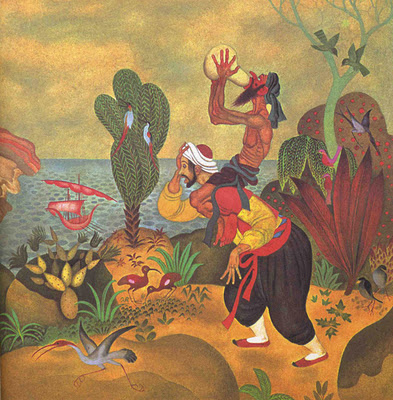
illustration by Gustaf Tengrren
[Webshaykh’s Note: This last semester I taught an Honors Seminar on the Arabian Nights. The last assignment asked students to write the 8th voyage of Sindbad, drawing on what happened in earlier voyages. I will post several of these here for your enjoyment. The first is by Taryn Teurfs…]
The 8th Voyage of Sindbad
by Taryn Teurfs
Sindbad began to recall his eighth voyage, his most truly remarkable voyage that was kept clandestine. He began:
I was visiting the palace of King Haffwadar because he spoke of a sword he needed me to capture in turn for a great reward. The Sword of Harun al-Rashid, as legend has it, belonged to the caliph himself and possesses a mystical element: If the true descendant of Harun al-Rashid obtains that sword, with one touch the sword lights on fire and can cut through 1000 enemies with one lash. King Haffwadar had no evidence that he was a descendant of Harun al-Rashid, but one of his magicians had a vision of Haffwadar holding the sword so Haffwadar felt that fate was telling him he was its rightful owner.
The sword was located in the Isla de los Monos, comprised of apes of all different shapes and sizes, but a thousand times more powerful that the island I visited on my third voyage. The journey to this island is so dangerous King Haffwadar couldn’t risk his life to obtain the sword but knew the type of journeys I would go on to try and recover valuables or ensure the safety of a kingdom.
“Sindbadâ€, said King Haffwadar, “Before you go to the island you must obtain a mirrored box, an ice crystal, and the secret potion of Ashwayar. It is said in the legend you must use these items to defeat the evil jinn Shahidi who controls the island. You must seek the enchantress Ashwayar and ask her for these pieces. I am giving you this compass presented by the magician as guidance. It shall bring you to the sword in haste.†I came upon Ashwayar at the great lake. She had long beautiful black hair like the starless sky. She sat amidst a rose bush undraped, likened as the great Almighty had created her.
“Ashwayar,†I began. “I am called Sindbad. I have sailed here from afar to —“ Continue reading The 8th Voyage of Sindbad: #1
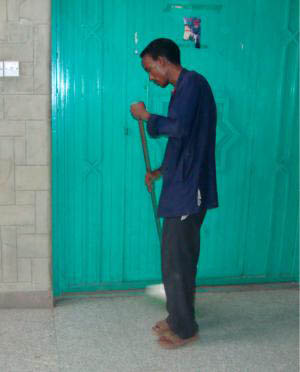
a Yemeni worker; photo by Amira Nasser
Severe working conditions with no way out
Amira Nasser, Yemen Times, May 17, 2012
Despite the revolution which exploded last year in Yemen with demands for human rights and opportunities, thousands of Yemenis still work in slave-like conditions with little hope of escape.
Surviving in Yemen’s harsh economy with limited choices has forced countless Yemenis to take work that affords them little social mobility, and leaves them drowning in debt.
Tight circumstances
Waheeb Abdul-Wahab, a 13-year-old, works in a mechanic shop with his 7-year-old brother, Majed, from 7a.m. to 4p.m. daily. They each make YR 1000 , less than 5 US dollars, for a long day of strenuous labor.
“My brother and I give some of the money to my mother and we keep about YR 600 for ourselves.”
Waheeb added that he alone makes roughly YR 8000 to 9000 in profits for the shop owner on a daily basis, but he keeps only YR 1000 for himself.
He and his brother are an example of thousands of Yemeni children who are forced to work demanding jobs in order to sustain their families. Continue reading What and who are not working in Yemen