If you are puzzled about camels, check out this online puzzle…
If you are puzzled about camels, check out this online puzzle…
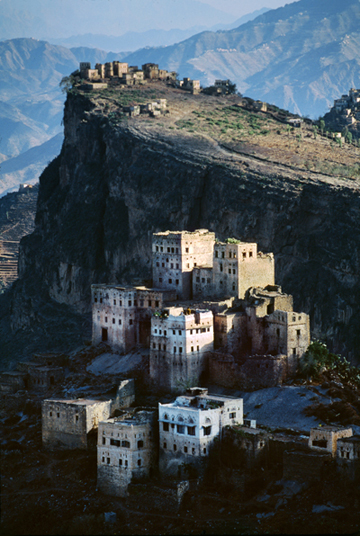
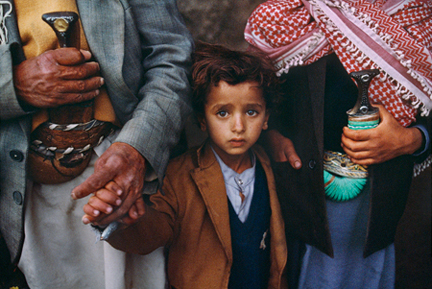
The photographer Steve McCurry has published some incredible pictures of Yemen on his blog. It is well worth checking out the pictures, but it is necessary to avoid the captions, which are neoconnish and ill conceived. When they say a picture is worth a thousand words, it can also be in reference to the kinds of words used. As long as the little boy is in the hands of his tribal family and values, he is most unlikely to be any kind of terrorist.
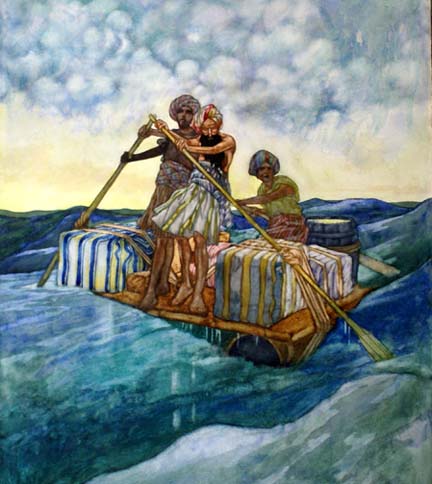
The Third Voyage of Sinbad, by Charles Robinson (1870 – 1937)
[Webshaykh’s Note: This last semester I taught an Honors Seminar on the Arabian Nights. The last assignment asked students to write the 8th voyage of Sindbad, drawing on what happened in earlier voyages. I will post several of these here for your enjoyment. This is the fifth one I am publishing by Becky Cuthbertson The fourth is by Mahmoud Abdelaziz. The third is by Peter Otis. The second is by Marissa Priest. For the first by Taryn Teurfs, click here.]
The Eighth Voyage of Sindbad the Sailor
by Becky Cuthbertson
For many years after his seventh journey, my father Sindbad the Sailor stayed at home, resuming his former lifestyle. He was joyous at my birth and that of my sister’s. We lead a life of indulgence and happiness; we had all the luck in the world. Many years later, my father sat at home with his wife, my mother, by the fire; they watched my sister and I play. He thought that it was a shame that my sister and I would never meet our grandfather; my parents fled my grandfather’s great city where men turn into birds and my father swore never to sail again. Smiling at my mother, he announced that we were journeying to see our grandfather; we were sailing next week.
My mother looked at him curiously, “Husband, have you not sworn to never sail the seas again?â€
He smiled broadly, “Yes my dear but I shall press my luck one more time; I am not sailing for excitement or adventure but to visit family. Allah should not begrudge me that.â€
So the following week we set off, sailing to find the city of my grandfather. A few days out to sea, a storm hit. The ship was rolling, rain down pouring, and wind gusts pitched the ship from side to side, almost capsizing us several times. All of us prayed to the Almighty God to protect us, save us, and deliver us from harm while the crew worked to stabilize the ship. Lightening began to strike off in the distance, but at every crash, a bolt loomed nearer and nearer. The captain bolted down below and brought up with him chalk. Murmuring to himself, he began to draw patterns all along the rails.
“Captain,†my father called, “why are you drawing with chalk all over the ship?†Continue reading The 8th Voyage of Sindbad: #5

Yemen Press is reporting that they have uncovered documentation that the head of military finances in Yemen from 1998-2009, ‘Abd al-Mun‘im al-AdÄ«mÄ«, appropriated about 281 million riyals for his own use during the Salih regime. As his name suggests, he was indeed a slave to the role of benefactor, but not in the hallowed religious sense. Such corruption is not unique to Yemen, as dictators and monarchs do the same all the time. Power corrupts, as it has since records have been kept. The political cartoon accompanying the article speaks for itself…
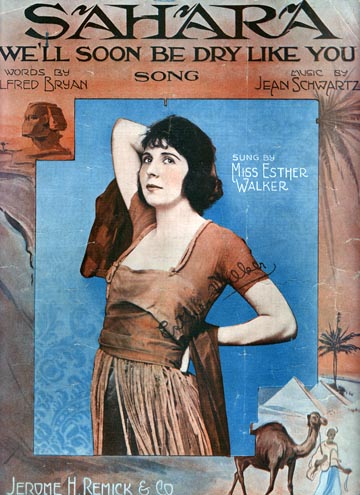
The Library of Congress has archived many of the Gramophone recordings from the early part of the last century. This includes several vaudeville songs about Arabs. One of these, about Egypt, is “Arab Love Song” sung by Harry Macdonough for Victor Records, made possibly as early as 1908. My personal favorite is “Sahara (we’ll soon be dry like you),” a prohibition era song recorded by Esther Walker in 1919. There are also comedy routines, like the schtick by Charles G. Widden on “Peterson at the Turkish Bath”. Then if you want a one-step from 1918, try “Arabian Nights” by the Waldorf Astoria Dance Orchestra or the fox trot “Oriental Love Dreams,” recorded in 1924 by Coon-Sanders Original Nighthawk Orchestra or “Harem Life” recorded in 1919 by the Paul Biese Novelty Orchestra.
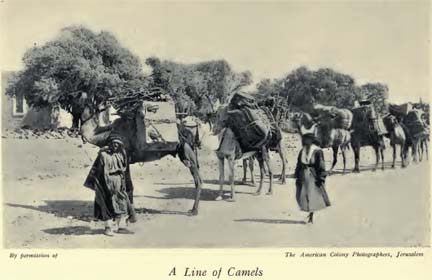
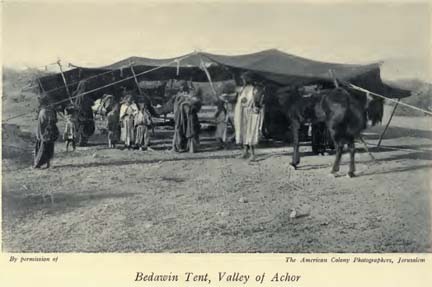
As begun in a previous post, here are several vintage photographs from Philip J. Baldensperger’s The Immovable East, published in 1913, and available for free as a pdf at archive.org

Qatari women as depicted on the main website of the Qatar Chamber of Commerce
Qatar’s social divide: hindering a pathway to the future?
By Michael Stephens, Open Democracy, June 10, 2012
When considering what Qatar might have in common with Arab countries which experienced revolutions following December 2010, one might get easily confused. There was no Arab Spring here, people did not take to the streets in protest. Indeed, most Qataris hold a genuine affection for the Emir, something which cannot be said for many other Arab nations.
It follows then that Qatar must be unaffected by the macro social processes that led to the outbreak of the Arab Spring. For if Qatar did not experience any of the symptoms it surely did not suffer from the illness, right?
Wrong, Qatar, like every Arab country in the world is struggling to deal with a number of social issues,ranging from a youth demographic boom, to political Islam, to inherent tribalism which pervades the public sphere.
Of most importance is the struggle between traditionalism and modernity, between the values of a mostly Bedouin orientated society clashing against western ideas. The struggle that many of the country’s young population go through on a daily basis is painfully obvious, as they attempt to combine the expectations of their families with growing up in a globalised world which their parents fundamentally do not understand.
This social cleavage leads to a society which awkwardly steps into the future, leading the ruler Sheikh Hamad Al Thani to plot a course which combines a mix of modernising polices on one hand with concessions to conservative forces on the other.
In recent years, this process has begun to accelerate. Continue reading Qatar’s Social Divide
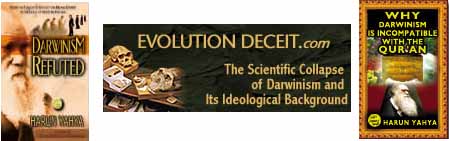
Has your atlas arrived yet? The New York Times reported yesterday that prominent American scientists and politicians are receiving what purports to be an “Atlas of Creation” from a Turkish media guru self-named Harun Yahya. No, it is not revenge for the “War on Terror.” Nor is a glossy book of patent nonsense, no matter how intelligently designed and styled as “probably the largest and most beautiful creationist challenge yet to Darwin’s theory” much of a challenge. Scientists will recognize it for a “load of crap,” as Kevin Padian, an evolutionary biologist at the University of California, Berkeley, impolitely phrased it.
The “War on Terror” has manufactured a whole host of new enemies. But what a strange bedfellow is Charles Darwin, who liberated science from the dogmatic demands of religious apologists like Mahdi Yahya a century and a half ago. Darwin’s approach now summarizes all of modern science, a steady advance in knowledge because no specific idea is ever held sacred. This does not mean that scientists must abandon religion and faith, but it does offer a view of the world in which human reason is not abandoned under the cloak and rhetorical dagger of a supposedly spiritual quest for moral behavior. Continue reading Tabsir Redux: Mahdi as Hell…