All posts by tabsir

Buried Cities Recovered


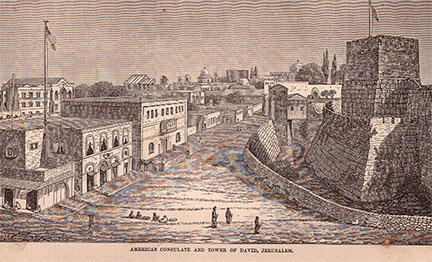
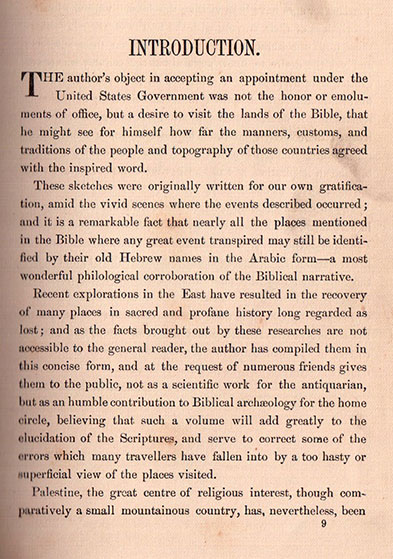
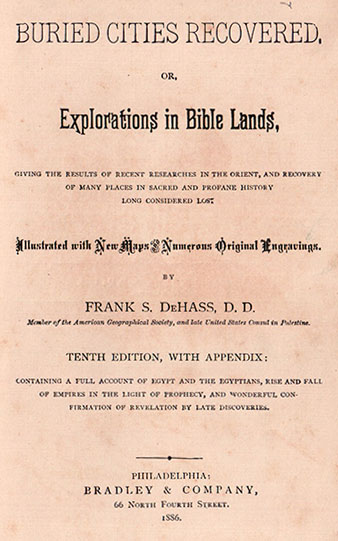
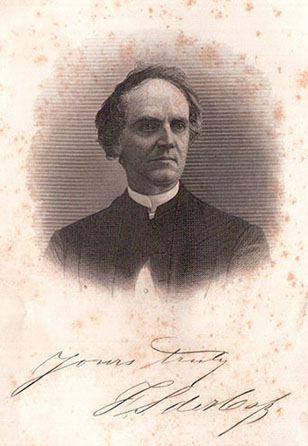
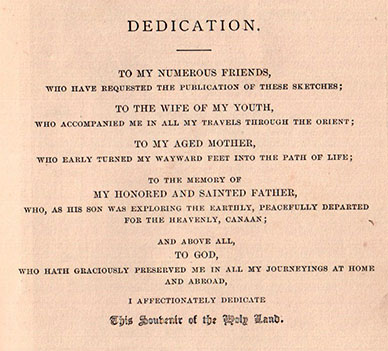
During the 19th century there was a flourishing genre of “Explorations in the Bible Lands.” As the geography and archaeology of the Holy Land came to light, often with only a modicum of scientific investigation, books flooded the market on how the remains and customs in this area were bringing the Bible to life for Protestants in England and America. Despite Mark Twain’s biting satire of the genre in his Innocents Abroad, the Bible Lands books piled on. One of these is Buried Cities Recovered by the Rev. Frank S. DeHass, who was appointed U.S. Consul to Palestine, where he lived for a considerable period. This was first published in 1882 and was in its 10th edition only two years later. The small print at the bottom of the title page says it all: “CONTAINING A FULL ACCOUNT OF EGYPT AND THE EGYPTIANS, RISE AND FALL OF EMPIRES IN THE LIGHT OF PROPHECY, AND WONDERFUL CONFIRMATION OF REVELATION BY LATE DISCOVERIES.” Such was the enthusiasm of Bible enthusiasts of the late 19th century.


The dedication of the book, reproduced below, is quite flowerly and hardly leaves anyone out, except perhaps the emerging higher critics of the Bible at the time.


to be continued

Hakadha (Thus Spake Zahed Sultan)


Zahed Sultan Releases ‘Revolutionary’ New Song & Music Video

Watch Zahed Sultan’s new ‘Like This (ha-ka-tha)’ music video on www.youtube.com/zahedsultan

Sign up on www.mousemusic.org and download free ‘Like This (ha-ka-tha)’ wallpaper for your computer.

Zahed Sultan announces the release of his new song & music video entitled “Like This (ha-ka-tha).” The song pays tribute to the social frustrations that have plagued the MENA region prior to the Arab Spring. In classical spoken-word Arabic, Zahed calls upon the Arab people to stand in unity, against tyranny, with a sense of civic pride.

In his music video, Zahed gives a gripping account of the revolutions as they sequentially unfold in each Arab country through use of raw-footage (shot by protestors with cell-phones) and stop-motion animation.

Be an active part of the change happening around you and share Zahed’s latest song & music video with your network!

About The Artist

Zahed is a music producer and social entrepreneur from Kuwait. He released his debut album “Hi Fear, Lo Love” on April 1st 2011and attained success with his 2nd single “I Want Her But I Don’t Want Her.” Parisian Dj, Stephane Pompougnac, featured the single on the internationally acclaimed Hotel Costes 15 compilation, which was released on Sept. 26th 2011. Continue reading Hakadha (Thus Spake Zahed Sultan)

Faith confronts culture in “American Dervish”


Author Ayad Akhtar, left

by JENNIFER S. BRYSON, Contending Modernities, August 7, 2012

American Dervish, by American actor and author Ayad Akhtar, is set in one of the many places in the world with vibrant Muslim communities. In this case: Wisconsin.

Akhtar skillfully develops wonderful characters. As I delved into this novel I kept wanting to find more and more time to read so I could find out what would happen to characters such as the main figure Hayat; Mina, a dear family friend; and Mina’s suitor, the kind Jewish doctor Nathan. Also, Akhtar powerfully tackles the serious, generally taboo topics of Jew-hatred and domestic abuse. (This courageous novel goes beyond abstract “anti-Semitism”; American Dervish confronts outright hatred and its real-life consequences.)

Quran “translation” conundrum

Along the way, American Dervish has one of the most interesting wrestling matches I’ve seen yet over whether or not to make the Quran accessible in languages other than Arabic for people who do not know Arabic. (While I as a non-Muslim am an onlooker to these intra-Muslim “wrestling” matches, I myself have sat through more than a few Catholic Masses in Latin trying to figure out why we weren’t using a language the people present would actually understand.) Continue reading Faith confronts culture in “American Dervish”

Occupy Mecca


by Omid Safi, Religion News Service, August 28, 2012

It is time, and past time, to Occupy Mecca.

I am adamantly not talking about a disaster US occupation, a la Iraq and Afghanistan.

What I am calling for is nothing less than millions of faithful pilgrims saving Mecca from destruction.

I would call the destruction imminent, except that it is not imminent. It has already happened.

No, it’s not the Americans, or the Israelis, who would be destroying Mecca.
It’s the so-called Guardians of the two holy sites (Mecca and Medina), the Saudi royal elites, who have negligently stood by over the last two decades as the majority of holy sites in these two most sacred Muslim cities have been destroyed, sacrificed to the false gods of modernization, capitalism, and progress.

Saudi Wahhabis have a long history of destroying shrines, including those of the family of the Prophet in Saudi Arabia and Iraq. Continue reading Occupy Mecca

Ethnic Indo-European languages?


gold chariot from a hoard found near the Oxus River in Central Asia ca 500 BCE, British Museum

Family Tree of Languages Has Roots in Anatolia, Biologists Say
By NICHOLAS WADE, New York Times, August 24, 2012

Biologists using tools developed for drawing evolutionary family trees say that they have solved a longstanding problem in archaeology: the origin of the Indo-European family of languages.

The family includes English and most other European languages, as well as Persian, Hindi and many others. Despite the importance of the languages, specialists have long disagreed about their origin.

Linguists believe that the first speakers of the mother tongue, known as proto-Indo-European, were chariot-driving pastoralists who burst out of their homeland on the steppes above the Black Sea about 4,000 years ago and conquered Europe and Asia. A rival theory holds that, to the contrary, the first Indo-European speakers were peaceable farmers in Anatolia, now Turkey, about 9,000 years ago, who disseminated their language by the hoe, not the sword.

The new entrant to the debate is an evolutionary biologist, Quentin Atkinson of the University of Auckland in New Zealand. He and colleagues have taken the existing vocabulary and geographical range of 103 Indo-European languages and computationally walked them back in time and place to their statistically most likely origin.

The result, they announced in Thursday’s issue of the journal Science, is that “we found decisive support for an Anatolian origin over a steppe origin.” Both the timing and the root of the tree of Indo-European languages “fit with an agricultural expansion from Anatolia beginning 8,000 to 9,500 years ago,” they report.

But despite its advanced statistical methods, their study may not convince everyone. Continue reading Ethnic Indo-European languages?

Cavorting with Cazotte #3

Here is the continuation of a previous post the story of Habib the knight from Jacques Cazotte’s Mille et une fadaises, Contes a dormir debout (The Thousand and One Follies, Tales to Sleep Upright), which was later translated into English. The English edition published in the year of his death is available in that magical resource for book lovers: archive.org. There are several volumes, but the excerpt here is from volume 3. Enjoy.

For the continuation of the story, you will need to consult volume 4 on the archive.org site.