All posts by tabsir

Al Shabab vs. Soccer in Somalia


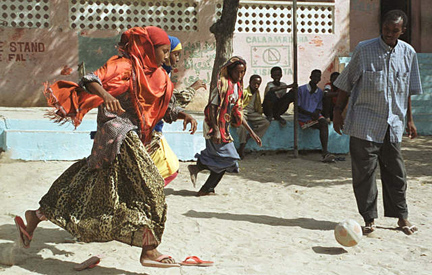
Veiled Somali Girls Playing [“xalaal”] Soccer

Soccer: A barometer of Al Shabab’s retreat in Somalia

By James M. Dorsey, Mideast Soccer Blog, October 5, 2012

Soccer is one barometer of the increasingly successful drive to deprive militant Al Shabab fighters of their grip on large chunks of war-torn Somalia.

With the recent withdrawal of the Al Qaida-linked militants from the port city of Kismayo, the last major rebel-held town, the increasing return of soccer to a football-crazy country where under Al Shahab rule enthusiasm for the beautiful game involved a greater act of courage and defiance than perhaps anywhere else in the world and soccer became a front line in the battle against the Islamists, football highlights the country’s changing battle lines.

The extent of Al Shabab’s retreat is evident from the fact that a campaign that started with the Somali Football Association (SFA) backed by local businessmen and world soccer body FIFA luring child soldiers away from Al Shabab which banned the playing and watching of soccer, and turning them into national youth team stars has mushroomed into the revival of national and regional competitions. For the first time in more than two decades, matches are being played at night, teams travel in relative safety within the country and war-ravaged sports facilities, including Mogadishu’s national stadium, once one of East Africa’s most impressive filled with 70,000 passionate fans during games that was used by the Al Shabab as an arms depot and training facility, are being refurbished. Continue reading Al Shabab vs. Soccer in Somalia

It’s still a rocky road


A few weeks ago I wrote a commentary which was eventually published in my “Middle East Muddle” column on Anthropology News. This was entitled “Between the Rock of Ages and a Hard Sell.” This was a month before the debate held earlier this week. Below I provide the first two paragraphs of my commentary, but you can read the whole thing here. After reading it, you can return here and see my update after the first debate.

As the 2012 presidential election draws near, the debate thus far has been anything but civil. Attack ads from all sides have been fact-checked and found wanting. A recent Pew poll found that 17% of registered voters still think President Obama is a Muslim and only 49% said he was Christian. Only 60% of registered voters are aware that Republican challenger Mitt Romney is Mormon. Of those who know Romney is Muslim 19% admit they are uncomfortable with his affiliation. To the extent religion matters, and anyone who thinks religion does not matter in American politics needs to think again, both the current Vice-President Joe Biden and the Republican candidate Paul Ryan are Catholic.

For voters in the Bible Belt this puts the choice on November 6 between a rock and a hard place, making it a hard sell for those who sing “The Rock of Ages” in Sunday morning services. Growing up decades ago in a proudly “fundamentalist” Baptist church in northern Ohio, I was told that Mormons were a cult, the Catholic church was Satanic and Muslims were obviously bound for hell along with all the others who were not born-again Bible believers. Jimmy Carter and Bill Clinton were Baptist, but as astute politicians they did not promote the more extreme beliefs of their faith just as John F. Kennedy did not mandate Catholic doctrine. The last time around Obama was attacked for having belonged to a church of the Rev. Jeremiah Wright. Both Obama and Jon McCain submitted to a religious litmus test in a televised forum hosted by Rick Warren, senior pastor of the one of the largest Protestant churches in America. This time, however, religion is taking a back seat to the economy, but the religious faith of each candidate is still the elephant in the room.

The first daily tracking polls after the debate, which the pundits gave to Romney hands down, show that there has yet to be a big bounce on the ground; even Rasmussen (which usually leans Republican) has Obama ahead nationally by 2 points on Thursday and Friday. Beyond the polls and pundits, however, it is still a very rocky road for Romney, whose etch-a-sketch performance in the debate will be hard to stretch against all the things he has been saying previously. Today’s drop in the unemployment rate to 7.8%, the same as when Obama took office, will blow out the tires of a campaign bus already in the ditch. But to my mind, the biggest mistake Romney made was promising to end the career of Big Bird. I realize that 8-year olds cannot vote (and depending on their skin color may not find it easy to vote when they grow up in certain states), but they can grab onto their parent’s arms and beg them to save Big Bird and Sesame Street. If Romney loses by a nose, it will be a combination of his own Pinocchio moments and the beak of an unemployed Big Bird.

Academic Freedom and Professional Responsibility


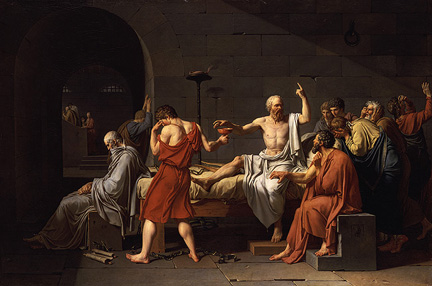
“Death of Socrates” by Jacques-Louis David, 1787, Metropolitan Museum of Art

Academic Freedom and Professional Responsibility:
A Handbook for Scholars and Teachers of the Middle East

Attempts to undermine professors’ abilities to teach and do research are increasingly directed at scholars who seek to provide a contextualized and critical view of recent international developments and their interaction with US foreign policies and practices.

The first draft of the handbook was based on research undertaken by the Taskforce on Middle East Anthropology to understand available institutional resources, as well as on ethnographic interviews conducted with academics who have encountered obstacles in their teaching and scholarship. The handbook was revised in 2012 by a group of current graduate students and recent PhDs in Middle East Anthropology, at the behest of the original handbook committee.

The revision aimed to evaluate the current atmosphere of academic freedom via a survey distributed to faculty and graduate students studying the Middle East, update the document to reflect legal changes that impact the ability of academics to carry out their scholarship and teaching, review major controversies over academic freedom since the original version of the handbook was published, and update links, citations, and contact information.

The handbook provides concrete suggestions for how to respond to attacks on academic freedom and to avoid them in the first place. It considers the potentials and limitations of internal university structures, professional organizations, legal recourse, and media outlets. Finally, it contains useful pedagogical tools for dealing with difficulties in the classroom, and an informative bibliography of recent writings on academic freedom.

“Academic Freedom and Professional Responsibility: A Handbook for Scholars and Teachers of the Middle East” (2012). Click here for information on how to download a pdf of this report.

New Online Issue of CyberOrient


CyberOrient, the online journal of the Middle East Section of the American Anthropological Association, has just published its 2012 issue on “The Net Worth of the Arab Spring.” The guest editor is Ines Braune, who writes in the Introduction:

When I was asked to be the guest editor of the current issue of CyberOrient, I realized this is a welcome opportunity to arrange and re-sort some aspects, points, and arguments about the role of the media during the Arab Spring. In the course of the events late in 2010 and early in 2011, I felt enthusiastic and overwhelmed – not primarily as a scholar with a background in Middle Eastern and media studies, but as someone who was part of the peaceful German revolution in 1989 as a young teenager. Upon reflection, I took up the role of a media researcher considering how the use of media shaped these events. Though much has already been said and written about the media and Arab Spring, it would be worthwhile after a bit more than a year to reflect and reevaluate the relationship between the media and revolutions. Due to my involvement in this edition, and after numerous discussions with colleagues, and students in my media seminar in the summer term, I frequently came across the following three points: the significance of mediatization processes, the online-offline dichotomy, and various kinds of amnesia.

The articles discuss the role of social media in Egypt, Iran, and Al Jazeera, along with two book reviews.

Buried Cities Recovered #4


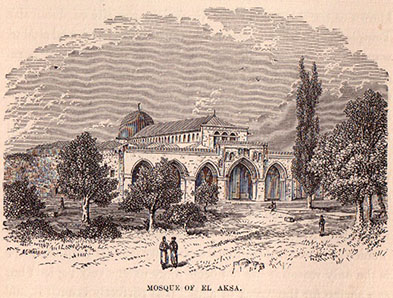
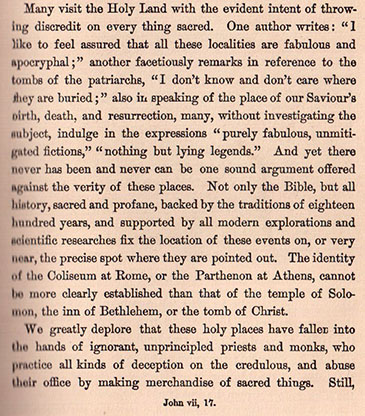
In a previous post I continued a thread on a 19th century Bible Lands text by Rev. Frank S. DeHaas. Now it is on to Jerusalem, holiest of the holiest places for this Protestant pilgrim. Yet again he has a hard time seeing past the poverty and destruction. But then he is consoled by the fact that such ruin was all according to prophecy. Unfortunately for a century more than this book, facts are indeed stubborn things and the artifacts DeHaas thought so compelling turn out not to be very factual.


Continue reading Buried Cities Recovered #4

How to Defend the Prophet?


Supporters of Lebanon’s Hezbollah leader Sayyed Hassan Nasrallah wave Hezbollah flags and shout slogans at a protest against a film made in the US that mocks the Prophet Mohammad, in southern Lebanon, Sept. 19, 2012. The Arabic on the headscarves read, “In your name prophet of God.” (photo by REUTERS/Ali Hashisho)

by Alaa al-Aswany, Al-Monitor, September 19, 2012

Whether you are Muslim, Christian or follow any other religion, you have the right to practice your faith, and others must respect your religious convictions without anybody mocking or degrading your beliefs. Thus, every Muslim has the right to feel angry upon watching a pathetic and badly made movie that depicts their prophet in a shameful, deceitful and insulting manner. Muslims were also within their rights when they felt angered by the cartoons that mocked the Prophet that were published in Denmark a few years ago. Furthermore, they were right to be angered by the movie Fitna (strife) — a film produced by right-wing Dutchman Geert Wilders in 2006 — which derided the Muslim faith and considered it the source of all the world’s terrorism. In all of these instances, Muslims were justifiably angered, and they had the legitimate right to embark on a campaign aimed at convincing the world that they were entitled, as human beings, to see their religious beliefs respected without prejudice. But, unfortunately, and as a result of these campaigns, Muslims lost that aforementioned right, and themselves contributed in distorting the image of Islam and Muslims because they let their anger get the best of them by overlooking the following facts:

First: The nature of freedom of expression in the West Continue reading How to Defend the Prophet?

The reform of the Islamic calendar: the terms of the debate, #2


Source of image

click here.]

The legal opinion of Qadi Shakir

Egyptian qadi Ahmad Muhammad Shakir (who was to become President of the Egyptian Supreme Court of the Shariah at the end of his career, and who remains to this day an author of reference in the field of hadith) (9), wrote a lengthy legal opinion in 1939 on the subject of the Islamic calendar, entitled : “The beginning of Arab months… is it legal to determine it using astronomical calculations?”. (2) According to him, the Messenger took into account the fact that the Muslim community of his time was “illiterate, not knowing how to write nor how to count”. So, he recommended to its members to observe the new moon to carry out their religious duties at the time of fasting and hajj. But the community evolved considerably over time, and some of its members even became experts in astronomy.

According to the principle of Muslim law which states that “a rule is no longer applicable, when the factor which justified its existence has disappeared”, the Messenger’s recommendation didn’t apply anymore to the Muslims, after they had learned to read and count and had ceased being illiterate. Therefore, according to Shakir, contemporary ulama’ commit an error of interpretation when they give to the Messenger’s hadith the same interpretation that applied at the time of Revelation, as if the hadith prescribed immutable rules. But, it has stopped being applicable to the Muslim community long ago, based on the principles of the shari’ah themselves. Continue reading The reform of the Islamic calendar: the terms of the debate, #2

The reform of the Islamic calendar: the terms of the debate, Part 1


[Note: This is a two-part article. After reading this you can proceed to Part two by clicking here.]

by Khalid Chraibi

Shortcomings of the Islamic calendar

A calendar associates a specific date with each day of any given week, month or year, to enable people to manage all their activities over an extended period of time. They must be able to anticipate, plan and organize in advance, using the information provided by the calendar, everything that they need to do. But, in Muslim societies, people wait to see, each country for itself, the appearance of the new moon at the end of each lunar month, before they declare the beginning of a new lunar month. As a result:
– the information in the Islamic calendar does not extend beyond the current month;
– and the data it shows each month differs from one Muslim country to another.
For instance, the first day of Ramadan 1427 corresponded to Saturday, September 23, 2006 in 20 countries ; Sunday, September 24 in 46 countries ; and Monday, September 25 in 5 countries. (1) This situation is in no way unusual, but can be observed every month.
Because of these shortcomings, after the major Muslim countries were occupied by foreign powers in the 19th and 20th centuries, Muslim people started using the Gregorian calendar to meet all their needs, and only care about determining Islamic dates on momentous Islamic religious occasions.

But, to this day, they regularly get puzzled at the inability of the Islamic calendar to predict precisely, well in advance, the day on which major Islamic events such as the first day of Ramadan, or eid al-fitr, or eid al-adha, or the first day of the new Islamic year are to take place. Continue reading The reform of the Islamic calendar: the terms of the debate, Part 1