All posts by tabsir

Yemen Conference at Harvard


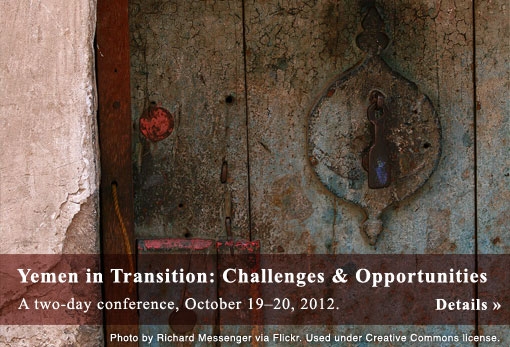
This past Friday and Saturday a conference was held on “Yemen in Transition.” While I was originally scheduled to give a presentation, I was not able to attend. But here is an overview of the conference, with complete details on the conference website.

Date: October 19, 2012 (All day) – October 20, 2012 (All day)
Speaker: various
Yemen in Transition: Challenges and Opportunities
Organized by Steven C. Caton, Harvard University, and the Yemen Working Group, this conference brings together Yemeni American professionals and academics along with some of their counterparts from Yemen, and academics from the U.S., Europe, and Yemen to discuss the future of Yemen and what might be done to help the country as it transitions into its new historical phase. It also brings together students from Harvard and the Boston area who are from Yemen. The main topics to be discussed are: women and youth, economic development, politics and political reform, and the water crisis. As an academic conference, the focus will be on theory and analysis, though concrete proposals and recommendations will also be presented.

The panels and the keynote address are open to the public. These presentations will be videotaped and made available on the website of the Harvard Center for Middle Eastern Studies but they will not be published as part of a conference proceedings. The use of recording devices by anyone other than the organizers is strictly prohibited.

On Drones


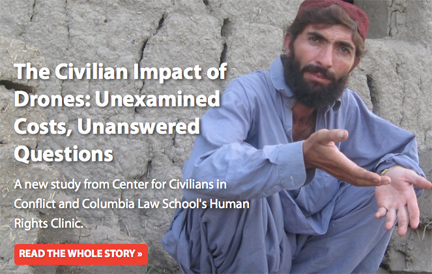
The Center for Civilians in Conflict and Columbia Law School’s Human rights Clinic have recently produced a report on the impact of drones on civilians. Below is the abstract; the full report can be found in pdf format here.

The Civilian Impact of Drones: Unexamined Costs, Unanswered Questions
Publication | 29 Sep 2012

This joint report from the Center for Civilians in Conflict and Columbia Law School’s Human Rights Clinic is an in-depth look at the US government’s covert drone program and its impact on civilian populations. Our objective is to critically assess US government procedures and standards for ensuring civilian protection and responding to civilian harm from drone strikes conducted both outside of full-scale military operations and with a degree of secrecy. The study is based on a review of publicly available materials, interviews with current and former government officials, responses to requests for information from agencies, and previous field interviews by Center for Civilians in Conflict.

Drones are touted as the most precise and humane weapons platform in the history of warfare. The technological advance is significant, but covert drone strikes carry costs for civilians and local communities even as they become a policy norm. Blinded by the promise of this technology and reports of short-term effectiveness in killing militants, policymakers are failing to ask hard questions of the drones program, including whether other tactics or strategies are more appropriate to counterterrorism strategy, and whether US expansion of strikes to new places and against new groups is truly justified.

Ottoman Music


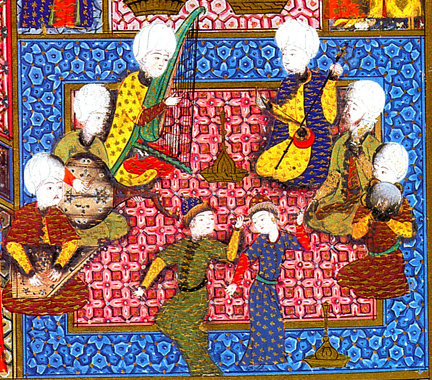
Ottoman ensemble in a Suleymaniye manuscript

For anyone interested in Ottoman music, or music as such, check out the nice webpage just uploaded in the Ottoman History Podcast.

Ottoman Classical Music: History and Transformations
with Mehmet UÄŸur Ekinci
74. Music of the Ottoman Court

While the Ottoman Empire was undoubtedly home to rich and diverse musical traditions, the subject of Ottoman music has often evaded historical analysis due to the scant nature of pre-nineteenth century sources on the subject. In this podcast, Mehmet Uğur Ekinci provides a general outline of the history of music during the Ottoman period along with its various waves of transformation and discusses his upcoming publication of Kevserî Mecmûası, an eighteenth century musical treatise that provides a rare glimpse of notation in Ottoman music before the nineteenth century. We also provide a number of recordings of Ottoman music composed during different periods.

A new Salafi politics


by Will McCants, Foreign Policy, The Middle East Channel, October 12, 2012

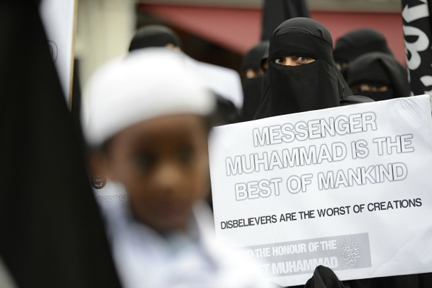
Salafis, or Sunni puritans, have been much in the news since they sparked riots at U.S. embassies throughout the Arab world protesting film clips lampooning the Prophet Muhammad. A television personality on a Saudi Arabian-funded Salafi satellite channel in Egypt first fanned the flames, and Salafis ranging from the militant Mohamed al-Zawahiri (the brother of al Qaeda’s chief, Ayman al-Zawahiri) to the mainstream Salafi political party al-Nour fueled the blaze when they blamed the U.S. government and called for protests against U.S. embassies. Salafis in Egypt, Tunisia, Libya, and elsewhere took up the torch, resulting in attacks on U.S. and other Western diplomatic installations across the Middle East.

Others were involved, of course, and the protests were small compared to the protests over the Muhammad cartoons several years ago. Nevertheless, the Salafi-driven protests are one more sign the ultra-religious right is asserting itself as the guardian of the moral order in Sunni-majority countries revolting against the ancien régime. Their noisy performance on the public stage poses a major challenge to emerging democratic systems, fueling polarization inside and fears abroad. But the new political realm also poses challenges to the Salafis who are on unfamiliar ground politically and ideologically.

To understand the political behavior of Salafis today, keep four things in mind: their religious beliefs do not predict their political behavior; they are a minority in almost every Middle Eastern country; the countries where they are a majority are incredibly wealthy; and their appeal and power arises from their commitment to an ultraconservative creed that is out of step with the mainstream. Continue reading A new Salafi politics

Iran, Iraq and Afghanistan: Mr. Peabody explains


For those of us who grew up getting our history from Mr. Peabody and his sidekick Sherman, politics was more than fractured fairy tales and a talking Moose (that had obviously escaped the helicopter hunt of Sarah Palin). So if you want to know why the Middle East is so messed up today, forget about Romney’s comic speech on Monday; here is a cartoon that explains it all. Get in your Youtube Not-So-Wayback Machine and enjoy Mr. Peabody’s view on what really happened.

Challenging the Norm


Q&A: Boushra Almutawakel
Challenging the Norm

The Economist, Aug 16th 2012, by S.B.

BOUSHRA ALMUTAWAKEL, a Yemeni photographer, aims to provoke discussions about social norms and question the ways people and cultures judge one another. Her stylised portraits, mostly of Middle Eastern women, challenge the view held by many in the West that the veil is a symbol of oppression. Issues of identity are central to her work. Though she is skeptical of veils that completely obscure the individual, she draws similarities with the way some women hide behind heavy make-up: in both cases, a woman is concealed behind a social mask of sorts, often for her own comfort. Ms Almutawakel (pictured below) is openly critical of certain social expectations of women in Yemen, yet she wears a long black abaya in public because she “wouldn’t feel comfortable otherwise”. This ambivalence pervades her work.

Having studied in America, Ms Almutawakel has returned to live and work in Sanaa in Yemen. Her photographs—controversial among Yemenis—seem designed mainly for a Western audience. But some can now be seen in a show of regional artwork at the National Museum of Yemen in Sanaa.

Ms Almutawakel recently met with The Economist to discuss her photography, her views on women and the role artists play in revolutionary Yemen.

Tell us about the art scene in Yemen.

When I started in the 1990s I was supposedly the first female photographer. There were only a few artists throughout Yemen and we formed a network to hold exhibitions. Now there are many more because digital cameras have made photography more accessible and schools and universities teach design. But the scene is still limited and goes up and down with the economic and political situation. We need support to have our work exhibited locally and internationally. Continue reading Challenging the Norm