All posts by tabsir

Johnsen on Yemen in New York

Book Night With Gregory Johnsen

12 November 2012 – 6:00pm – 7:30pm

40 West 45th Street, Club Quarters, New York, Free admission

by Sonya K. Fry, Overseas Press Club of America

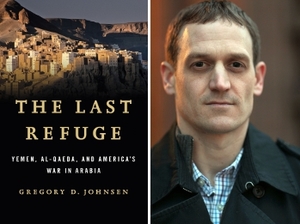
The Last Refuge: Yemen, Al-Qaeda, and America’s War in Arabia [W.W. Norton & Company, November, 2012] is an eye-opening look at the successes and failures in fighting a new type of war in the turbulent country of Yemen, written by Gregory D. Johnsen, who is an OPC Foundation Scholar, a Fulbright fellow in Yemen, part of a 2009 USAID conflict assessment team and is now a doctoral candidate in Near Eastern studies at Princeton University.

Johnsen takes readers into Yemeni mosques where clerics in the 1980’s recruited young men to jihad to fight the Russian invaders in Afghanistan. These men eventually formed the basis for the Al-Qaeda movement. The story also leads to the presidential palace in Yemen where the country’s military dictator, Ali Abdullah Salih vascillated between helping the U.S. get rid of Al-Qaeda in the Arabian Peninsula and hindering the process. Salih himself called this delicate balancing act of staying in power a “snake dance.” For years this dance included concealing Islamists from the prying eyes of U.S. intelligence and yet later he allowed the U.S. to conduct attacks that killed dozens of Al-Qaeda operatives including Abu Ali al-Harithi, who was known as the “godfather” by U.S. intelligence. The dramatic story sounds like a Hollywood movie: Haritihi turned on his cell phone as he left a secret meeting which signaled a predator drone to track him. The first missile from the drone exploded next to Harithi’s speeding car. He threw the phone out of the window and screamed at everyone to get out, but there was nowhere to go since they were in the middle of the desert. The drone fired its second missile and the car exploded in flames. Continue reading Johnsen on Yemen in New York

Two documentary films on Islam in NYC

For those in the New York area and who have power (I still do not after Sandy hit last week), there are two films that will be of interest to those who read this blog. One is American Imam by Donya Ravasani. It is showing twice at the IFC Center: Saturday, Nov 10 at IFC 11:15am and Thursday, Nov 15 at IFC 1pm

It will be screened together with Building Babel, David Osit’s documentary about the developer of the so called Ground Zero Mosque.

For details on New York’s Documentary Festival, check out their website.

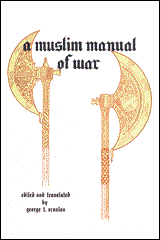
A Muslim Manual of War


A Muslim Manual of War
being Tafrij al-kurub fi tadbir al-hurub
by ‘Umar ibn Ibrahim al-Awsi al-Ansari
Edited and translated by George T. Scanlon
Foreword by Carole Hillenbrand

Free online facsimile anniversary edition

One of the first three books published by the AUC Press after its founding in 1960 was A Muslim Manual of War, an annotated editing and translation of a hitherto little-known fifteenth-century Arabic manuscript on the art of war, prepared by George Scanlon, then embarking on his career to become one of the most respected scholars in the field of Islamic art, architecture, archaeology, and history. Now, in celebration of 50 years of the AUC Press, and in honor of Professor Scanlon’s recent retirement after an illustrious career, most recently as professor of Islamic art and architecture in the Department of Arab and Islamic Civilizations at the American University in Cairo, the AUC Press is proud to make available once again this long out-of-print book, as a freely accessible scanned facsimile with a new Introduction by the author and a Foreword by eminent scholar Carole Hillenbrand, a former student of Professor Scanlon.

Harvard Arab Weekend


It is our honor, on behalf of the Harvard Arab Alumni Association, the various MENA clubs across campus, and the Arab student body, to welcome you all to the 6th Harvard Arab Weekend, taking place at Harvard University from the 8th through the 11th of November, 2012.

As the largest pan-Arab conference in North America, the Harvard Arab Weekend has prided itself on showcasing a mosaic of perspectives and insights on the most pressing issues in the Arab world. Last year, the Harvard Arab Weekend was commended by the White House as “The Premier Arab World Conference” in North America. This year, we strive to uphold our venerable tradition of engaging discourses and informative debates.

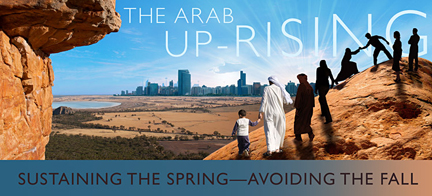
At this critical moment of modern Arab history, and in the midst of the many challenges created by the unprecedented transformations in the Arab world, Arabs, from the Gulf to the Ocean, are posing critical questions about their past, present, and future. While the entire Arab landscape is undergoing a process of re-creation, Arabs look ahead at the future, wondering whether they will be able to sustain what they have achieved after more than a century of struggle. This year’s edition of the Harvard Arab Weekend specifically aspires to tackle these challenges and discuss how Arabs can sustain the “Spring” and avoid reverting back to authoritarianism or falling into chaos. Continue reading Harvard Arab Weekend

Kicking the Palestinian down (the Road)


“The Bearer of Burdens” painting by Suleiman Mansour

Candidates ignore plight of Palestinians
By Nadia Hijab, The Hill, October 25, 2012

As a Palestinian-American, I awaited the presidential debate on foreign policy with anticipation, given the massive U.S. military footprint in the region of my birth.

I confess to being torn in my attitude to the candidates. From a Palestinian perspective, I know there is little difference: Neither would take effective steps to end Israel’s 45-year occupation, challenge its illegal building of settlements, or shake its draconian hold on Jerusalem.

Their record speaks for itself. President Barack Obama soon gave up on the Israeli settlement freeze he pushed early in his tenure. American and Israeli troops are even now participating in a joint missile-defense exercise The New York Times described as “the largest in the history of the two countries’ relationship.” Continue reading Kicking the Palestinian down (the Road)

Yemen: can southern separatists break up Yemen?


Photo in southern Yemen by Adam Reynolds

by Helen Lackner, Open Democracy, October 23, 2012

Yemeni unity in 1990 was greeted with enthusiasm by Yemenis at large, whether from the former Yemen Arab Republic (YAR) or People’s Democratic Republic of Yemen (PDRY). Although there was considerable discussion and disagreement in the leadership about the form it took, there is no doubt that for ordinary Yemenis the possibility of travelling anywhere in the country was welcome.

While many women in the YAR had looked forward to the spread of the PDRY’s Family Law to the whole country, many men and women everywhere hoped to see the same for qat consumption laws, and southerners were looking forward to economic liberalisation, all were swiftly disappointed when the economy collapsed after the sanctions taken against Yemen by neighbour states following Iraq’s invasion of Kuwait. In addition, after the initial flourishing freedom of expression through a multiplicity of new parties and newspapers in the first years of enthusiasm, the political situation rapidly deteriorated as tension developed between the two former ruling groups. Starting with some clearly targeted assassinations of Southern leaders, this eventually brought about the 5 months Civil War of 1994 which was decisively won by Sana’a’s forces. Continue reading Yemen: can southern separatists break up Yemen?