All posts by tabsir

Notes from Algeria and Turkey


Notes from Algeria and Turkey — Charting the Modern Face of Islamic Civilization and Democracy in a Global World

by Bruce Lawrence, Transcultural Islam Research Network, November 30, 2012

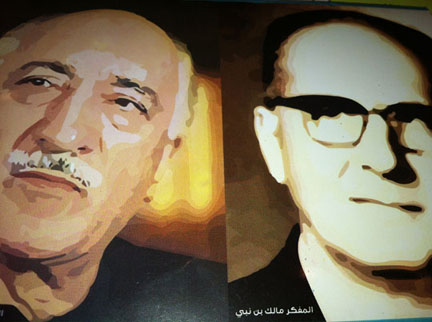
What can we learn from an aging Turkish Imam with a pan-Turkish cultural movement to his name and a deceased Algerian philosopher — both of whom command attention as devout Muslims and men of science — about civilizational rebuilding in the modern era?

Scholars gathered in Algiers from Nov 21-22 at the College of Islamic Sciences at the University of Algiers to find out.

“The Philosophy of Civilizational Rebuilding, according to Malek Bennabi and Fetullah Gülen: Guidelines for Creative Thinking & Effective Action” was the theme for the conference, and I was invited to give a paper on this weighty subject.

I had been teaching in Istanbul during Fall 2012. My assignment there had been to train graduate students, both Turkish and non-Turkish, in theories and methods that apply to civilizational studies.

I had also been traveling and giving lectures elsewhere in Turkey, including a memorable lecture to 400 students at Mustafa Kemal University in Antakya — where the topic was Islam and Global Civilization and included a survey of constitutionalism, citizenship and cosmopolitanism, along with numerous approaches to Islamic civilization in the crowded marquee of world civilizations that claim to be both global and universal.

Just who were Fethullah Gülen and Malek Bennabi? Why was their thinking paired to address the topic of civilizational rebuilding, and how would their views advance an initiative that spanned centuries and engaged some of the best minds, from Ibn Khaldun in late 14th century North Africa to Arnold Toynbee in mid-20th century Britain? Continue reading Notes from Algeria and Turkey →
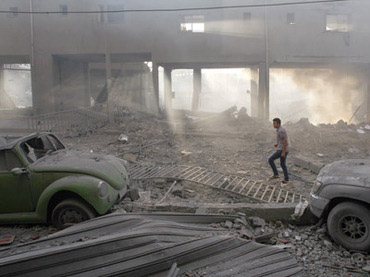
The Soccer Stadium that was


Gaza’s war-damaged Palestine Stadium

Israeli measures fuel international anti-Israeli soccer protests

By James M. Dorsey

A series of Israeli measures against Palestinian soccer culminating in an attack on a stadium in Gaza during last month’s confrontation with Hamas, the Islamist Palestinian group that controls the heavily populated strip along the Mediterranean, has fueled growing international soccer opposition to the Jewish state’s policies.

In the latest expression of discomfort, 62 professional players have called for depriving Israel of the right to host European soccer body UEFA’s 2013 Under-21 championship. Israel has already employed the championship to counter the image of being an area dominated by war and conflict that was reinforced by last month’s hostilities with Hamas that killed more than 150 Palestinians and five Israelis.

“In June we have the Under-21 here in Israel. I hope that everything will be quiet until then and we can show the different sides of Israel,” said Maccabi Tel Aviv defender Omer Vered in a BBC interview.

The statement by the players follows protests earlier this year by world soccer body FIFA, UEFA and players’ group FIFPro against Israel’s handling of a hunger strike of an imprisoned Palestinian player, Mahmoud Sarsak, accused of being a member of militant group Islamic Jihad, and the arrest of two other players suspected in involvement in violent anti-Israeli actions. Continue reading The Soccer Stadium that was →

America’s Failed Palestinian Policy


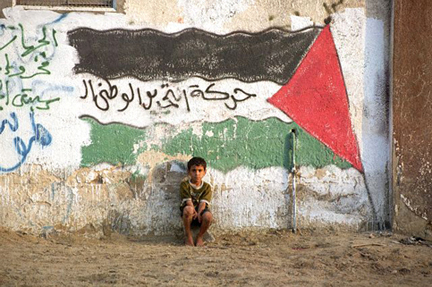
Palestinian boy in Gaza

By YOUSEF MUNAYYER, The New York Times, November 23, 2012

MORE than 160 Palestinians and 5 Israelis are dead, and as the smoke clears over Gaza, the Israelis will not be more secure and Palestinians’ hopes for self-determination remain dashed. It is time for a significant re-evaluation of the American policies that have contributed to this morass.

The failure of America’s approach toward the Israelis and the Palestinians, much like its flawed policies toward the region in general, is founded on the assumption that American hard power, through support for Israel and other Middle Eastern governments, can keep the legitimate grievances of the people under wraps.

But events in Gaza, like those in Egypt and elsewhere, have proved once again that the use of force is incapable of providing security for Israel, when the underlying causes of a people’s discontent go unaddressed.

The United States government must ask: what message do America’s policies send to Israelis and Palestinians?

Washington’s policies have sent counterproductive messages to the Palestinians that have only increased the incentives for using violence. Continue reading America’s Failed Palestinian Policy →

Paul on Gaza

The election circus is over for another four years; at least it is less a rhetorical political cliff than a slippery slope. But I recently came across a C-Span Youtube video of Representative Ron Paul (who is sure to run again for the GOP nod) speaking in congress in 2009 against a resolution to support Israel’s invasion into Gaza (which is why he will never win). It is well worth viewing again, politics aside. You can see it here: http://www.youtube.com/watch?feature=player_embedded&v=Yb3vF6Vcjr0#!

Nader on Gaza


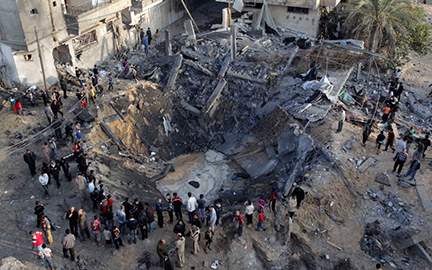
Palestinians gather around an enormous crater after an Israeli air strike levelled a building in Khan Younis in the southern Gaza Strip; photograph for REUTERS by Ibraheem Abu Mustafa

Israel-Palestine: What is the U.S. National Interest?

By Ralph Nader, The Nader Page, Tuesday, November 20, 2012

Israeli elections are coming up in January so it is Palestinian hunting season again. Israeli cynics call it a time “for mowing the grass.”

Out comes the well-worn playbook by Israel’s militaristic government that has worked to silence Israeli politicians and citizens who want a two-state solution. This is an opportunity to use and test advanced weaponry from the U.S., compliments of U.S. taxpayers, and squelch ongoing peace efforts, small and large, by Palestinians, Israelis and international peace advocates.

The playbook’s first chapter is provocation to upset a tense but workable truce with Hamas, the elected government of Gaza. Hamas was encouraged at its creation years ago by both Israeli and U.S. backers to counter the secular Palestine Liberation Organization (PLO). Bit of a blowback there.

Israeli government leaders are expert provocateurs when they wish to seize land, water or prisoners and upset any movement toward a peace that would create a viable Palestinian state back to the 1967 borders, which includes East Jerusalem. When Israel came into being in 1948, it soon broke a UN truce and doubled its territory by taking the large area known as the Negev desert, whose refugees ended up in the Gaza Strip. Now 1.6 million encircled and impoverished humans, blockaded and under siege by Israel, try to survive in an open-air prison little more than twice the size of the District of Columbia.

Israel’s strategy of breaking cease-fires and truces over the years has been documented by Princeton University history professor emeritus, Arno J. Mayer, in his scholarly book Plowshares into Swords: From Zionism to Israel (Verso, 2008). Continue reading Nader on Gaza →

The Formation of Syria’s National Coalition


Syrian President Assad; photography by Benoit Tessier/ REUTERS

The Formation of Syria’s National Coalition: An Assessment and Analysis

By Amr al-Azm

Syria Comment, November 13, 2012

Following talks with a number of people who attended the Doha meeting of November 8-11, this is my assessment of the newly formed “National Coalition for Revolutionary Forces and the Syrian Opposition”. The coming together of the various Syrian opposition factions to finally strike a deal based on a 12 point agreement that would unify them under the umbrella of a newly created coalition body is remarkable considering the obstacles that had to be overcome. It faced intense opposition by some groups, particularly the SNC, which viewed this as a blatant effort to sideline them. Its members have fought for a leading role in the new group.

The original Riad Seif plan called for a council of 51 seats, a joint supreme military council, a judiciary commission and the formation of a provisional government selected from technocrats.

The new National Coalition that emerged in Doha on Monday ended up comprising of 65 seats. The SNC was earmarked 22 seats, the local administration councils were allocated 14 seats (one for each of the provinces in Syria), national figures were allocated initially 8 seats, eventually rising to 10 seats, with the balance (19 seats) to be distributed amongst the various remaining opposition groups and entities. The new coalition eventually managed late on Monday evening to eventually select Moaz Al-Khatib (a cleric and former imam of the Ummayad Mosque in Damascus) and two deputies (with a third still to be named by the Kurds) who are Riad Seif (both prominent dissidents and activists). A third position, which is until now poorly, understood is that of Secretary General, to be occupied by Mustapha Sabagh (head of the Syrian Business men Group). It is rumoured (by Al-Jazira and others) that the position would carry sweeping powers to rival even those of the head of the coalition Moaz Al-Khatib and seen as a principle demand by the Qataris. Continue reading The Formation of Syria’s National Coalition →