All posts by tabsir

And the winner is … Islamophobia


The moral ambiguity of Homeland or Argo is a fitting tribute to the reality of US Middle East policy

by Rachel Shabi, The Guardian, Monday 14 January 2013

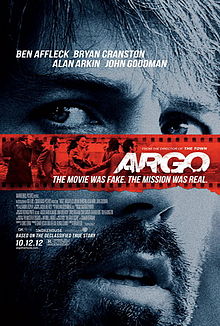
America’s Middle East policy has been enthusiastically endorsed. Not at the UN or Arab League, however, but by the powerbrokers of Hollywood. At the Golden Globes, there were gongs for a heroically bearded CIA spook saving hostages and American face in Iran (the film Argo); a heroically struggling agent tracking down Bin Laden (Zero Dark Thirty) and heroically flawed CIA operatives protecting America from mindless, perpetual terror (TV series Homeland).

The three winners have all been sold as complex, nuanced productions that don’t shy away from hard truths about US foreign policy. And liberal audiences can’t get enough of them. Perhaps it’s because, alongside the odd bit of self-criticism, they are all so reassuringly insistent that, in an increasingly complicated world, America just keeps on doing the right thing. And even when it does the wrong thing – such as, I don’t know, torture and drone strikes and deadly invasions – it is to combat far greater evil, and therefore OK.

When I saw Argo in London with a Turkish friend, we were the only ones not clapping at the end. Instead, we were wondering why every Iranian in this horribly superior film was so angry and shouty. It was a tense, meticulously styled depiction of America’s giant, perpetual, wailing question mark over the Middle East: “Why do they hate us?” Iranians are so irked by the historically flimsy retelling of the hostage crisis that their government has commissioned its own version in response.

Zero Dark Thirty, another blanked-out, glossed-up portrayal of US policy, seems to imply that America’s use of torture – sorry, “enhanced interrogation” – is legitimate because it led to the capture of Osama bin Laden (something that John McCain and others have pointed out is not even true). Adding insult to moral bankruptcy, the movie has been cast as a feminist film, because it has a smart female lead. This is cinematic fraud: a device used to extort our approval. Continue reading And the winner is … Islamophobia

On War: A Sociologist’s Take


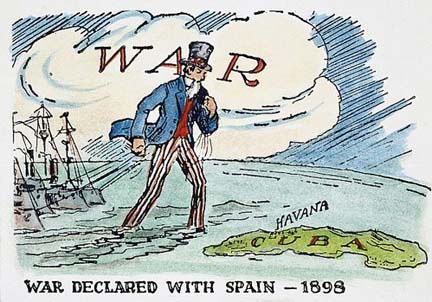
Sociologist William Graham Sumner was an outspoken critical of American imperialism in the Spanish American War

by William Graham Sumner (1903)

Can peace be universal? There is no reason to believe it. It is a fallacy to suppose that by widening the peace-group more and more it can at last embrace all mankind. What happens is that, as it grows bigger, differences, discords, antagonisms, and war begin inside of it on account of the divergence of interests. Since evil passions are a part of human nature and are in all societies all the time, a part of the energy of the society is constantly spent in repressing them. If all nations should resolve to have no armed ships any more, pirates would reappear upon the ocean; the police of the seas must be maintained. We could not dispense with our militia; we have too frequent need of it now. But police defense is not war in the sense in which I have been discussing it. War, in the future will be the clash of policies of national vanity and selfishness when they cross each other’s path.

If you want war, nourish a doctrine. Doctrines are the most frightful tyrants to which men ever are subject, because doctrines get inside of a man’s own reason and betray him against himself. Civilized men have done their fiercest fighting for doctrines. The reconquest of the Holy Sepulcher, “the balance of power,” “no universal dominion,” “trade follows the flag,” “he who holds the land will hold the sea,” “the throne and the altar,” the revolution, the faith — these are the things for which men have given their lives. What are they all? Nothing but rhetoric and phantasms. Doctrines are always vague; it would ruin a doctrine to define it, because then it could be analyzed, tested, criticised, and verified; but nothing ought to be tolerated which cannot be so tested. Continue reading On War: A Sociologist’s Take

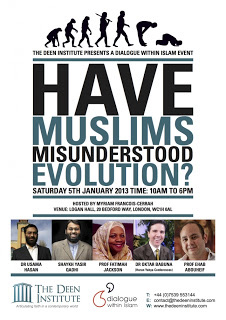
Have Muslims Misunderstood Evolution


The importance of Evolution and Islam debate in London

by Salman Hameed, Irtiqa’, January 7, 2013

I’m now back in US and I’m glad that I had a chance to attend the London debate, Have Muslims Misunderstood Evolution? It was organized by The Deen Institute and I posted some quick thoughts on Saturday.

You can find a good summary of each speaker’s presentation at Farrukh’s blog.

Here are a few reasons why I think the London debate on evolution and Islam may turn out be a game-changer in the way Muslims look at evolutionary biology, and science, in general.

This was an intra-faith debate. There is no question that the topic was controversial. However, the conversation on evolution often gets derailed by common misconceptions and juvenile creationist ideas. The debate would have been a failure, had it been simply between biologists and those who follow Harun Yahya. There is no common ground – as Yahya’s group has no understanding of science.

The reason for the success of the debate was that almost all of the speakers (with the exception of Harun Yahya acolyte, Oktar Babuna) accepted the scientific consensus on evolution. Then the question became: Can Muslims reconcile human evolution with their faith? Now this is an important question.

Here are a few take-aways from the London debate: Continue reading Have Muslims Misunderstood Evolution

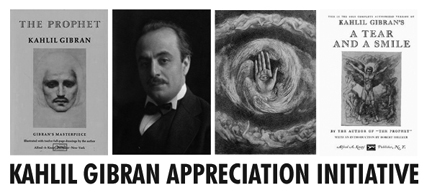
Petition for a Kahlil Gibran US Postage Stamp


Sign the Petition for a Kahlil Gibran US Postage Stamp!

Why Gibran?

Since his passing, fans of Gibran Kahlil Gibran (1883-1931) have called for a fitting tribute to the poet, author, artist, and philosopher, who remains one of the most renowned figures in the world literary landscape. For Arab Americans and Arabs daunted by political, financial and social uncertainty, Gibran holds a valuable place as the immigrant voice in America. Arab Americans and Arabs have long ago claimed Gibran’s achievements as their own, proudly holding his life and works close to their hearts.

Perhaps this protective emotional engulfing has to do partly with Gibran’s own quest to belong. Early on in his childhood, the Lebanese born poet was rendered homeless after his father was sent to prison for tax evasion, and his property was impounded. Shortly thereafter, the family emigrated to Boston’s South End, where non-English speaking Gibran was told he should Anglicize his name, and refer to himself simply as Kahlil Gibran. Continue reading Petition for a Kahlil Gibran US Postage Stamp

ISLAM IN THE COLUMBIA CURRICULUM, 1886-2012


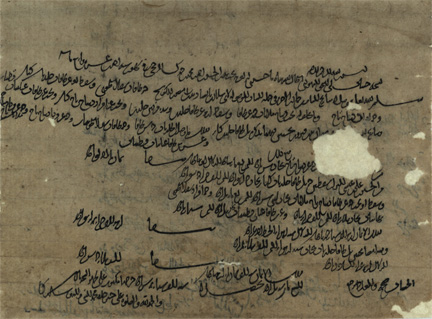
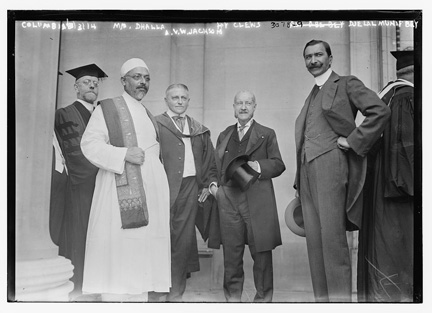
This photo shows Jackson with his student Dhalla, the financier Henry Clews (1836-1923), and Djelal Munif Bey (d. 1919), the Ottoman Consul General in New York. The other two men are unidentified.


The Columbia University Seminar on Religion and Writing and the American Institute of Iranian Studies are pleased to announce:

ISLAM IN THE COLUMBIA CURRICULUM, 1886-2012: FROM ORIENTAL LANGUAGES TO AREA STUDIES AND RELIGIOUS STUDIES

Thursday, January 31, 2013
Faculty House (400 West 117th St)

The one-day conference will explore the history of Islamic Studies in North America in general, and at Columbia University in particular. Its starting point is the observation that Islamic Studies slipped into the Columbia curriculum when in the late 1880s Oriental languages were first added to the fledgling University’s course offerings. For a detailed schedule, please see the conference website at
https://researchblogs.cul.columbia.edu/islamicbooks/religionwriting/conference/

The conference accompanies the exhibition “Collecting Oriental Books for the Columbia Libraries, 1886–1936” in Columbia’s Rare Book and Manuscript Library. The exhibition explores the beginnings of the University’s Islamic book collections, and will be on view in the Chang Octagon from December 19, 2012 until March 2013.

This conference is open to the public, but we request that you register, as seating is limited. Please RSVP to icc1886@gmail.com.

For further information contact icc1886@gmail.com.

Buried Christian Empire Casts New Light on Early Islam


The “crowned man” relief found in Zafar, Yemen is seen as evidence that there was a Christian empire in the region before Islam took hold.

by Matthias Schulz, Der Spiegel, December 21, 2012

The commandment “Make yourself no graven image” has long been strictly followed in the Arab world. There are very few statues of the caliphs and ancient kings of the region. The pagan gods in the desert were usually worshipped in an “aniconic” way, that is, as beings without form.

But now a narcissistic work of human self-portrayal has turned up in Yemen. It is a figure, chiseled in stone, which apparently stems from the era of the Prophet.

Paul Yule, an archeologist from the southwestern German city of Heidelberg, has studied the relief, which is 1.70 meters (5’7″) tall, in Zafar, some 930 kilometers (581 miles) south of Mecca. It depicts a man with chains of jewelry, curls and spherical eyes. Yule dates the image to the time around 530 AD.

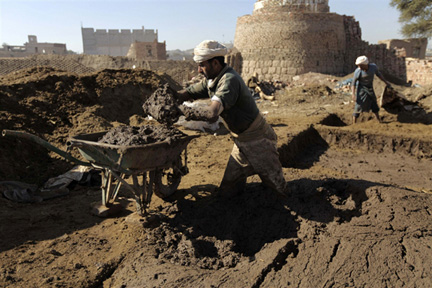
The German archeologist excavated sites in the rocky highlands of Yemen, an occupation that turned quite dangerous recently because of political circumstances in the country. On his last mission, Yule lost 8 kilograms (18 lbs.) and his equipment was confiscated.

Nevertheless, he is pleased, because he was able to bring notes, bits of debris and bones back to Heidelberg. Yule has concluded that Zafar was the center of an Arab tribal confederation, a realm that was two million square kilometers (about 772,000 square miles) large and exerted its influence all the way to Mecca. Continue reading Buried Christian Empire Casts New Light on Early Islam