
In the midst of all the bad news emanating from the Middle East, here is a youtube video of traditional Kurdish music with pastoral scenes in Kurdistan.
In the midst of all the bad news emanating from the Middle East, here is a youtube video of traditional Kurdish music with pastoral scenes in Kurdistan.

By Qasim Rashid and Chris Stedman, Religion & Politics, March 5, 2013
Thomas Jefferson once wrote: “But it does me no injury for my neighbor to say there are twenty gods or no God. It neither picks my pocket nor breaks my leg.â€
For many of us, it’s easy to appreciate Jefferson’s eloquently stated advocacy of religious freedom of conscience, as well as the idea that all individuals should be able to express religious or nonreligious positions independent of others’ beliefs. Likewise, at the United Nations, both the Universal Declaration on Human Rights and the binding International Covenant on Civil and Political Rights guarantee “freedom of thought, conscience and religion†to all individuals. But, in spite of international agreements and Jefferson’s beautiful words, the reality is that these tenets are often forgotten.
Today, few corners of the world are immune from the oppression of conscience. Last year, Pakistan’s Malala Yousafzai captivated the world after the Taliban viciously attacked her for promoting education for girls and women. Nearby, Pakistani Christian Rimsha Masih’s future and safety are still uncertain after she beat a blasphemy charge. In 2010, the Taliban murdered 86 Ahmadi Muslims on account of their faith. In Indonesia, Alexander Aan continues to languish in prison for the “crime†of professing his atheism, and atheist Alber Saber has been persecuted in Egypt for his lack of faith. In Iran, U.S. Pastor Saeed Abedini is serving an eight-year prison sentence for the alleged crime of preaching Christianity. And these examples are just a snapshot of what Pew reports as roughly 75 percent of the world—5.25 billion people—that live under some sort of social or governmental oppression of religious conscience. Continue reading Can Atheists and Muslims Support Freedom of Conscience Together?
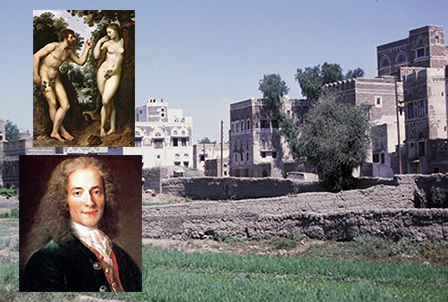
Could the biblical Garden of Eden really be a reference to the gardens of Sanaa, Yemen? If you think this is a crazy idea, you simply do not realize the genius of Voltaire, the 18th century savant whose Philosophical Dictionary is in itself a garden of intellectual delights. In his commentary on Genesis, Voltaire rejects the idea that Eden was between the four rivers mentioned, claiming another explanation is needed and other rivers should be searched for. Then he drops this tantalizing datum:
In any case, the garden of Eden was manifestly taken from the garden of Eden at Sanaa, in Arabia Felix, famous throughout antiquity. The Hebrews, a very recent people, were an Arab horde. They prided themselves on what was finest in the best canton of Arabia. They have always used for their own purposes the ancient traditions of the great nations in whose midst they formed an enclave.
So Sanaa once was paradise. Let us hope that it shall return to that state again, with fruit only from the tree of the knowledge of good and rivers flowing with the water Yemen so desperately needs.

Photo by Jerome Delay/AP
by Orit Bashkin, Jadaliyya, March 20. 2013
During the past week Americans, Europeans, and Middle Easterners were reminded of Iraq. A stream of photos, articles, essays, and analyses has tried to make sense of the situation in Iraq during the last decade. One group, however, does not need to be reminded of the gravity of the situation—the many Iraqis, men and women alike, whose lives have been irreversibly changed during the last decades.
In this piece, I want to reflect on the kinds of themes historians have been writing about in the present, and those we ought to write about in the future. In the last ten years, we seemed to have learned much more about Iraqi history; probably more than any of us has ever imagined upon entering graduate school, as our field witnessed the publication of dozens of academic books, articles (including ones published in The International Journal of Contemporary Iraqi Studies), and dissertations. Thus, we now seem to better understand gender relations in Iraq as well as the country’s Diasporas and trans-regional and social networks. We are more knowledgeable about Iraqi patriotism and Arab-Iraqi nationalism. We have learned to appreciate Iraq’s culture, namely its astonishing literary production, the ways in which Iraqi poets revolutionized the field of modern Arabic poetics, and the writings of Iraq’s gifted novelists, whose works have appeared in translation in the last decade. We comprehend better various mechanisms related to the state: the development of its health system, the production of its social memory, its disciplinary institutions—especially its education system—and, significantly, its production of sectarian policies. Historians have likewise attempted to analyze Iraq’s relations with the British Empire, and the modes of resistance to empire, especially the 1920 Revolt. The controversial move that brought the Baath Party archives to the United States in 2008 will enable those who work in these archives, as well as their readers, to know much more about the Baath regime and the ways in which it functioned, possibly more than any other Middle Eastern regime. Continue reading The Forgotten Protagonists: The Invasion and the Historian
المساء برس- المساء برس التاريخ : 21-03-2013
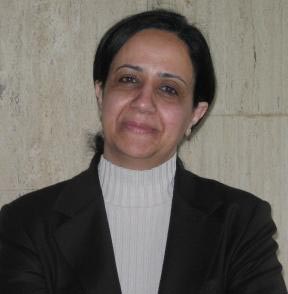
أمة العليم السوسوة ظلت تبØØ« عن مكان للمرأة ÙÙŠ الصÙو٠الأولى لمؤتمر الØوار الوطني Ùلم تجد أي مكان شاغر لها أو لغيرها Øتى ÙÙŠ منصة القاعة التي كانت مخصصة للرئيس ولرؤساء الأØزاب السياسية نواب الØوار الوطني .
السوسوة لم تعترض على ذلك كما Ùعل البخيتي ولكنها أكتÙت بتوجيه رسالة عبر وسائل الإعلام Øول غياب المرأة عن قيادة الØوار وإختراقها لمستوى التمثيل وظهور بعض الوجوه الجديدة من خلال بعض القوائم .
السوسوة كانت Øرة ÙÙŠ Ø·Ø±Ø Ø¢Ø±Ø§Ø¦Ù‡Ø§ ولم تنقاد وراء القوى السياسية وهذا ما جعلها تكسب Ø¥Øترام الجميع وتقود قضية المرأة اليمنية بإمتياز Ùتاريخها يدل على ذلك Ùيما تسعى بقية المشهورات من النساء اليمنيات الى الصعود السياسي من بوابة الأØزاب ما جعلهن يتعرضن للنقد بسبب إتباع مواق٠بعض القادة السياسيين ومراكز النÙوذ كما Ùعلت توكل كرمان مؤخراً من إتباع Ù„Øميد الأØمر ÙÙŠ الإنسØاب من الØوار بعد كانت تستجدي ضمها للØوار وهو ما جعل الرئيس ÙÙŠ نهاية الأمر يواÙÙ‚ على ضمها ÙÙŠ قائمة بعد أن تخلى Ø§Ù„Ø¥ØµÙ„Ø§Ø Ø¹Ù†Ù‡Ø§ Øتى أنها اشادت بقرار الرئيس وأعتبرت هادي أنه باقي ÙÙŠ قائمتها .
Continue reading هل أمة العليم السوسوة نموذج للمرأة اليمنية ؟!

For an interesting article on the death of the Syrian religious scholar Muhammad Sa’id Ramadan al-Bouti, see the article by by H.A. Hellyer at Tahrir Squared.
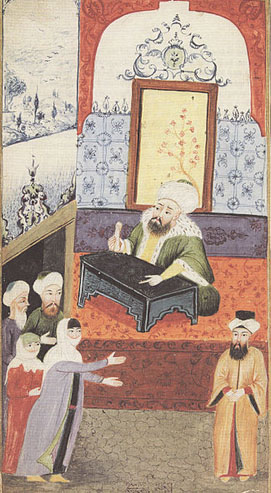
An unhappy wife is complaining to the Qadi about her husband’s impotence, 18th century.
Fresh Air, NPR, April 16, 2012
Sadakat Kadri is an English barrister, a Muslim by birth and a historian. His first book, The Trial, was an extensive survey of the Western criminal judicial system, detailing more than 4,000 years of courtroom antics.
In his new book, Heaven on Earth, Kadri turns his sights east, to centuries of Shariah law. The first parts of his book describe how early Islamic scholars codified — and then modified — the code that would govern how people lead their daily lives. Kadri then turns to the modern day, reflecting on the lawmakers who are trying to prohibit Shariah law in a dozen states, as well as his encounters with scholars and imams in India, Pakistan, Syria, Egypt, Turkey and Iran — the very people who strictly interpret the religious and moral code of Islam today. And some of those modern interpretations, he says, are much more rigid — and much more draconian — than the code set forth during the early years of Islamic law. Continue reading Interpreting Shariah Law Across The Centuries

A villager makes cow dung cakes used as cooking fuel at Maloya village on the outskirts of the northern Indian city of Chandigarh on January 31, 2011; photograph by Ajay Verma / Reuters
[Webshaykh’s note: Here is a great story coming out of Indonesia about two young female science students contributing to society. I believe Marvin Harris would love this, as would anyone appreciates the Hindu doctrine of ahimsa. Yet another sacred cow sacrificed in the interest of science.]
Fermented Cow Dung Air Freshener Wins Two Students Top Science Prize
by Kimberley Mok, Care2.com, March 16, 2013
Conventional air fresheners are known for their toxic soup of chemicals that may be linked with asthma, reproductive disorders and even lung disease. While there’s no shortage of environmentally-friendly and human-healthy air fresheners on the market, two Indonesian science students are behind a rather bizarre concoction that you may be seeing soon: an affordable air freshener made from cow dung.
Yes, cow dung — as weird as it sounds, the formulation actually has a pleasant herbal smell, and has won Dwi Nailul Izzah and Rintya Aprianti Miki a gold medal at Indonesia’s Science Project Olympiad (ISPO). According to Oddity Central, the young women overcame 1,000 other competitors with their surprising freshener, which was painstakingly created by collecting unused cow manure from a cattle farm and fermenting it for three days:
Then they extracted the water from the fermented manure and mixed it with coconut water. Finally, they distilled the liquid to eliminate all impurities. The whole process took 7 days, which is pretty long, but in the end they obtained what they were looking for – a liquid air freshener with an herbal aroma from digested cow food. Continue reading Mind your manures…