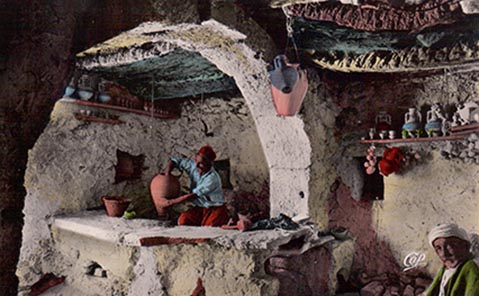
ILE de DJERBA: Atelier du Potier de Guallala; Cie des Arts Photomécaniques, 44, r. Letellier, Paris-15
Two postcards from the 1950s.

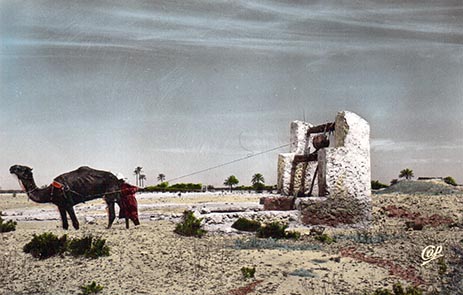
ILE de DJERBA: Le Puits Djerbien et son Chameau;Cie des Arts Photomécaniques, 44, r. Letellier, Paris-15

ILE de DJERBA: Atelier du Potier de Guallala; Cie des Arts Photomécaniques, 44, r. Letellier, Paris-15
Two postcards from the 1950s.

ILE de DJERBA: Le Puits Djerbien et son Chameau;Cie des Arts Photomécaniques, 44, r. Letellier, Paris-15

Goodbye, Al-Masry Al-Youm
by Sarah Carr, Egypt Independent, April 26, 2013
In 2010, Abdel Moneim Saeed, then the chairperson of state mouthpiece Al-Ahram, oversaw an outrageous bit of Photoshopping on the newspaper’s front cover, when US President Barack Obama was replaced with Hosni Mubarak at the head of a group of leaders striding out of a meeting in Washington.
This Photoshop-gate inspired the inevitable deluge of derision on social media. As well as being breathtaking and hilarious in its own right, it was a bit of light relief from the tense and strange months leading up to the revolution and, in particular, another photo that went viral in 2010 thanks to social media — that of the mutilated corpse of Khaled Saeed.
Al-Ahram’s big cheeses remained belligerent in the face of the ridicule. Its editor-in-chief, Osama Saraya, described it as an “expressionist†photograph that gave a “brief, live and true expression of the prominent stance of President Mubarak in the Palestinian issue.â€
In a 2010 interview with Al-Ahram Weekly, Abdel Moneim Saeed, meanwhile, insisted that the paper did nothing wrong, condemning the “herd mentality†that dominated the response to the picture and pointed out that the Economist “often employs graphics, pictures and illustrations to make its point.â€
According to the weekly, Saeed was particularly piqued by the fact that nobody had bothered to read the report below the Photoshopping, penned by him.
He also lamented that “some in this profession mix opinion with news, thus becoming the jury and the judge. We have a long way to go on the road to advanced journalism.â€
Coming from the man who ran Al-Ahram for almost four years, this statement is extraordinary. It is like a mosquito complaining about buzzing noises. Al-Ahram, like virtually all state press in Egypt, has wildly — shall we say, “expressionist†— content. It gives itself the license to report the news as it appears in the daydreams of whoever is Egypt’s most influential player on any given day, and the public purse funds this. Continue reading Al-Masry al-Youm wa-la-bukra
Photograph courtesy of Dr. Muhammad Gerhoum
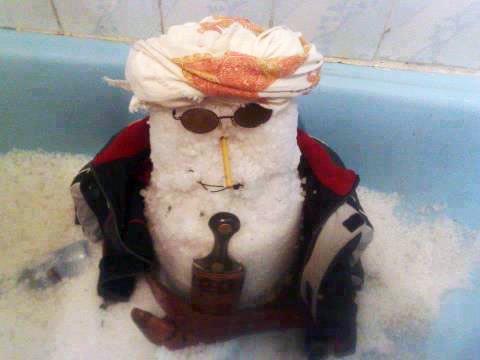
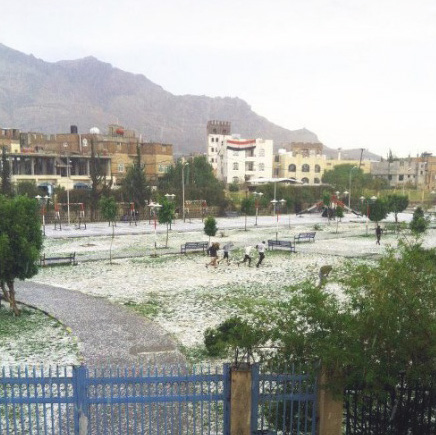
The recent hail storm in Sanaa took a cold turn. Here is Frosty the Yemeni Snowman in his Friday best. But just because he will so easily melt away into the crowd, don’t assume he is a terrorist. No more drones, please…

The photographs here were taken of camels and people in Libya around 1957 by Dr. Virgil Clift.


After a hail storm in Sanaa; photograph courtesy of Dr. Muhammad Gerhoum
The economic and political situation in Yemen these days is anything but heavenly, but then yesterday in a different kind of climate all hail broke loose.

by Timothy P. Daniels, The Islamic Monthly, April 22
In the aftermath of a week of mainstream media coverage and elite political figure’s statements related to the Boston Marathon bombing, the ongoing processes of pathologizing Islam and its significance for Pax Americana are made evident. Initial questions about whether this bombing was the work of domestic or foreign terrorists or the work of “lone†wolves quickly turned to claims about Arab individuals, international students, and dark-skinned men with foreign accents as “persons-of-interest†and “suspects.†The specter of dangerous foreign “others†in Boston overshadowed the likely homegrown white-supremacist-Christian terrorism lying behind the eerie fertilizer factory explosion in Waco, Texas close to the 20th anniversary of the FBI massacre of the Branch Davidian “cult.†Fourteen dead, scores injured, and an entire town left demolished; however this devastating event was hurriedly pushed out of the news cycle and political rhetoric without any answers for why this blast occurred. The irrationality of this differential response became even more apparent after the FBI released and posted pictures of two suspected bombers and the subsequent massive military mobilization of forces and technologies to corner, capture, and kill these young men. As their identities as Muslim Chechens became known, the media began to speculate about their links to international terrorism and their presumed religious motives. Continue reading Pathologizing Islam and Pax Americana

Above and below are two scenes in Tripoli, Libya from the 1950s, when it was still a kingdom. Both are from Christmas and New Years greeting cards with the greeting in English.
Photo by Jenah in Tripoli; printed in Italy
Sleeping With the Enemy? Review of “”Would You Have Sex With an Arab?
By Clara Abdulaziz,http://ta3beer.blogspot.com, April, 19
“One in five Israelis is an Arab, but it is difficult to find places where they touch fingertips.â€
In her latest feature-length documentary, French filmmaker Yolande Zauberman ventures out into the nightlife of Tel Aviv and asks the people she meets a deceptively simple question: “Would you have sex with an Arab?†It is clear that sex serves merely as a proxy to grapple with a much larger question: can individuals transcend identities rooted in long histories of conflict, or is identity so rigidly constructed that it in fact defines one’s humanity?
Zauberman has said that she produced the film to “give space for awareness.†It is meant to be “a little bit sexy, a little bit funny.â€
It is also, quite frankly, pretty depressing.
Zauberman’s choice of Tel Aviv for her film was not arbitrary. It is famous for its non-stop club scene, and is one of the most LGBT and queer-friendly cities in the world. She shows that even here, where most young residents seem more concerned with partying than religion and politics, the boundaries of Jewish and Arab identity remain stubbornly situated within the larger Arab-Israeli conflict. Continue reading Would You Have Sex With an Arab?