All posts by tabsir

Bedtime for Bibi

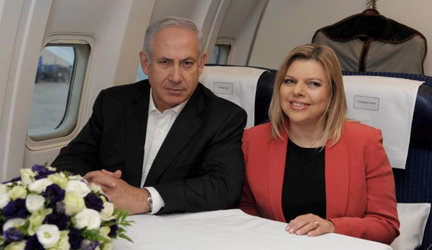
Austerity and sequestration are the dismal economic buzzwords of the day. While thousands of airline passengers in the United States waited for late flights due to a lack of air traffic controllers, and while tens of thousands of Israelis protested the latest cutbacks, Prime Minister Benjamin Netanyahu of Israel had his own solution. He flew to the funeral of Margaret Thatcher last month in a specially fitted plane. There are obvious perks to being a leader, especially a sleepy one. So why not rent a retrofitted El Al superliner to take 75 guests to London for a mere $427,000 from the national treasury. It was not the latest in security secrets that upped the price, but rather a newly installed rest cabin in which a $127,000 bed was installed for his wife and himself for a five hour trip. I am not sure if Bibi has ever watched the Lialda ad that warns a man to consult his physician if he experiences an erection lasting over four hours. No doubt some Israelis feel as though Israel has suffered enough from electoral dysfunction throughout his tenure.

The Killing of Abdulrahman al-Awlaki


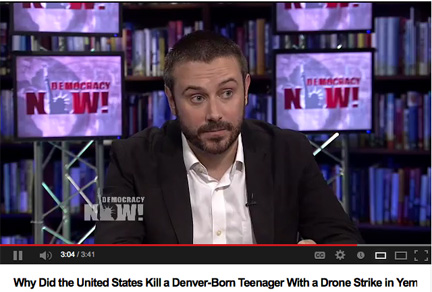
For a brief introduction to a report on the killing of the 16-year old son of Anwar al-Awlaki, check out this brief Youtube video. Here are the details on the video:

Watch the full 50-minute interview with Jeremy Scahill at http://owl.li/klnWN. Abdulrahman al-Awlaki was a 16-year-old boy, born in Colorado, who liked listening to hip-hop and posed as a rapper in pictures posted on Facebook. He was killed by a U.S. drone strike in Yemen two weeks after the Obama administration assassinated his father, the U.S. citizen Anwar al-Awlaki, in a separate strike. Abdulrahman’s death is a central part of Jeremy Scahill’s new book, “Dirty Wars: The World Is A Battlefield.” While the Obama administration has defended the killing of Anwar, it has never publicly explained why his son was targeted. Scahill reveals CIA Director John Brennan, Obama’s former senior adviser on counterterrorism and homeland security, suspected that the teenager had been killed “intentionally.” “I understand from a former senior official of the administration who worked on this program at the time, that when it became clear that Abdulrahman al-Awlaki had been killed, that President Obama was furious, and that John Brennan, who at the time was … the guy running all of these operations, that Brennan believed or suspected that it was an intentional hit … against this 16-year-old kid,” Scahill says.

Democracy Now!, is an independent global news hour that airs weekdays on 1,100+ TV and radio stations Monday through Friday. Check out our vast news archive and stream live 8-9am ET at http://www.democracynow.org.

Drone Policy in Yemen

For anyone in the NYC region, I will be giving a talk at the COLUMBIA UNIVERSITY SEMINAR on KNOWLEDGE, TECHNOLOGY, and SOCIAL SYSTEMS on Wednesday, May 15, 7 pm (at Columbia University’s Faculty House). The title of the talk is: “Drone Strikes in the War on Terror: The Case of Post-Arab-Spring Yemen.” Unmanned drones have been used by the US military against terrorism in many areas of the world. In particular, these drones have become the US military’s weapon of choice in targeting terrorists in Yemen, where strikes quadrupled in 2012 from the previous year. This talk addresses the impact of these strikes on the political context within Yemen and the effectiveness of the strategy in combating Al Qaeda recruitment. The talk builds on a commentary published in the Middle East Muddle blog of the Anthropology News website.

For information on the talk, please contact me directly by email at daniel.m.varisco@hofstra.edu.

Qat, Cosmopolitanism, and Modernity in Sanaa, Yemen

Webshaykh’s Note: An article entitled “Qat, Cosmopolitanism, and Modernity in Sana’a, Yemen” has been written by Irene van Oorschot, and published inArabian Humanities, Vol. 1, 2013. Her ethnographic study focuses on urban women in Sanaa. I attach here the beginning paragraphs, but urge readers to read the full article on Arabian Humanities, a new journal dealing with Yemen and the Arabian Peninsula.

The prevalence of qat consumption in Yemen strikes even the most casual of observers. Adolescent and adult men can be seen chewing in shops, taxis, and on the streets, while the many qat vendors in the streets and squares of Sana’a contribute —in the eyes of many tourists— to its quaint charm. While women do not usually chew qat in public places, married women chew qat in the privacy of their own or their female relatives’ houses. Chewing qat is however held to be shameful for unmarried women, a notion which is sometimes explained with reference to the alleged effects qat has on people’s libido. As a (sexual) stimulant, qat has no place in unmarried women’s lives. After all, they are not supposed to have premarital relationships, and as such are “not supposed to chew”. However, among unmarried women of the educated and urban elites, qat chewing is an popular way to spend one’s spare time:

“It is just a way to relax, to unwind, to be away from work, and to be with my friends,” Wafā’, an unmarried woman, told me. “My married sister chews qat, too, and she is even younger [than I am]! So why should I not get to chew qat and relax?” Continue reading Qat, Cosmopolitanism, and Modernity in Sanaa, Yemen

Harun’s Harem Prime Time


From left, the women of Turkey’s Building Bridges: Ebru, Ece, Aysegul (who occasionally joins the four hosts on their show), Aylin, and Ceylan; Courtesy of A9 TV

[Webshaykh’s Note: I previously posted a blog commentary on the media beauties of Harun Yahya. A recent article in Slate is on the same group, and I post the start of the article below.]

The Versace Harem
A group of Muslim women with tight shirts, bright lipstick, a feminist mission, and total devotion to a creationist guru.

By Jenna Krajeski. Slate, Thursday, May 2, 2013

I first agreed to meet Ece, Ceylan, Aylin, and Ebru because I didn’t really believe they existed. They host the Turkish talk show Building Bridges and had recently gotten some attention, but not for the interviews. The women look astonishing. They are mostly bottle blonds, save for Ece, who has raven hair. Neon lipstick gives their lips a whole extra dimension. They coordinate outfits. At one of our meetings, they wore brightly colored satin pantsuits and T-shirts with designer brand names that stretched over their chests. What they talk about on Building Bridges—interfaith dialogue, women and Islam, the greatness of Turkey—isn’t particularly sexy, but their outfits are designed to make up for that. They are also devout Muslims—conservative, even—a supposed contradiction that is also the show’s allure.

Guests often appear—usually by Skype—with their eyebrows arched in the manner of a serious person certain he is the victim of a practical joke. But they proceed. The women sweetly dare the guests to suggest the hosts are anything but what they claim to be—activists, political commentators, Muslims—because of how they dress. During one interview, which I observed in the studio, Ceylan right away asked a German diplomat if a “true religious education” could “combat bigotry.” Continue reading Harun’s Harem Prime Time

The Morsi Blues

Egypt’s Economy, the Muslim Brotherhood & the U.S.

by Rachel Ehrenfeld and Ken Jensen, American Center for Democracy, May 2

Under Muslim Brother Morsi’s inept economic team more than 4,500 factories have shut down. Egypt’s unemployment rate in the fourth quarter of 2012, have reached 13%, most of which, (77.5%) is among the 15-24 years old. Inflation has climbed much above the official 7.5% (March 2013), and foreign currency reserves declined to US $ 13,424 billion. The country spends about $14.5 billion subsidizing fuel and $4 billion subsidizing food each year. Nearly half of Egypt’s 90 million people live at or below the poverty line of $2 per day. The Egyptian Centre for Economic and Social Rights (ECESR), reports of “3,817 labor strikes and economically motivated social protests” following Morsi’s election, and more than 2,400 “between January and March” 2013.

Campuses all over the country are rocked by violent demonstrations, and “it’s getting worse by the day,” a student is quoted saying by Al-Hayat. Bloody clashes between students affiliated with Brotherhood and independent and opposition groups have been reported in Cairo’s Ain Shams University, and ongoing demonstrations in Al-Azhar University have gotten more violent after tainted food made dozen of students ill. Continue reading The Morsi Blues