All posts by tabsir

Muslim Journeys

The National Endowment for the Humanities has a fantastic website on Islam with a variety of resources, especially valuable for teaching about Islam, but also just for browsing. The outreach part of the project is “The Muslim Journeys Bookshelf,” a collection of 25 books and 3 films, noted as “a collection of resources carefully curated to present to the American public new and diverse perspectives on the people, places, histories, beliefs, practices, and cultures of Muslims in the United States and around the world.” American libraries can apply for receipt of this collection. Available on the site are images, samples from texts, audio recordings and short film clips, web links and a bibliography.This website is worth spending a few hours on and coming back to; it is precisely what a virtual museum should be.

Here is a sample text excerpt to whet your appetite. This is from al-Jahiz, who died in 869 CE, on “The Disadvantages of Parchment”
Continue reading Muslim Journeys

On the Jews of Yemen


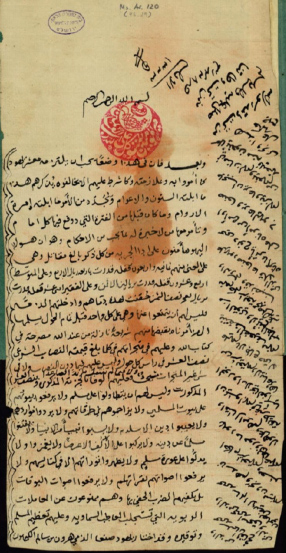
Imam Yahya’s “Niẓām al-YuhÅ«d,” ms.ar.120 from the National Library of Israel

There is a new study out on the statute on Yemeni Jews by Imam Yahya in 1323/1905 by the historian Kerstin Hünefeld. This is published in Chroniques du manuscrits au Yémen, in the July 2013 issue, which is available in download as a pdf. Hünefeld provides both an edition and an annotated translation.

Picturing the ka‘ba


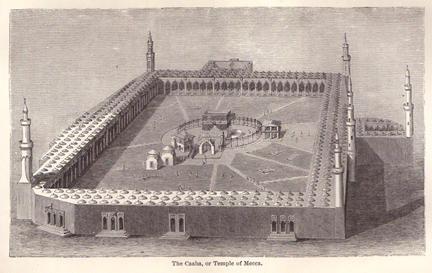
Although few Western non-Muslim travelers penetrated the forbidden zone of the ka‘ba in Mecca, illustrations proliferated by the mid-18th century. The image above was taken from the 1857 edition of Sale’s translation of the Qur’an (London: W. Tegg & Co) and reproduced in Henry J. Van-Lennep’s Bible Lands: Their Modern Customs and Manners Illustrative of Scripture (New York: Harper & Brothers, 1875). The two most famous travelers to make surreptitious trips to Mecca were Johann Ludwig Burckhardt in 1814 and Richard Burton in 1853.

Street Art in Sanaa


Pasted photography on wall, Sana’a 2012; photograph by Jameel Subay

From Street Politics to Street Art in Yemen
By Anahi Alviso-Marino, Nafas Art Magazine, July 2013

In January 2011, demonstrations inspired by the contentious mobilizations taking place in Tunisia and Egypt started to be carried out in Yemen. Gradually, anti-governmental demonstrators came to modify old repertoires of contention, such as the demonstration or the sit-in, into what became a permanent camp and a new space of contention in Sana’a named “Change Square.” Among the self-proclaimed “revolutionary youth” of a sit-in that lasted until April 2013 were a number of visual artists. Their presence in the Square contributed in giving political demands an artistic expression, alongside using artistic practices as a means of contention. Contributing to the symbolic aspects of this mobilization, artistic practices developed inside and outside the tents. As a continuation of street politics acquired in the Square, certain visual artists incorporated dissent, transgression, and civil disobedience in their artistic practices. Among such cases, street art techniques such as graffiti, free writing, mural painting or stenciling participated throughout 2011 in reproducing political slogans that aimed to overthrow Ali Abd Allah Saleh’s regime.

In 2012 this contentious street art underwent certain changes. Continue reading Street Art in Sanaa