All posts by tabsir

Tabsir Redux: An Unprofitable Prophet from Maghrebinia

[In 1953 Gregor von Rezzori published a fictional satire of an anonymous East European/Near Eastern land he called Maghrebinia. Here is an excerpt that is still poignant today…]

“I am about to report on the great and glorious country Maghrebinia. You won’t find it on a map, it isn’t in any atlas or on any globe. There are people who say it lies in southeast Europe, others like to think it is southeast Europe, but, for heaven’s sake, what is southeast Europe? … Of course pedantic people might make an effort to define the borders of Maghrebinia geographically and vaguely, but just these pedants would get it all wrong. For Maghrebinia’s true borders lie in the hearts and souls of its people, and pedants don’t know the first thing about the hearts and souls of people…”

“Maghrebinia is beautiful. Continue reading Tabsir Redux: An Unprofitable Prophet from Maghrebinia

In the steps of Ibn Battuta


Mackintosh-Smith in China

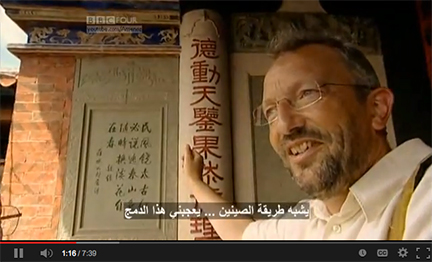
One of the most celebrated Arab travelers was the 14th century Ibn Battuta. For a book on the travels of Ibn Battuta, Timothy Mackintosh-Smith literally followed in the footsteps that the Arab savant had taken some seven centuries earlier. In addition to the book, a documentary film was made. An excerpt of the film on Tim’s experience int he Chinese city of Zaytun is available on Youtube and well worth watching. Other Youtube excerpts are on an Ibn Battuta shopping mall in Dubai and on Turkey. Vimeo provides access to the entire first part of the three-part series. For more information on the work of Mackintosh-Smith, check out his website. An earlier documentary on the English Sheikh and the Arab Gentleman by Bader Ben Hirsi is available in its entirely on Youtube.

Moroccan Photography Museum


اما المراكشي داود ولد سيد، المتأثر بالمصورين هنري كارتييه بريسو وروبرت فرانك وريتشارد افيدون، فقد تخصص بتصوير الرحلات المنفردة التي قام بها في ارجاء المغرب. في هذه الصورة، ينقل رجل جهاز تلفاز في الرباط.

The Arabic BBC website has presented several photographs for a proposed Moroccan Photography Museum in Marrakesh. Here are two of the photographs.


حسن حجاج الذي ولد في المغرب عام 1961 غادر بلاده الى لندن في سن مبكرة. تجمع اعمال حجاج العناصر المرئية لفن تصوير الازياء المعاصر مع فن البوب.

The Boon in Yemen’s Bun


Men smoke shisha water pipes in a cafe in Sanaa, Oct. 1, 2011. (photo by REUTERS/Ahmed Jadallah)

Yemen’s Modern Coffee Shops: Progressive, Yet Exclusive
by Farea al-Muslimi, Al-Monitor, September 5 2013

SANAA, Yemen — Over the past few decades, Yemen has been known to conjure images of serious conservatism, isolation between men and women and male dominance over issues pertaining to daily life.

However, things look different here: A group of boys, girls, men and women are having discussions in modern coffee shops, which have become popular in the past 10 years and have significantly become more common across Sanaa in the past few years, including the historical part of the old city. The coffee shops, however, are more concentrated in the southwest of the city, where the richest and most open neighborhood, al-Siyasi Hadda, is located. They have become posh meeting spots for the privileged classes that can afford it.

There are coffee shops with foreign names that largely resemble any coffee shop in Amman, Cairo or Beirut, but the difference here is that the stone buildings are more elegant and posh.

Waitresses — hailing from Ethiopia and East Asia, alongside a few Yemenis — wear uniforms and serve you with a gentle smile that you cannot find elsewhere in the city. In fact, you usually cannot so much as look at a woman’s body, even if she were covered from head to toe. One can typically see little more than the standard black abaya, or a niqab for the more conservative.

You can order hot or cold beverages and Western snacks, the names of which are unknown to many people. Moreover, you can spot the most modern and cleanest coffee shops if you do not smoke shisha [sweetened tobacco smoked with a water pipe]. Some coffee shops offer it for high prices, while others do not find it suitable to be served in their establishment. Continue reading The Boon in Yemen’s Bun