All posts by tabsir

Tabsir Redux: When the Fat Lady Sings

For those fortunate enough to own a MAC computer there is the digital blessing of ITunes. One of the stations listed under “Eclectic” is “The 1920’s Radio Network” which features jazz and vaudeville songs from the 20s through the 40s. Every once in awhile along comes one of those “Oriental” tunes, usually riding stereotypes into the desert on a sand-blasted camel of Araby. One I recently heard manages to offend both Egyptians and obese women (not to mention any serious poet). This is Egyptian Ella, not to be confused with Ella Fitzgerald, who did not debut until four years after this tune was written by Walter Doyle and popularized by Ted Weems and his orchestra.

Egyptian Ella

by Walter Doyle

Ella was a dancing girl who started getting fat
Every day saw three more pounds on Ella
Until one day she found she’d lost her job because of that
And to make it worse, she’d lost her fella
She took a trip to Egypt to forget
And she made such a hit that she’s there yet … Continue reading Tabsir Redux: When the Fat Lady Sings →

Pass the Pistacios

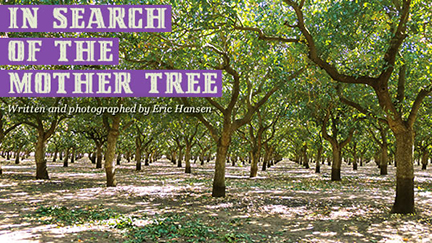
In the current issue of ARAMCO World, which is available free online, there is an interesting article on how Iranian pistacios came to California. Click here for the full article. I attach a teaser below…

In 1957, a small experimental orchard in Chico, California distributed to commercial nut-growers a promising new variety of pistachio tree from Iran, called Kerman.

The United States Department of Agriculture wanted to see how these Kerman trees might perform in the richly fertile Central Valley of California.

By 2013, the Kerman had created a billion-dollar agricultural industry, and what was once a delicacy was a long way toward becoming a common household snack. University of California pistachio specialist Louise Ferguson calls the California Kerman pistachio tree “the single most successful plant introduction of the 20th century.”

Wellcome Library Arabic Manuscripts Online


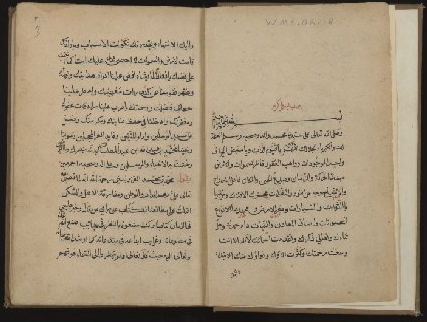
عجايب المخلوقات وغرايب المخلوقات الموجودات

The Arabic manuscripts collection of the Wellcome Library (London) comprises around 1000 manuscript books and fragments relating to the history of medicine. For the first time this website enables a substantial proportion of this collection to be consulted online via high-quality digital images of entire manuscripts and associated rich metadata.

This has been made possible by a pioneering partnership between the Bibliotheca Alexandrina, the Wellcome Library, and King’s College London, with funding from the JISC Islamic studies programme.

These manuscripts are part of the Wellcome Library’s Asian Collection, which comprises some 12,000 manuscripts and 4,000 printed books in 43 different languages. The Islamic holdings include Arabic and Persian manuscripts and printed books, and a small collection of Ottoman manuscripts and Turkish books. The core of these collections relates to the great heritage of classical medicine, preserved, enlarged and commentated on throughout the Islamic world, stretching from Southern Spain to South and South-east Asia.

Picturing Syria

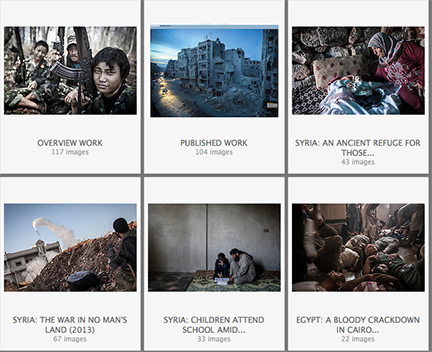
The photographer Narcisso Contreras has an extraordinary gallery of photographs taken in Syria and Egypt on his website.

His biography, as taken from his website, is as follows:

Narciso Contreras is a photographer born in Mexico City, fond of exploring each encounter to precisely capture its most poignant moments. His work focuses in feature stories, reportage and documentary based on religious communities, human nature and conflicts, the later being his main focus for the past years. Contreras has studied Philosophy and Photography, conducting research for many years and dedicating himself to photography professionally for three. Contreras is currently covering the ongoing civil war in Syria. His work has been published in newspapers and magazines all over the world, among others in TIME, the Guardian, the Times, the New York Times, der Spiegel, National Geographic, the Telegraph, the Washington Post, Newsweek, Wall Street Journal, L’ Espresso among others.

Emirati Ennui

Perhaps it is boring to be rich, especially for the super rich in a traditional cultural setting. Take the Emirates, for example, with the ultra modern business hub of Dubai and the fabulous new buildings that oil money funds in Abu Dhabi. The Emirates is an unusual oasis in the heartland of the Islamic faith. What makes it unusual is that some 88% of the population here is foreign. So it is not surprising that there should be a murmur of culture clash under the glitz. So when Western pop stars like Snoop Dog, Jay Z, Justin Bieber and Rihanna role into one of the Emirates, you can expect some culture clash talk. Al Jazeera reports that several recent Western superstars have raised eyebrows by their language and behavior. Did the organizers really think that Jay Z would forget how to swear or call women by demeaning terms? This is his bread and butter.

There is a famous biblical saying that Jesus once said it is easier for a camel to go through the eye of a needle than for a rich man to enter heaven. Jesus, theologians tell us, was referring to a narrow gate in Jerusalem that made it very hard for camels to enter, but the sentiment is apt. Abraham, Moses, Jesus and Muhammad are respected prophets, but none of them squandered riches or lived in opulence or built huge pyramids. This is not just a problem for Muslims, but for all the major monotheisms which preach about helping the poor. Islam is exemplary in this regard with its principle of sadaqa, but Judaism and Christianity also stress helping the unfortunate. For that matter, even concerned atheists care about their fellow humans. But there is something about wealth (the love of money being the root of all evil) that strains religious behavior. Jay Z and Snoop Dog went to the Emirates, where the money flows, not Yemen, though I suspect young Yemenis have heard them as well in the global pop music market.

My point is not to disparage pop music, nor to defend those who would place a Muslim in a 7th century cultural bubble, but simply to note that defining one’s personal faith is not made easier in a context of vast wealth. Even a cursory reading of the Arabian Nights shows that this is not a modern problem. But if you invite Jay Z, don’t expect a sermon.

Ramziyya Abbas al-Iryani

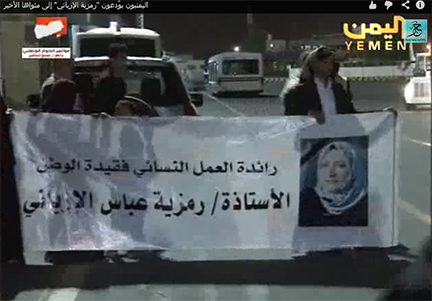
The Yemeni literary figure Ramziyya Abbas al-Iryani, who recently passed away, is given tribute in this video with recollections by her students and other Yemenis who knew and respected her.

اليمنيون يوّدعون “رمزية الإرياني” إلى مثواها الأخير السبت, 16-نوفمبر-2013 صنعاء Ù€ خبر للأنباء: – استقبلت جموع اليمنيين، مساء السبت، جثمان فقيدة الوطن رمزية عباس الارياني – عضو اللجنة العامة للمؤتمر الشعبي العام.. رئيسة اتحاد نساء اليمن، الذي وصل مطار صنعاء، على متن طائرة تابعة للخطوط الجوية اليمنية قادماً من جمهورية ألمانيا الاتحادية. ويودع جموع اليمنيين، وفي مقدمتهم قيادات وكوادر المؤتمر الشعبي العام والفعاليات الوطنية الرسمية والحزبية ومنظمات المجتمع المدني والجموع الشعبية، غداً “الأحد” الجثمان الطاهر للفقيدة، إلى مثواه الأخير بمقبرة الرحمة ظهر الأحد بالعاصمة صنعاء بعد الصلاة عليه بجامع التوحيد. وخسرت اليمن واحدةً من أعظم قياداتها النسائية البارزة، حيث وافاها الأجل في احد مستشفيات العاصمة الألمانية برلين إثر إصابتها بجلطة دماغية. وكانت الفقيدة — رحمها الله — من أبرز أعلام النضال الوطني ولها حضورها المتميز في كافة المجالات وفي مقدمتها الدفاع عن حقوق المرأة اليمنية. وقد نعت رئاسة الجمهورية، وقيادة المؤتمر الشعبي العام، ومؤتمر الحوار الوطني، والوزارات، والأحزاب والمنظمات السياسية والمجتمعية، ومنظمات حقوق الإنسان، الفقيدة الراحلة. وعبرت البرقيات عن تعازيها الحارة للأسرة الكريمة، سائلة المولى العلي القدير، أن يتغمدها بواسع رحمته، ويلهم أهلها وكل محبيها الصبر والسلوان. إنا لها وإنا إليه راجعون

Hailing Hellfires


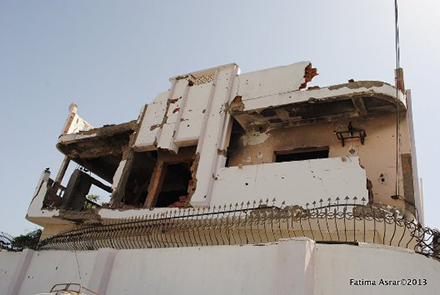
A destroyed building as a result of fighting between AQAP and the Yemeni government in 2012, taken in June 2013. (Photo: Fatima Abo Alasrar)

by Fatima Abo Alasrar, Atlantic Council, October 30, 2013

Apart from the Yemeni National Dialogue Conference that has been generating good news in the press, the country is on a rapidly deteriorating course toward uncertainty. On October 18, al-Qaeda in the Arabian Peninsula (AQAP) launched a suicide attack targeting a military installation in al-Ahwar district of Abyan governorate which killed twelve soldiers and left several others wounded. This was the same governorate that fell under control of the terrorist group of Ansar al-Sharia during the Arab Spring uprising in 2011. Despite the liberation of Abyan from the terrorist occupation, the group still conducts terrorist acts, through planting land mines in schools, kidnapping aid workers, in addition to their usual suicide tactics against military installations and local popular committees that guard the city.

The danger of AQAP in Yemen is real, but so are the drone attacks which intensified during the Obama administration. The weapon meant to target terrorists caused great harm to Yemen in a number of ways. Human Rights Watch issued a report on October 22 highlighting the devastating effects of air strikes. The report examined six drone strikes since 2009. Although the number of investigated cases is not a representative quantitive sample on the drone strikes in Yemen (various sources document an estimated eighty-two to ninety-two drones attacks during this period), the qualitative sample made one important point abundantly clear: no matter how precise the drones, they still generate civilian casualties, destruction, fear, trauma, motherless children, loss of income, and increasing rage towards the United States. Continue reading Hailing Hellfires →