All posts by tabsir

Schisto in Mesopotamia


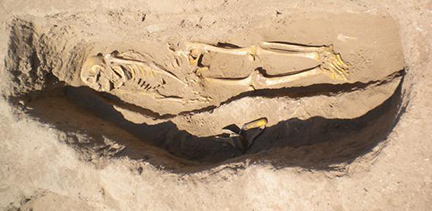
Chalcolithic burial at Zeidan; Credit: Gil Stein, Oriental Institute, University of Chicago


6200-year-old parasite egg may be first proof of early human technology spreading disease

Cambridge Research

Latest research shows that schistosomiasis, a disease caused by flatworm parasites, may have been spread by earliest crop irrigation in ancient Mesopotamia, suggesting early technology exacerbated disease burden.

The discovery of a schistosomiasis parasite egg in a 6200-year-old grave at a prehistoric town by the Euphrates river in Syria may be the first evidence that agricultural irrigation systems in the Middle East contributed to disease burden, according to new research published in Lancet Infectious Diseases.

Schistosomiasis is a disease caused by several species of flatworm parasites that live in the blood vessels of the bladder and intestines.

Infection can result in anaemia, kidney failure, and bladder cancer. This research shows it may have been spread by the introduction of crop irrigation in ancient Mesopotamia, the region along the Tigris-Euphrates river system that covers parts of modern-day Iraq, Iran, Kuwait, Syria, and Turkey. Continue reading Schisto in Mesopotamia

On The Moral Hazards of Field Research in Middle East Politics

By Sheila Carapico, Middle East Research and Information Project, July 14

* This memo was prepared as part of the “Ethics and Research in the Middle East” symposium

American political scientists studying the Middle East face ethical dilemmas not shared by most of our disciplinary colleagues. Sometimes – perhaps unexpectedly – our presence in countries or communities experiencing repression and/or political violence puts our local colleagues, hosts, or contacts at risk by association. The massive U.S. military footprint and widespread mistrust of U.S. policies and motives multiplies the risks to our interlocutors.

The trademark methodology of American Arabists is fieldwork, meaning, in political science, in-depth interviews, participant observation, data collection, document-gathering, opinion polling, political mapping, and recording events. As sojourners but not permanent residents, we rely heavily on the wisdom, networks, and goodwill of counterparts “on the ground,” particularly other intellectuals.

In any environment where agencies of national, neighboring, and U.S. governments are all known to be gathering intelligence, our research projects may look and sound like old-fashioned espionage. Even under the very best of circumstances (which are rather scarce) a lot of people are wary or suspicious of all Americans, including or sometimes especially Arabic speakers who ask a lot of questions and take notes. Immediate acquaintances probably grasp and trust our inquiries. Their neighbors or nearby security personnel may not. It is common knowledge that at least some spies and spooks come in academic disguise and that some U.S.-based scholars sell their expertise to the CIA or the Pentagon. Instead of treating whispered gossip as the product of mere paranoia or conspiracy theories, we need to recognize its objective and sociological underpinnings. Continue reading On The Moral Hazards of Field Research in Middle East Politics

Sikh and ye shall find “Siran”

Misapprehending Muslims and the Media’s Misinformation

by Hasan Azad, Huffington Post. November 17, 2012

My friend Sim is a strapping young man in his 20s. He is fitter than I could ever dream of becoming. Sim has run in the New York marathon for two years in a row, and hopes to run in many more to come. When you meet Sim you’re immediately struck by the warmth of his smile. Opinions are unanimous, Sim has a heart of gold — and the good looks to go with it!

Sim was recently flying back to New York from visiting with his parents in Texas, when the chipper middle-aged Texan lady sitting next to him asked in the most disarmingly matter-of-fact manner that only Texans are capable of, “You’re not a Muslim are you?” A question possibly prompted by Sim’s full-length beard and turban. When he responded, “No, I’m Sikh,” the woman was visibly relieved, so much so she hugged Sim (short for Simran, in case you’re wondering), adding “I’m so glad you’re not a Muslim. They want to take over America with ‘Siran’!” Simran, being the gentleman that he is, smiled politely, but later revealed to me that he had no idea how to respond to the exchange. And it’s true, it wasn’t a “simple” exchange that had occurred, which could or should be explained away as another example (and aren’t there so many?) of unwitting Texan folk who can’t tell the difference between a Sikh and a Muslim. Continue reading Sikh and ye shall find “Siran”

Fouad Ajami and his legacy


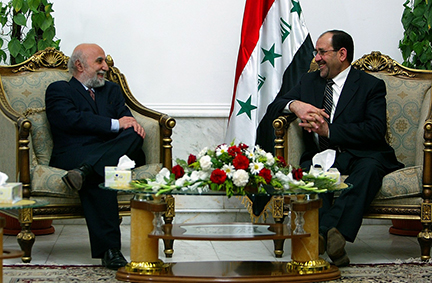
Fouad Ajami, left, met in 2007 with Iraqi Prime Minister Nouri al-Maliki in Baghdad’s Green Zone. (Wathiq Khuzaie/AP)


By As’ad AbuKhalil – Alakhbar English, June 23, 2014

The news of Ajami’s death triggered a competition among American journalists: they all wanted to express how much they loved him and admired him. They all spoke about his “grace” and one Zionist publication called him the “genuine Arab hero.” The New York Times and Wall Street Journal were quick to publish glowing obituaries.

Fouad Ajami is not the only Arab Zionist (and I am using the word Zionist here as a description and not as an insult, which it is for all of us anti-Zionists who measure the ideology by its devastating impact on the lives of Palestinians and Arabs and by its blatantly racist discourse) but he may have been the first Arab Zionist to advocate publicly for his Zionism. Ajami’s career is a political career and not an academic one.

Academic careers in the top US universities are specifically and rigidly structured and designed: those who are not graduates of the “elite US universities” don’t even get short-listed for jobs. Yet, Fouad Ajami went to school at Eastern Oregon College and received his PhD at the University of Washington, Seattle. It is certain that he is the only graduate of the University of Washington, Seattle who got an offer from Harvard University (he turned it down). When Martin Peretz and other Zionists at Harvard were lobbying for the university to hire Ajami, he demurred. He set his own conditions: that he did not want to teach undergraduates. They explained to him that all faculty at Harvard teach undergraduates. Continue reading Fouad Ajami and his legacy

Irhabis against the World Cup

By James M. Dorsey, The Turbulent World of Middle East Soccer, June 22

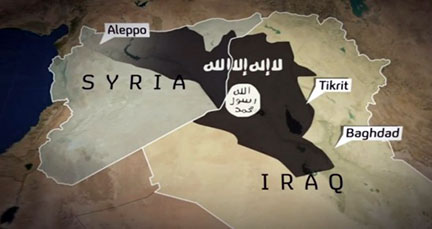
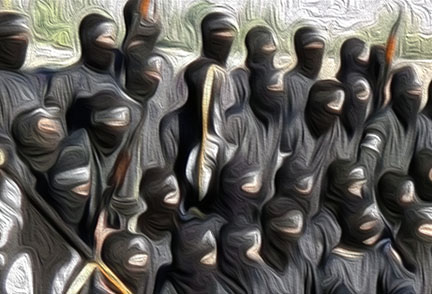
It’s not just soccer fans whose football fever soars during a World Cup. So does that of militant Islamists and jihadists with deadly consequences. Scores of fans have been killed since this month’s kick-off of the Cup in attacks in Iraq, Kenya and Nigeria.

The attacks by the likes of the Islamic state in Iraq and Syria (ISIS), Al Shabab in Somalia and Boko Haram appear to have become a World Cup fixture with similar random slaughter having occurred during the 2010 tournament in South Africa.

They reflect the diversity of opinion among jihadists on the merits of soccer as well as a degree of opportunism among all jihadists, irrespective of their attitude towards the beautiful game, in exploiting its popularity whether by seeking to maximise publicity by targeting fans during the tournament or using it as a recruitment tool.

The attacks occurred against the backdrop of a series of statements and fatwas, religious opinions, by militant clerics, often Salafis who seek to emulate to the degree possible 7th century life at the time of the Prophet Mohammed and his immediate successors who are not jihadists, condemning soccer as an infidel game that is intended to divert the faithful from their religious obligations or create divisiveness. Continue reading Irhabis against the World Cup

Zamzam Flim Flam

The sacred sites of Mecca have a long and rich history in Islamic tradition. One of the most important aspects is the well of Zamzam located close to the ka‘ba in the Meccan shrine. According to tradition this well flowed out miraculously when Ibrahim’s son Ismail was thirsty and scraped his feet on the ground. The well was later rediscovered by the Prophet Muhammad’s grandfather, Abd al-Mutallib. For centuries the well of Zamzam has provided the water for Muslim pilgrims to the site. Regardless of what one thinks about legendary attribution, Zamzam water has been a great marketing tool over the years. On Amazon you can even buy water allegedly bottled at the well in Saudi Arabia, only a mere $15 for 500 ml. In Germany you can buy the same amount for only 3.5 Euros, even though it appears that Saudi Arabia bans the export of Zamzam water.

Then there is the Burj Zamzam Clock, a virtual ibn Big Ben towering over the ka‘ba and shielding a shopping mall and luxurious hotel. Such selling of holy sites has a long history as virtually every inch of Palestine can be linked to some biblical event. But by turning a sacred site into a tourist attraction, does not Zamzam become the victim of flim flam?