All posts by tabsir

Saving Syria’s Antiquities

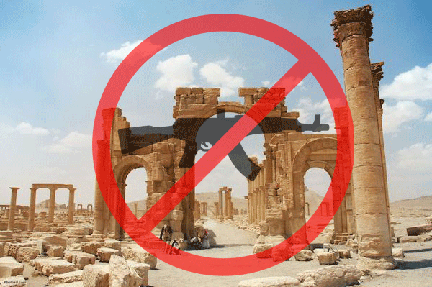
The turmoil and ruthless slaughter that is destroying both lives and heritage in Syria has multiple consequences. Beyond the humanitarian crisis, which is huge, there is widespread looting of antiquities in a country where there is a valuable heritage. Dr. Amr Al-Azm has started a campaign to save these antiquities. Details below. Click here to sign the petition to the UN.

Treasures from our museums and ancient cities in Syria are being looted and destroyed, falling victim to the war’s blind aggression. My former archeology students are working diligently and risking their lives to protect our country’s cultural heritage.

It’s important that our heritage is preserved, not only for its intrinsic beauty and historical value, but also because it helps us reconstruct Syrian identity. Now, the market for stolen artefacts is in the millions, but one important thing can make a difference.

The UN must ban the trade in Syrian artefacts.

So far they have ignored numerous calls to push through a resolution as they did in the past to protect Iraq’s heritage, but there’s something much larger at stake now that should get them to act. Looting Syria’s history is big business and the extremist group known as ISIS have added millions of dollars to their war chest because of it.

Syrians are now not only watching their history being torn down and sold to foreign buyers, but they’re having that money turned against them in the form of more weapons.

— Dr. Amr Al-Azm

Associate Professor of Middle East History, Shawnee University
Professor at the University of Damascus (1998-2006)
Director of Science and Conservation Laboratories at the General Department of Antiquities and Museums in Syria (1999-2004)
On The Moral Hazards of Field Research in Middle East Politics

By Sheila Carapico, Middle East Research and Information Project, July 1, 2014

* This memo was prepared as part of the “Ethics and Research in the Middle East” symposium

American political scientists studying the Middle East face ethical dilemmas not shared by most of our disciplinary colleagues. Sometimes – perhaps unexpectedly – our presence in countries or communities experiencing repression and/or political violence puts our local colleagues, hosts, or contacts at risk by association. The massive U.S. military footprint and widespread mistrust of U.S. policies and motives multiplies the risks to our interlocutors.

The trademark methodology of American Arabists is fieldwork, meaning, in political science, in-depth interviews, participant observation, data collection, document-gathering, opinion polling, political mapping, and recording events. As sojourners but not permanent residents, we rely heavily on the wisdom, networks, and goodwill of counterparts “on the ground,” particularly other intellectuals.

In any environment where agencies of national, neighboring, and U.S. governments are all known to be gathering intelligence, our research projects may look and sound like old-fashioned espionage. Even under the very best of circumstances (which are rather scarce) a lot of people are wary or suspicious of all Americans, including or sometimes especially Arabic speakers who ask a lot of questions and take notes. Immediate acquaintances probably grasp and trust our inquiries. Their neighbors or nearby security personnel may not. It is common knowledge that at least some spies and spooks come in academic disguise and that some U.S.-based scholars sell their expertise to the CIA or the Pentagon. Instead of treating whispered gossip as the product of mere paranoia or conspiracy theories, we need to recognize its objective and sociological underpinnings. Continue reading On The Moral Hazards of Field Research in Middle East Politics →

Who will have the last laugh?


Turkish women defy deputy PM with laughter

Bülent Arinç said women should not laugh in public, prompting backlash and highlighting state of women’s rights in Turkey

by Constanze Letsch in Istanbul, The Guardian, Wednesday, July, 30 2014

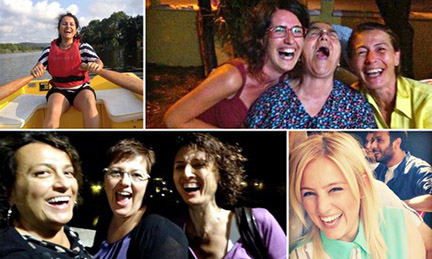
Twitter in Turkey broke into a collective grin on Wednesday as hundreds of women posted pictures of themselves laughing.

They weren’t just happy. They were smiling in defiance of the deputy prime minister, Bülent Arinç, who in a speech to mark Eid al-Fitr on Monday said women should not laugh in public.

“Chastity is so important. It’s not just a word, it’s an ornament [for women],” Arinç told a crowd celebrating the end of Ramadan in the city of Bursa in an address that decried “moral corruption” in Turkey. “A woman should be chaste. She should know the difference between public and private. She should not laugh in public.”

On Wednesday thousands of women posted pictures of themselves laughing out loud, with the hashtags #direnkahkaha (resist laughter) and #direnkadin (resist woman) trending on Twitter.

Turkish men also took to social media to express their solidarity. “The men of a country in which women are not allowed to laugh are cowards”, tweeted one user. Continue reading Who will have the last laugh? →

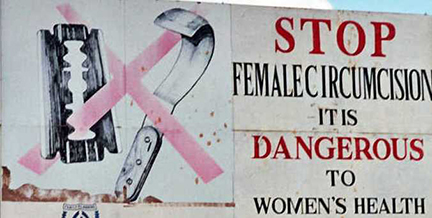
FGM Un-Islamic


Muslim Council of Britain says female genital mutilation is ‘un-Islamic’

Group issues explicit guidance for the first time, condemning practice which it says is no longer linked to religious teaching

by Alexandra Topping, The Guardian, June 23

The Muslim Council of Britain, the country’s largest Muslim organisation, has condemned the practice of female genital mutilation as “un-Islamic” and told its members that FGM risks bringing their religion into disrepute.

The influential MCB has for the first time issued explicit guidance, which criticises the practice and says it is “no longer linked to the teaching of Islam”. It added that one of the “basic principles” of Islam was that believers should not harm themselves or others.

The organisation will send flyers to each of the 500 mosques that form its membership, which will also be distributed in community centres in a drive to eradicate a practice that affects 125 million women and girls worldwide and can lead to psychological torment, complications during childbirth, problems with fertility, and death. Continue reading FGM Un-Islamic →

It’s the occupation, stupid…

On stupidity and war

Israel is a fast learner, but did it learn the most valuable lesson of all?

by Marwan Bishara, Al Jazeera, July 23, 2014

The war hasn’t ended and already the criticism over Israel’s military adventure in Gaza is mounting as the Islamist movement, Hamas, continues to surprise the “invaders”.

Leading and, presumably, respected media commentators have blamed Prime Minister Benjamin Netanyahu for his hastiness, Israel’s Security Service – the Shabak – for its ignorance and the military for its poor performance.

Israel might claim technological superiority and tactical victory, but, as one expert concluded, strategically, it’s been defeated.

Needless to say, there are many ways by which one takes stock of the ongoing war. But after three military adventures in six years, Hamas remains a formidable force in Palestine. And Israel has little to show for its military prowess and technological edge aside from the terrible devastation wrought across the Gaza Strip – home to 1.8 million Palestinians living impoverished lives in the world’s longest-standing refugee camp.

Prime Minister Netanyahu has boasted of Israel’s moral standing and condemned Hamas for targeting civilians. But in the last few days, it’s the Israeli military that has suffered hundreds of casualties, including 29 soldiers killed, thus far. While on the Palestinian side, Israel’s bombings led to thousands of civilian casualties. It takes chutzpah to take pride in such a dreadful record. Continue reading It’s the occupation, stupid… →

Looking Beyond the ‘Safety’ of the Hate Narrative

by Yakir Englander, ISLAMiCommentary, JULY 18, 2014

Serious illness calls for first aid, then sometimes surgery, followed by healing the source of the disease. If you ask which is most important, I’d say you can’t have one without the other. Without first aid, the patient will never reach the doctor. First aid without deeper treatment and true healing can cause a slow, more painful death and/or disability.

Unfortunately, this analogy applies to the recurring violence between Israel and Palestine. As first aid, we must quickly stop the violence. Then the leaders will need to sit and talk and agree on a political solution. But an immediate ceasefire and political negotiations, like first aid and surgery, are no guarantees of a long term healing of the underlying diseases of hatred and fear, of injustice and deep discrimination.

The Facebook posts of my friends this week — both pro-Israeli pro-Palestinian — do reflect a focus on stopping the violence; that is good. But at the same time they are screaming that the other side is entirely to blame. This discourse does not heal the disease. When a cease-fire comes, I’m afraid that most of my American and Israeli Facebook friends will simply continue on with their ordinary lives as if the current conflict had never happened.

Elie Wiesel once wrote that the Holocaust “robbed man of all his masks.” If we want change, we cannot go back to wearing the masks. Instead, we must internalize the stark reality of the death of the image of God, and then create a new system that allows, once again, for true human relationships.

A cease-fire between Israel and Hamas can slow down the death of more bodies. But it will not stop the death of the soul and of the image of God. I understand why many of my family and friends will put their masks back on and continue their daily lives, leaving memories of the bombings and sirens behind. We have many other issues in our lives. But some (mostly Palestinians and people living in the south of Israel) will not be able to so easily move on.

To my friends: when you publish another article about why the “other” side is totally evil and wrong, I ask you: Does your soul feel healed? Continue reading Looking Beyond the ‘Safety’ of the Hate Narrative →

A Practical Solution for Iraq


[Sinan Antoon channeling Jonathan Swift…]

by Sinan Antoon, al-Jadaliyya, July 15, 2014

The rise of ISIS and the declaration of a Caliphate that controls large swaths of Iraq and Syria signals a moment of exceptional danger not only for Iraq and its future existence as a state, but for US national interests.

The United States has sacrificed life and limb and invested billions of dollars to save Iraq from dictatorship and help its people build a thriving democracy. Mistakes were made for sure, but our intentions and objectives were always clear: to stabilize and democratize the region. President Obama’s craven policies and his withdrawal from Iraq have squandered the credit and political capital the US held in Iraq and the region. Sending advisors and providing logistical support to Baghdad is insufficient and will not weaken or defeat ISIS. President Obama has allowed Iran to step in and further strengthen its grip on Iraq.

As we write this, Iraqi parliamentarians are voting to choose new leaders. While ditching Maliki is a necessary step for moving forward, we believe that the gravity of the situation calls for a radically different approach. The Caliphate has its eyes on Baghdad and other capitals in the region. Its Jihadist ideology has already attracted hundreds of young Muslims from Europe and elsewhere who have joined its ranks. The violence will be exported to the free and civilized world and this threatens to squander all the hard-fought gains of the war on terror. Continue reading A Practical Solution for Iraq →