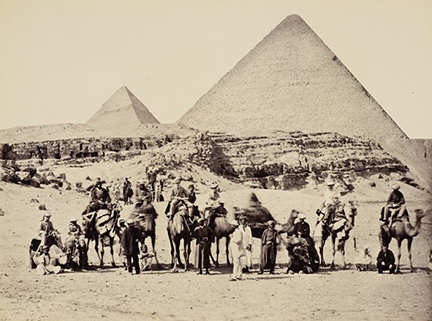
The Prince of Wales and group at the Pyramids, Giza, Cairo, March 1862 Royal Collection Trust / (c) Her Majesty Queen Elizabeth II 2014
Prints from first photographed royal tour go on show at Buckingham Palace. Click here to see ten images.
The Prince of Wales and group at the Pyramids, Giza, Cairo, March 1862 Royal Collection Trust / (c) Her Majesty Queen Elizabeth II 2014
Prints from first photographed royal tour go on show at Buckingham Palace. Click here to see ten images.

The fighting is not all in Yemen these days. Take the boxing world, for example. In the past there was “Prince” Naseem Hamad.
Now there is Sadam Ali from Brooklyn, who was inspired by Naseem. He has an impressive ring record so far. On November 8, 2014 in Atlantic City he defeated Luis Abregú with a TKO to achieve a record of 21 wins (13 knockouts) and no losses or draws. It is still early in his career, but so far things have gone very well for the young welterweight. He has his own Wikipedia page and a Facebook Page. Stay tuned.
My thanks to Jihan Varisco for bringing this to my attention.

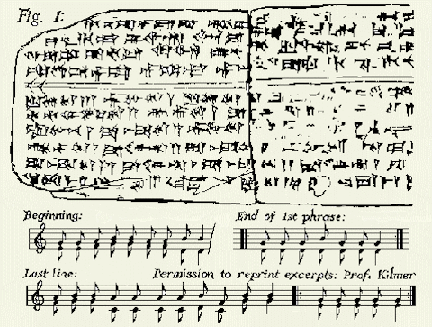
Listen to the Oldest Song in the World: A Sumerian Hymn Written 3,400 Years Ago
Open Culture, July 8th, 2014
In the early 1950s, archaeologists unearthed several clay tablets from the 14th century B.C.E.. Found, WFMU tells us, “in the ancient Syrian city of Ugarit,†these tablets “contained cuneiform signs in the hurrian language,†which turned out to be the oldest known piece of music ever discovered, a 3,400 year-old cult hymn. Anne Draffkorn Kilmer, professor of Assyriology at the University of California, produced the interpretation above in 1972. (She describes how she arrived at the musical notation—in some technical detail—in this interview.) Since her initial publications in the 60s on the ancient Sumerian tablets and the musical theory found within, other scholars of the ancient world have published their own versions.
The piece, writes Richard Fink in a 1988 Archeologia Musicalis article, confirms a theory that “the 7-note diatonic scale as well as harmony existed 3,400 years ago.†This, Fink tells us, “flies in the face of most musicologist’s views that ancient harmony was virtually non-existent (or even impossible) and the scale only about as old as the Ancient Greeks.†Kilmer’s colleague Richard Crocker claims that the discovery “revolutionized the whole concept of the origin of western music.†So, academic debates aside, what does the oldest song in the world sound like? Listen to a midi version below and hear it for yourself. Doubtless, the midi keyboard was not the Sumerians instrument of choice, but it suffices to give us a sense of this strange composition, though the rhythm of the piece is only a guess.

These articles are freely available until 31 January 2015 on the Brill Website.
Islamic Law in the Modern World
Author: Aharon Layish
Islamic Law and Society, (Volume 21, No. 3, pp. 276-307)
An Epistemic Shift in Islamic Law
Author: Aria Nakissa
Islamic Law and Society, (Volume 21, No. 3, pp. 209-251)
Reconstructing Archival Practices in Abbasid Baghdad
Author: Maaike van Berkel
Journal of Abbasid Studies, (Volume 1, No. 1, pp. 7-22)
The Early Ḥanafiyya and Kufa
Author: Christopher Melchert
Journal of Abbasid Studies, (Volume 1, No. 1, pp. 23-45)
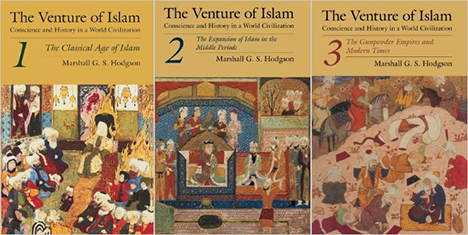
Bruce Lawrence has written an interesting reflective essay on the work of Marshall Hodgson for the online Marginalia page of the Los Angeles Review of Books. I attach the start of the essay here.
Marshall Hodgson was both a genius and a visionary. While he may have seemed to be just another university professor, at once restless, innovative, and genial, he was also an academic Ãœbermensch with a global agenda. He wanted to change the world by changing the way we saw, understood, and engaged Islam within world history. Born in 1922, he was drafted but as a Quaker refused to fight in World War II. After serving five years in detention camp, he returned to school, graduating from the University of Chicago with a PhD in the early 1950s. He had been teaching from the notes that became The Venture of Islam for over a decade before his demise in 1968. Forty-six years after his death, and 40 years since the posthumous publication of his magnum opus, his legacy remains puzzling. Was he ahead of his time, or has he been overtaken by the Cold War and its aftermath, including the horror of 9/11, along with its own, persistent aftermath?
Hodgson was informed, above all, by a moral vision of world history. He thought that Islam mattered because it righted the intellectually wrong yet emotively triumphalist notions of Eurocentric domination in world history. Hodgson began by expanding the backdrop for Islam to include the emergence of all historically documented societies. He stressed the formative features of world civilization dating from 3 millennia before the Common Era. By 1500 BCE, there had emerged four core cultural areas: Mediterranean, Nile-to-Oxus, Indian, and Chinese. It was two rivers, the Nile to the south and Oxus to the north, which provided the map markers etching the core area of what became Islamicate civilization. There was no Middle East or Near East, since in each case these qualifiers presumed an absent center: middle to where? near from where? east of where? Instead, it was these two major waterways, the Nile and the Oxus, which framed major developments characterizing the earliest three phases of Islamicate civilization. They are best viewed in alliterative or assonant pairs. Continue reading Bruce Lawrence on Marshall Hodgson

Iranian photographer Mohammad Reza Domri Ganji has compiled a beautiful portfolio of images taken inside landmarks like the Nasir al-mulk Mosque, in Shiraz, Iran.
A set of extraordinary photographs of mosques in Iran by Mohammad Reza Domri Ganji is available on the web. It is well worth checking out. More of his photographs of Iranian mosques can be found here.
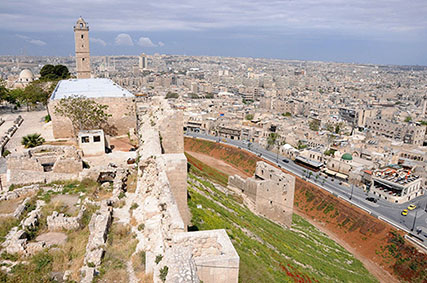
Aleppo from the Citadel before the recent destruction
New high-resolution satellite image analysis: 5 of 6 Syrian World Heritage sites ‘exhibit significant damage’
September 19th, 2014, Archaeology News
In war-torn Syria, five out of six World Heritage sites now “exhibit significant damage†and some structures have even been “reduced to rubbleâ€, according to new high-resolution satellite image analysis conducted by the nonprofit, nonpartisan American Association for the Advancement of Science (AAAS).
The AAAS analysis, offering the first comprehensive look at the extent of the damage to Syria’s precious cultural heritage sights, was completed in partnership with the University of Pennsylvania Museum of Archaeology and Anthropology’s Penn Cultural Heritage Centre (PennCHC) and the Smithsonian Institution, and in cooperation with the Syrian heritage Task Force. The National Science Foundation funded the analysis, which provides authoritative confirmation of previous on-the-ground reports of damage to individual sites.
“Only one of Syria’s six World Heritage sites‒ the Ancient City of Damascus‒ appears to remain undamaged in satellite imagery since the onset of civil war in 2011,†said Susan Wolfinbarger, director of the Geospatial Technologies and Human Rights Project at AAAS. Historic structures residing at the other five sites, including ancient mosques, schools, and civilian as well as government buildings, have all been damaged, and in some cases, destroyed, AAAS reported. Wolfinbarger added, however, that “the Damascus site also could have damage not visible in satellite images.†Continue reading Syria’s World Heritage in Peril
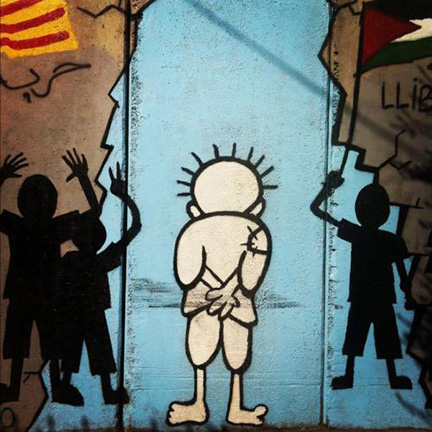
Image by Naji al-Ali. Painted on the Palestinian side of the separation barrier close to Bethlehem.
by Ammiel Alcalay, Warscapes,
August 11, 2014,
You know as well as I do that a people under occupation will
be unhappy, that parents will fear for the lives of their precious children,
especially when there is NOWHERE TO HIDE.
You know as well as I do that a husband’s memory of his wife forced to
deliver their child at a checkpoint will not be a happy one. You know as
well as I do that the form of her unborn child beaten to death in the womb
will never leave a mother’s mind. And you know as well as I do that a girl will
have cause to wonder at the loss of her grandfather, made to wait on his
way to the hospital, and she’ll have cause to cry at the bullet lodged
in her brother’s head — You know as well as I do that watching
someone who stole the land you used to till water their garden
while you hope some rain might collect to parch your weary throat