All posts by tabsir

If Lincoln Had Seen Aladdin…


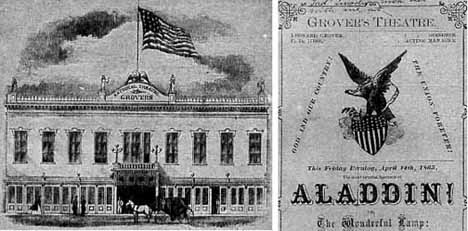
Grover’s Theater, Washington D.C.


[Today is Lincoln’s Birthday, but perhaps it is useful to remember his death as well…]

April 14, 1865. For Americans, at least above the Mason Dixon line, this is one of those dates that live in infamy. John Wilkes Booth, a rather bad actor on the stage, shot President Abraham Lincoln at Ford’s Theatre. According to an account by Mrs. Helen Palmes Moss in The Century Illustrated Monthly Magazine for 1909, Lincoln had the option of going to a rival theatre, the National or Grover’s, that night where a private box had been prepared for him by Mr. C. D. Hess, the co-manager. Apparently Booth had planned to attempt the assassination at whichever theater Lincoln attended. He much preferred Ford’s, since he had no inside help at the National and would have to shoot Lincoln as he stepped out of the carriage. What does this fateful event have to do with the Middle East? If Lincoln had attended the National Theatre and J. Wilkes Booth had missed, the President would have seen a dramatization of the Arabian Nights tale ‘Aladdin.’ Would that Lincoln had been more of an Orientalist?¦ Continue reading If Lincoln Had Seen Aladdin…

CNN on Yemen’s Border

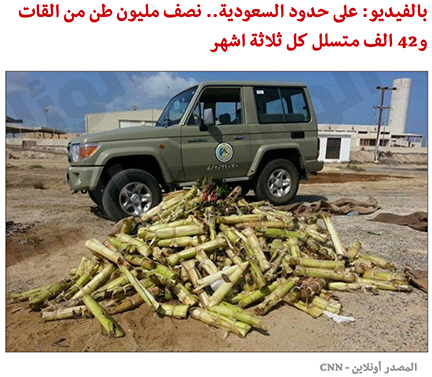
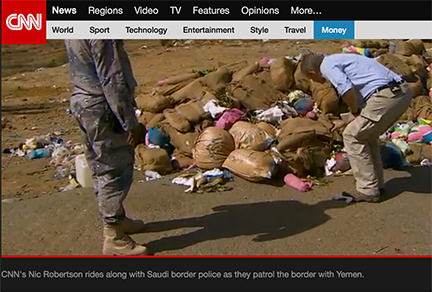
The media news network CNN sent reporter Nic Robertson to the border of Saudi Arabia and Yemen, where he was given a tour and saw several of the Yemenis caught smuggling over the border. One of the items being smuggled was qat. A young boy was given $50 to smuggle it into Saudi territory. The authorities tell him that in the past three months they captured close to half a million tons of qat worth 100 million dollars on the street. Here is one way the Huthis are getting cash. The report indicates that the Saudis are spending a lot of money to build fences and guard towers, although much of the border is so rugged it is impossible to stop everyone. Robertson is a bit overactive in his role at one point telling the Saudi interior spokesman with him that the Iranians are behind the Huthis and then saying this is what the Saudis say. I suspect it is what the Saudis say, but it was presented as a statement in the excerpt provided.

You can watch the video here in English, here in Arabic and read about it in Arabic here.

Bullfighting in the UAE

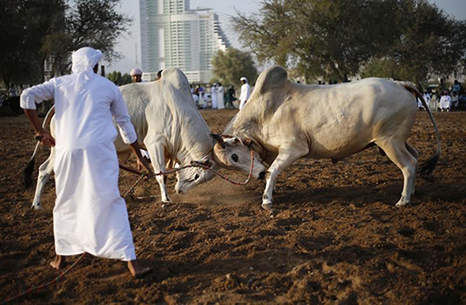
Reuters has an interesting photo essay of recent bullfighting in the UAE.

Two bulls lock their horns during a bullfight in the eastern emirate of Fujairah October 17, 2014. There are no matadors or picadors, but bulls locking horns with each other draw big crowds to bullfights in the United Arab Emirates (UAE). An hour’s drive from the dancing water fountains of Dubai’s glitzy downtown, hundreds of fans gather in Fujairah to watch bulls fighting, or perhaps more accurately head butting, with honour rather than money at stake. The UAE sport involves two bulls locking horns in a three-to-four minute Sumo-wrestling-like fight that usually ends with no bloodshed. Picture taken October 17, 2014. REUTERS/Ahmed Jadallah

Symposium at Berlin State Library


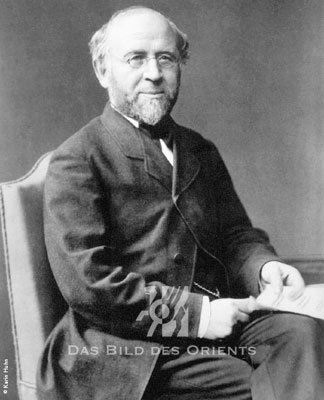
Johann Gottfried Wetzstein (1815 – 1905)

by Christoph Rauch, H-Net

Arabic manuscripts and Oriental studies: Symposium on the occasion of the 200th birthday of Johann Gottfried Wetzstein.

The international symposium “Studies on Johann Gottfried Wetzstein (1815-1905): Manuscripts, Politics and Oriental Studies” will be held at Staatsbibliothek zu Berlin from 19th to 21st February 2015. (Venue: Potsdamer Strasse 33, 10785 Berlin)

The symposium will be inaugurated Thursday, 19th February 2015, 6:00 PM with a keynote lecture by François Déroche (Paris): “The Qur’anic collections acquired by Wetzstein”; and a musical-literary program by Claudia Ott and her ensemble. Furthermore, some original documents and manuscripts related to Wetzstein will be exhibited at the opening.

If you plan to attend the conference please register before 31st January at the secretary of the Oriental Department, Mrs. Muenchow, orientabt@sbb.spk-berlin.de.

The symposium is generously supported by the Fritz Thyssen-Stiftung and the Verein der Freunde der Staatsbibliothek e.V.; and is organized in cooperation with the Oriental Institute of Leipzig University.

Here is the list of contributions in alphabetical order:

Ibrahim Akel (Paris), Wetzstein in Arabic sources and remarks on some manuscripts from his collections

Kaoukab Chebaro and Samar El Mikati El Kaissi (Beirut), Manuscript ownership and readership at the American University of Beirut at the turn of the 20th century

Alba Fedeli (Cambridge), Tischendorf and the Mingana Collection: Manuscript acquisition and Qur’ānic Studies

Ludmilla Hanisch (Berlin), Semitic studies at the University of Berlin during Wetzstein’s lifetime.

Michaela Hoffmann-Ruf (Bonn), The Wetzstein collection at Tuebingen University Library – its history, its content and its reception in Oriental Studies

Ingeborg Huhn (Berlin), Some remarks concerning the official correspondence of Johann Gottfried Wetzstein

Robert Irwin (London), The Arabist and Consul in Damascus Sir Richard Burton and the problematic nature of his translation of The Thousand and One Nights
Continue reading Symposium at Berlin State Library

The outer edges of Islam

By Amir Hussain, UCObserver

So, what do you think about ISIS?” The question was posed at the end of September by an agnostic colleague at the Jesuit university in Los Angeles. The query was directed at me, no doubt, because I’m the lone Muslim theology professor on staff. And I’m not sure how to respond or what else I can say except that members of the Islamic State of Iraq and Syria are horrific. I also can’t imagine my colleague asking me a comparable question — “What do you think about the Nazis?” or “What do you think of clergy who sexually abuse children?” — and expecting any kind of nuanced answer. I put his question aside.

A couple of weeks later, I was driving home from visiting friends in Santa Barbara when I heard that Warrant Officer Patrice Vincent had been deliberately run over and killed in Saint-Jean-sur-Richelieu, Que. Two days after that, while I was in an airline lounge in Chicago, word flashed across the TV monitors that Cpl. Nathan Cirillo had been shot dead while he guarded the National War Memorial in Ottawa and that the assailant was killed in a hail of gunfire in the corridors of the Parliament Buildings. It turned out that both murderers were self-radicalized converts to Islam. I was horrified.

The October attacks brought back to mind my colleague’s question about ISIS. Perhaps, when he asked, he wasn’t looking for nuance but context. Perhaps he wanted to better understand what motivates and inspires their evil, where the movement came from, how they are able to export their ideologies to troubled young men and women around the world, and how worried we North Americans should be about their threat to us.

My response is the same now as it was before. As shocking and frightening as incidents of “homegrown terrorism” may be, we must keep one fact in mind: the primary targets of Muslim fanatics are much more likely to be other Muslims than non-Muslims. Their main purpose is to force their own skewed version of Islam onto other Muslims. In the same way that Ebola is a serious threat to West Africans, not to North Americans, ISIS is a serious threat in Iraq and Syria, not here in North America. Personally, I’m much more concerned about Islamic fundamentalism in general than I am about ISIS specifically. Continue reading The outer edges of Islam