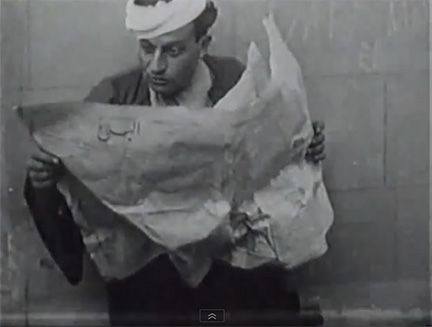
The first Egyptian silent film apparently appeared in 1923 under the title Barsoum Looking for a Job
برسوم يبØØ« عن وظيÙØ©
It is now on Youtube. It has poor, hungry Egyptians, lots of fighting, a dinner party and a drunken ending…
The first Egyptian silent film apparently appeared in 1923 under the title Barsoum Looking for a Job
برسوم يبØØ« عن وظيÙØ©
It is now on Youtube. It has poor, hungry Egyptians, lots of fighting, a dinner party and a drunken ending…
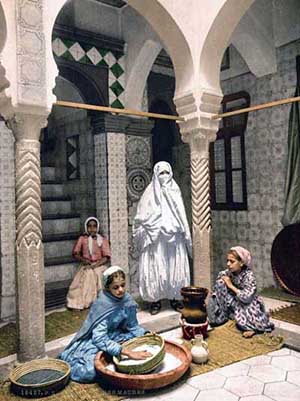
The photograph illustrates Luce Ben Aben, Moorish women preparing couscous, Algiers, Algeria.
There is a trove of old photographs from around the Middle East at the website http://www.azerbaijanrugs.com/oldphotos/old-photographs-me.htm
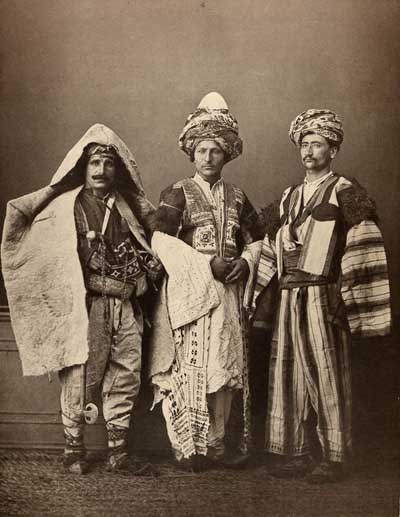
Kurds in national costumes
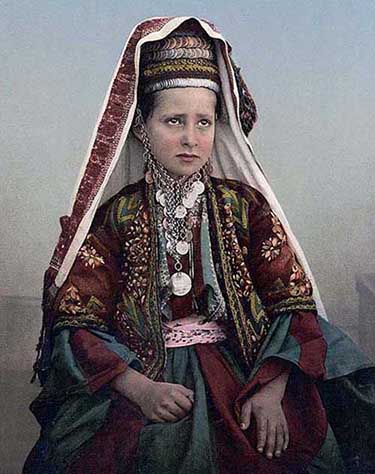
Young girl of Bethlehem. This color photochrome print was made between 1890 and 1900.
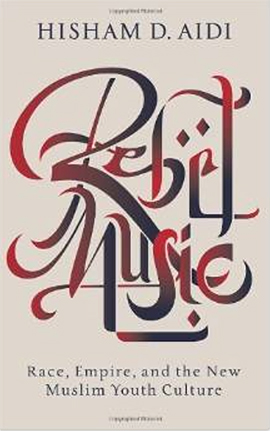
Hisham Aidi gave a fascinating interview on NPR about his recent book, Rebel Music. You can listen to the interview here.
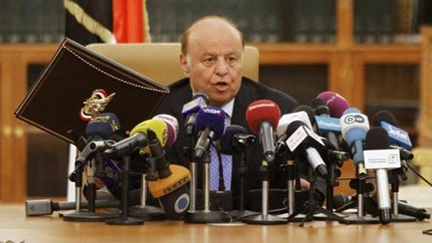
President Hadi, who is currently governing from Aden
Yemen’s legitimacy crisis is not new but is critical
By: Sama’a al-Hamdani, al-Araby al-Jadid, 3 March, 2015
On February 21, Yemen’s President Abd-Rabbo Mansour Hadi, escaped the Houthi-mandated house arrest and successfully fled to the southern city of Aden. A few hours later, al-Jazeera television broadcast a statement by the then resigned president. At the end of the statement, Hadi signed his name, “Abd-Rabbo Mansour Hadi, President of the Republic of Yemenâ€. It strongly suggested he had withdrawn his resignation.
So Yemen is now left arguably with two former presidents (Hadi and Ali Abdullah Saleh), a hugely powerful rebel militia leader (Abdulmalik al-Houthi), several secessionist movements (a couple of Southern Hiraks, a Marib Hirak and a Tihaman Hirak), UN-backed transitional committees, and two transitional agreements (The Gulf-Cooperation Council (GCC) transitional deal of 2011 and The Peace and Partnership Agreement of 2014).
In this confusion what, or rather, who, has legitimacy? Continue reading Yemen’s legitimacy crisis
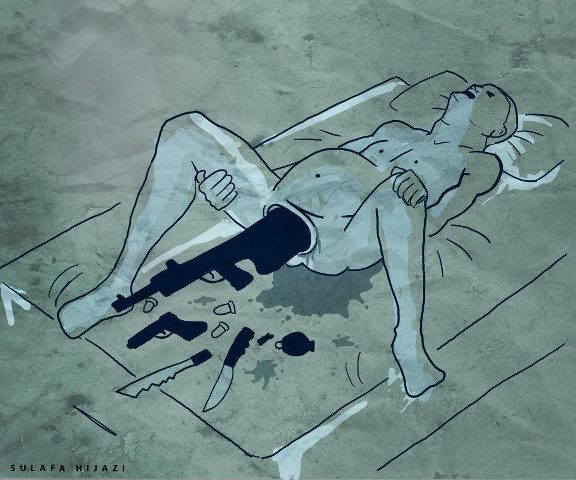
A painting that says it all by Sulafa Hijazi on Arab Women Artists.
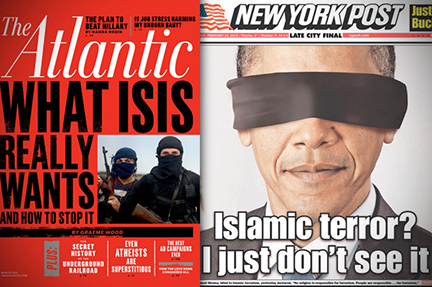
This stupidity needs to end: Why the Atlantic & NY Post are clueless about Islam
Pundits claiming that ISIS is emblematic of Islam ignore the intellectual traditions at the heart of the religion
by H.A. Hellyer, Salon, Februrary 20, 2015
This week, President Obama hosted a summit on countering “violent extremism,†where he received criticism from some on the rightwing over his refusal to call such violence “Islamic.†American media outlets, particularly the Atlantic and the New York Post, have struck a similar chord of late. All of this happens against a rather poignant backdrop: Only a few days ago, ISIS released a video showing the killing of 21 Coptic Egyptians in Libya. The group expressed what it considered to be Islamic justification for its actions. Long after the summit, specialists in the field of counter-extremism will continue to ask the question: Is ISIS actually representative in some way of Islam? And what, really, is the relationship between the group that calls itself the “Islamic State†and the world’s second largest religion?
There will be those that will insist that ISIS has nothing to do with Islam or religion in general — that ISIS is primarily a social and political phenomenon, bereft of ideology entirely, or simply using Islam as a superficial justification. Counterterrorism studies indicate that for very many people in the broader radical Islamist universe, non-ideological factors certainly play magnificently important roles. At the same time, it is also the case that for radical Islamists, an ideological component not only exists, but is crucial in understanding their world views. In some shape or form, for ISIS supporters, religion certainly plays a role. But what religion, precisely?
The easy answer is to say “Islam†– but it is also a rather lazy answer. There are around 1.5 billion Muslims around the world. The vast, overwhelming majority of them, needless to say, are not members of ISIS — and, in fact, Muslims actually make up the majority of ISIS’s victims, its most active enemies on the battlefield, and its most prominent detractors. Continue reading This stupidity needs to end
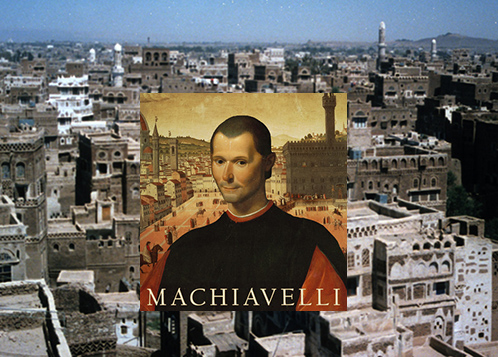
by Samaa Al Hamdani, Fikra Forum, February 20
[For this article in Arabic, click here.)
Last September, a rebel militia known as the Houthis successfully captured large portions of Yemen’s north and its capital, Sana. A few months later, in January 2015, President Abdu Rabu Mansour Hadi and his government resigned following clashes with the Houthis. By February 10, diplomatic missions in Sana’a had evacuated the country to protest the “illegitimate Houthi takeover.†Overnight, the Houthis became Yemen’s new rulers, but very little was known about them.
The enigmatic Houthi movement transformed from a Zaydi revivalist group in the early 1990s, to a rebel movement in the mid-1990s, to an enemy warring against the Yemeni state in the early 2000s. Following the revolution in 2011, the Houthis secured 33 seats in the National Dialogue Conference (NDC), because they had significant local influence and were considered victims of the former regime. The Houthis were granted a specialized committee in the NDC solidifying them as an influential political player. However, as soon as the dialogue concluded, the Houthis lost faith in the internationally backed political transition. Since then, the Houthis – led by Abdul-Malik al-Houthi – have employed Machiavellian tactics to gain influence in Yemen, taking advantage of the dismal performance of Hadi’s National Unity Government to seize territory and power.
In September 2014 Hadi lifted fuel subsidies, which angered much of the Yemeni population and provided an opening for the Houthis. Cleverly, the Houthis sided with the people against the government; thereafter, within six days, they seized the capital. Months later, on February 11, they mobilized mass protests to overshadow any activities by the opposition. It is likely that a Houthi-led protest will take place on March 18, the anniversary of the “Friday of Dignity,†during which 56 protestors were killed in 2011. By hijacking public rallies, the Houthis aim to silence the opposition and, in this specific case, avoid criticism by the Gulf Cooperation Council and the United Nations Security Council.
Continue reading Lessons in Yemeni Machiavellianism
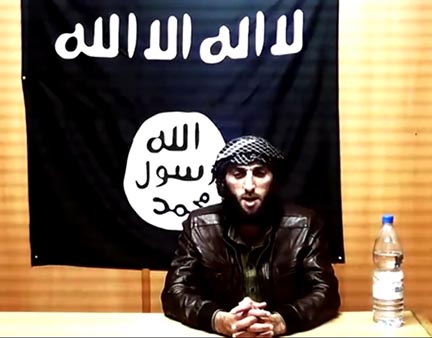
By Juan Cole (Informed Comment), February 17
The self-styled ‘Islamic State’ Group (ISIS or ISIL), the Arabic acronym for which is Daesh, is increasingly haunting the nightmares of Western journalists and security analysts. I keep seeing some assertions about it that strike me as exaggerated or as just incorrect.
1. It isn’t possible to determine whether Daesh a mainstream Muslim organization, since Muslim practice varies by time and place. I disagree. There is a center of gravity to any religion such that observers can tell when something is deviant. Aum Shinrikyo isn’t your run of the mill Buddhism, though it probably is on the fringes of the Buddhist tradition (it released sarin gas in the Tokyo subway in 1995). Like Aum Shinrikyo, Daesh is a fringe cult. There is nothing in formal Islam that would authorize summarily executing 21 Christians. The Qur’an says that Christians are closest in love to the Muslims, and that if they have faith and do good works, Christians need have no fear in the afterlife. Christians are people of the book and allowed religious freedom by Islamic law from the earliest times. Muslims haven’t always lived up to this ideal, but Christians were a big part of most Muslim states in the Middle East (in the early Abbasid Empire the Egyptian and Iraqi Christians were the majority). They obviously weren’t being taken out and beheaded on a regular basis. They did gradually largely convert to Islam, but we historians don’t find good evidence that they were coerced into it. Because they paid an extra poll tax, Christians had economic reasons to declare themselves Muslims.
We all know that Kentucky snake handlers are a Christian cult and that snake handling isn’t typical of the Christian tradition. Why pretend that we can’t judge when modern Muslim movements depart so far from the modern mainstream as to be a cult? Continue reading Today’s Top 7 Myths about Daesh/ ISIL