The Library of Congress has a very nice website with online resources regarding its collection of Near Eastern materials.

The Library of Congress has a very nice website with online resources regarding its collection of Near Eastern materials.

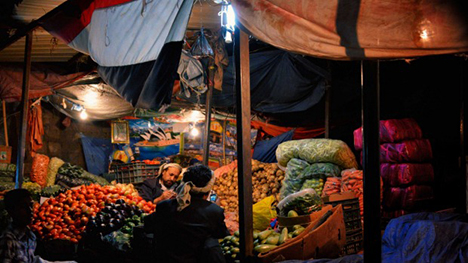
The Sana’a Suq (market) at night. Photo: Rod Waddington/Flickr Creative Commons
The ancient treasure of Sana’a in Yemen: One of the world’s most beautiful cities is being bombed
Luke Malpass, The Sydney Morning Herald, April 1, 2015
Inhabited continuously for more than 2500 years, and connected to the civilisations of the Bible and Koran, the old city of Sana’a in Yemen is an architectural and cultural jewel.
It is also under attack, with the possibility the UNESCO World Heritage site could suffer the same fate as Syria’s Aleppo, where fierce fighting has devastated its population and cultural treasures.
Australian photographer Rod Waddington, who visited Yemen in 2013, fears a tragedy: “It would be major; it’s like what ISIS is doing in Northern Iraq, destroying all of the sights.”
Following are a selection of images from Mr Waddington and UNESCO portraying a country he describes as one of the most photogenic in the world.

A girl in Sana’a. Photo: Rod Waddington/Flickr Creative Commons
Click here for more images of Sanaa

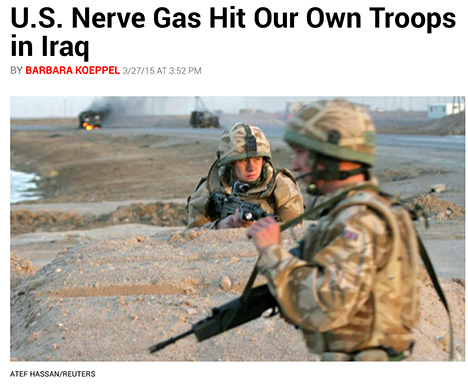
This is a chilling account of a cover-up by the U.S. military of the exposure of 200,000 American soldiers in the first Gulf War to nerve gas.
http://www.newsweek.com/how-us-nerve-gassed-its-own-troops-then-covered-it-317250

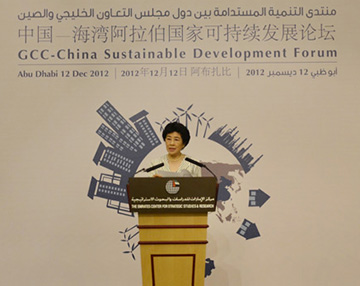
The GCC States and the Viability of a Strategic Military Partnership with China
By Imad Mansour, Qatar University, The Middle East Institute, Mar 17, 2015
The term “strategic partnership†has been increasingly used in GCC circles to signify that relations with China are important and worthy of long-term investment. In a March 14, 2014 speech during his visit to Beijing, Saudi Arabia’s then Crown Prince Salman announced that “we are witnessing the transformation of the relationship with China to one of strategic partnership with broad dimensions, to the benefit of both our countries.â€[1] Saudi Arabia’s position was echoed by the emir of Qatar during a 2014 visit to China in which issues of common concern to all GCC states, especially combating terrorism, were discussed.[2] Abdel-Aziz Aluwaisheg, GCC general assistant secretary for negotiations and strategic dialogue, has also noted that there is growing interest in the Gulf to develop a “strategic dialogue†with China.[3]
Despite this growing GCC recognition of China’s strategic role in the region, what exactly a “strategic partnership†or “strategic dialogue†would look like remains unclear. This essay discusses why officials in GCC member states might be hesitant to embrace the idea of China as a viable strategic military partner, while at the same time recognizing the need to further develop relations with China.
Securing Independent Military Capabilities
From the perspective of GCC leaders, the main military advantage of partnership with China is Beijing’s potential willingness to provide weapons that the United States is currently reluctant to sell. Given the United States’ lukewarm responses to recent regional unrest, the GCC countries are seeking to augment their independent capabilities, and China could be an important supplier, whether or not it is a full “strategic partner.â€[4] These GCC views are based on the understanding that as economic interdependence grows, China might be more willing to provide advanced weapons systems in greater quantities. It is important to note that looking to China for arms sales is consistent with the GCC states’ broader strategy of expanding their network of suppliers.[5]
However, GCC leaders continue to assess the benefits of such an arrangement through the prism of their enduring relationship with the United States. This is largely due to historical momentum. GCC states have long procured most of their military hardware, training, intelligence systems, and combat systems directly from the U.S. government or from American businesses. In addition, the United States and its allies share GCC concerns about containing regional conflicts in Iraq and Syria, as well as the region-wide threat posed by al-Qa‘ida and its affiliates.[6] Furthermore, it seems that despite its reluctance to sell certain weapons directly to the GCC, the United States has tacitly approved GCC purchases of such weapons from China.[7] This balance―whereby the United States sells the GCC most of its conventional weapons systems, while GCC states purchase other approved weapons elsewhere―allows the GCC to accrue the benefits of remaining within the U.S. umbrella while also buttressing its defenses. Obtaining military hardware from China that the United States has not approved would involve an extremely delicate diplomatic game—one in which the GCC stands to lose more than it would currently gain. Continue reading The GCC and China

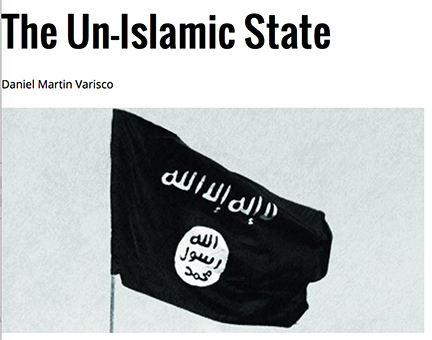
There is an excellent analysis of ISIS as a cult recently posted on War on the Rocks.
Here is the start, but click here for the full article…
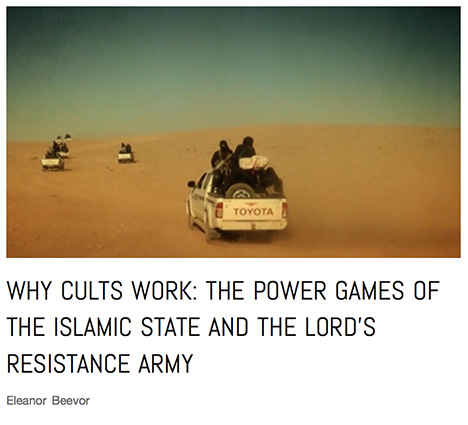
Why Cults Work: The Power Games of the Islamic State and the Lord’s Resistance Army
by Eleanor Beevor
Graeme Wood’s article “What does ISIS really want?†has become the most discussed foreign policy article of the year. Yet the piece’s power lies not in the title question, but in Wood’s blunt assessment of a paradox that leaves Western leaders flummoxed: How does one explain the traction of the Islamic State in Iraq and the Levant (ISIL), while also denying its religious legitimacy, in order to combat anti-Muslim bigotry? Wood didn’t mince words in refuting this hesitancy:
The reality is that the Islamic State is Islamic. Very Islamic… the religion preached by its most ardent followers derives from coherent and even learned interpretations of Islam.
What follows is a fascinating piece of research, and a frustrating read. Despite addressing all the right aspects of ISIL’s ideological content to understand its power, Wood’s argument is guided by the wrong question: “How Islamic is ISIL?†For him, denial of ISIL’s Islamic nature is why we fail to understand it. The analytical pitfalls of quantifying “Islamic-ness†should be self-explanatory. Are some of Islam’s 1.6 billion practitioners less Muslim than others if they are less violent? How do we explain the religious devotion of politically “quietest†Salafism, compared to the British ISIL fighters who purchased Islam for Dummies pre-departure? This is not to say that religion is irrelevant in the analysis of ISIL. ISIL uses Islam as an existential anchor, so its actions have to be influenced by it in order to work. It also freely capitalizes on global Islamist sentiment. But to say the whole structure is uniquely, potently Islamic is not just a logical fallacy, but part of the very illusion that sustains loyalty to it. Actually, the features that Wood claims represent ISIL’s Islamic orthodoxy – its obsession with “purity†and the apocalyptic prophecy it stakes its claim on – have “been done,†and not just by Islamists. This is revealed by comparing ISIL with another notoriously violent army, led by another self-styled holy man.
ISIL and the Lord’s Resistance Army (LRA) represent grabs for power, but power of a cosmic kind, beyond what human society can grant them. In examining both, I suggest a word substitution. The ways in which ISIL works, to extraordinary success, are not uniquely Islamic. They are uniquely “cultic.†And to examine ISIL as a cult is to see chinks in its armor. ISIL’s territory may be shrinking, but that alone won’t kill the loyalties of its cadres, nor slow the spread of its bloody sectarian ideology. In ISIL, as in the LRA, knowledge is power. If we can challenge the leaders’ tight hold on that power, ISIL’s ideological grip on its fighters might just begin to crumble…

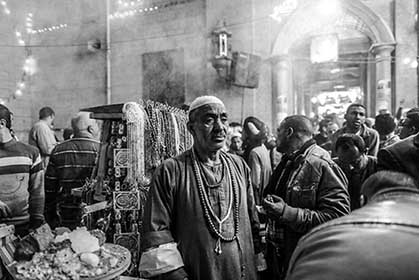
Time Magazine has a photographic essay on “Exploring the Mawlids of Egypt.”

The first Egyptian silent film apparently appeared in 1923 under the title Barsoum Looking for a Job
برسوم ÙŠØ¨ØØ« عن ÙˆØ¸ÙŠÙØ©
It is now on Youtube. It has poor, hungry Egyptians, lots of fighting, a dinner party and a drunken ending…

The photograph illustrates Luce Ben Aben, Moorish women preparing couscous, Algiers, Algeria.
There is a trove of old photographs from around the Middle East at the website http://www.azerbaijanrugs.com/oldphotos/old-photographs-me.htm

Kurds in national costumes

Young girl of Bethlehem. This color photochrome print was made between 1890 and 1900.