Speakers of every human language use words or phrases pragmatically, as discourse markers. Some of these discourse markers (for example, English “mm-hmmâ€) can be used by a listener to tell a speaker that he is paying attention to what is being said and understands it. This is what linguists call a “back-channel†marker. It tells the principle speaker that he may go on talking. Other discourse markers can be used by the principle speaker to prompt the listener to speak briefly without taking center stage in the discussion. Such prompts – for example, English “y’know what I’m saying?†– elicit a short backchannel response from the listener (ex. “uh-huh…â€) but do not invite him to take a full turn in the conversation. Continue reading Islamic Discourse Markers in Arabic
All posts by tabsir
The Eighth Voyage of Sinbad (Lately Discovered)
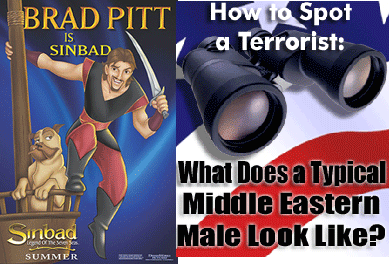
by Sean Emer
One night, several months after Scheherazade had ended her fabled thousand and one night succession of tales, the king (sleeping beside his now pardoned bride) suddenly awoke from his slumber – quite a feat indeed, as he had not been able to sleep for the equivalent of roughly 2.7425 years, due to a certain progression of interesting and arousing recounts of people, places, and wonders.
Turning towards his queen, who was knitting contentedly (she had long since disposed of the pesky indulgence of sleep during the darker hours of the day), he started, “My wife, I have a question to ask of you.†Continue reading The Eighth Voyage of Sinbad (Lately Discovered)
An Arabian Night Up Against Walpole
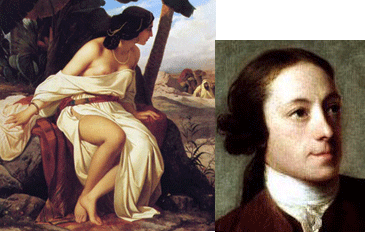
[Webshaykh’s Note: One of the more delightfully nonsensical take-offs on the famous ‘Tales of the 1001 Nights’ was penned by the late 18th century literary wit Horace Walpole. The following is a selection from his ‘Hieroglyphic Tales’, published in 1785.]
The King and his Three Daughters
There was formerly a king, who had three daughters—that is, he would have had three, if he had had one more, but some how or other the eldest never was born. She was extremely handsome, had a great deal of wit, and spoke French in perfection, as all the authors of that age affirm, and yet none of them pretend that she ever existed. It is very certain that the two other princesses were far from beauties; the second had a strong Yorkshire dialect, and the youngest had bad teeth and but one leg, which occasioned her dancing very ill. Continue reading An Arabian Night Up Against Walpole
Headless in Saudi Arabia
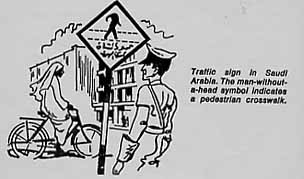
[â€Traffic sign in Saudi Arabia. The man-without-a-head symbol indicates a pedestrian sidewalk.â€]
I recently came across a rather plebian junior high school level text on The Middle East: History, Culture, People (by Thomas G. Kavunedos and Harold E. Hammond, Bronxville, New York, Cambridge Book Company, Inc, 1968). The book is quite forgetable, but some of the illustrations bring you to a full stop. My favorite is the illustration above. If indeed this was once the sign for a crosswalk, no wonder everyone seems to drive Mercedes in the kingdom.
Daniel Martin Varisco
Where Are We Beheading?
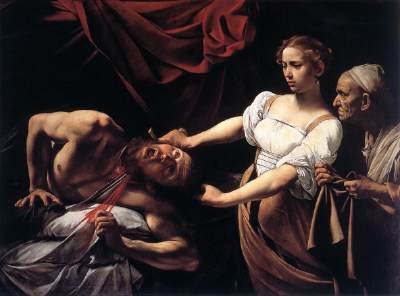
The search engine Google can easily become a kind of ouija board for those of us engaged in connected scholarship. There is much useful information just a click away, but also much out there of which to be wary. It is worthwhile to take time out every once in awhile to see what Goggle will offer up for an innocent query. Out of curiosity on October 4, 2005, I decided to type “beheading†into Google and see what came up.
The first 10 sites (of 1,890,000) are instructive (you can see for yourself) of the problem facing the representation of Islam on the internet. Continue reading Where Are We Beheading?
Woody Guthrie, Pope Benedict and Western Stereotypes
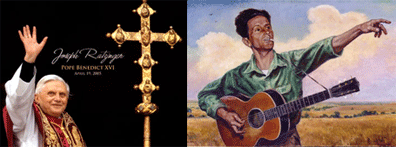
“Argue not with the People of the Book unless it be in a better way, except with such of them as do wrong; and say: ‘We believe in that which has been revealed to us and revealed to you; our God and your God is One, and to God do we surrender’†(Qur’an 29:46)
I am a Canadian Muslim (of Pakistani background) who teaches theology at a Jesuit university in Los Angeles. As such, a number of people have asked me about my thoughts on His Holiness Pope Benedict XVI’s remarks in September about Islam, and the subsequent events that unfolded. Before I do that, I begin with a story about the importance of symbols for Christians and Muslims. Continue reading Woody Guthrie, Pope Benedict and Western Stereotypes
What Went On
 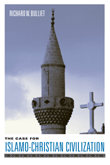
Having just returned from the annual conference of MESA (Middle East Studies Association) in Washington, D.C., my eyes are still glazed from all the new titles in the book exhibits. I doubt there was a major publisher represented that did not have a new offering with “Jihad,” “Post 9/11,” “Islamism” or just plain “Terrorism” on prominent display. The pundits are having a field day, embedded journalist and intrepid academics alike. The greatest volume of texts by a single author went to Bernard Lewis, who had so many titles on display at the Oxford booth that this reputable forum might be in danger of becoming the Oxford-Lewis University Press. Several books back, not that the content varies much, Lewis hit the market right after 9/11 with his What Went Wrong?,a typical Lewisite (following the common media usage of Shiite) rehash lamenting the fact “they” are not as curious about “us” as “we” are about “them.” There are many valuable books now available that counter this iconic neocon imagination of the Middle East. But one book that I fear may be lost in the constant shuffle of new titles is historian Richard Bulliet’s The Case for Islamo-Christian Civilization (Columbia University Press, 2004).
The Incomplete Terrorist
How do you profile a Muslim Terrorist? Some leave clues, a few even record video epitaphs. For the last two years a day has probably not gone by without a suicide bomber pulling a string and blowing himself and those around him to bits or driving a car to explode the lives of innocent bystanders. Is there a way to predict who such a bomber might be, or who builds the bombs and plans the operations? Logic fails, at least the logic that says something has to be very special to die for and even more special to make other people die for a cause just because you believe in it. Continue reading The Incomplete Terrorist