All posts by tabsir

Water rather than Whining


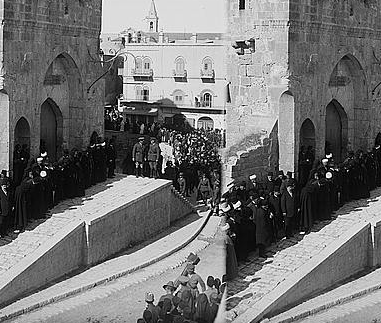
[“…I entered the city officially at noon, “December 11th”, with a few of my staff, the commanders of the French and Italian detachments, the heads of the political missions, and the Military Attaches of France, Italy, and America. The procession was all afoot, and at Jaffa gate I was received by the guards representing England, Scotland, Ireland, Wales, Australia, New Zealand, India, France, and Italy. The population received me well…” (General Allenby in Source Records of the Great War, Vol. V, ed. Charles F. Horne, National Alumni 1923)]

[Note: Almost 90 years ago, on December 9, 1917, General Allenby marched into Jerusalem to accept the surrender of the city by Ottoman Turkish officials. But unlike the current debacle in Iraq, where liberation has not been followed up by tangible development, it was the ability of British engineers to provide clean drinking water that helped smooth the transition from Ottoman rule to a mandate, ultimately as unclean and messy as it would become. It is worth reading the following excerpt by W. T. Massey, not only for strategic advice on how to win over a conquered populace, but also for a prime example of the journalistic ethnocentrism in which the West provides a “civilising hand” to the poor Oriental.]

THE TOUCH OF THE CIVILISING HAND
by W. T. Massey (1919)

It is doubtful whether the population of any city within the zones of
war profited so much at the hands of the conqueror as Jerusalem. In
a little more than half a year a wondrous change was effected in the
condition of the people, and if it had been possible to search the
Oriental mind and to get a free and frank expression of opinion,
one would probably have found a universal thankfulness for General
Allenby’s deliverance of the Holy City from the hands of the Turks.
And with good reason. The scourge of war so far as the British Army
was concerned left Jerusalem the Golden untouched. For the 50,000
people in the City the skilfully applied military pressure which
put an end to Turkish misgovernment was the beginning of an era
of happiness and contentment of which they had hitherto had no
conception. Justice was administered in accordance with British
ideals, every man enjoyed the profits of his industry, traders no
longer ran the gauntlet of extortionate officials, the old time corruption was a thing of the past, public health was organised as far as it could be on Western lines, and though in matters of sanitation and personal cleanliness the inhabitants still had much to learn, the appearance of the Holy City and its population vastly improved under
the touch of a civilising hand. Sights that offended more than one of
the senses on the day when General Allenby made his official entry had
disappeared, and peace and order reigned where previously had been but misery, poverty, disease, and squalor. Continue reading Water rather than Whining
Traveling Light in Arabia

[Note: the following list of items for light camping in Arabia is provided by G. Wyman Bury for the early part of the 20th century.]

CAMP EQUIPMENT
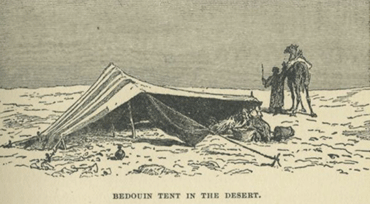
Try to do without a tent. Arabs hate pitching tents after a long day’s march, and seldom pitch them well. They draw fire and afford no protection, while preventing your own observation; they also betray the site of your camp to bad characters and casual callers on the look out for supper.

BEDDING
Avoid Wolseley valises or anything with pleats and folds, which become the permanent abiding places of parasitic insects.
‘Blankets.’ One each for the men. A few extra for convalescents or invalided men. Two for yourself.
‘Pillows.’ Carry your spare clothes in a green canvas sack. Continue reading Traveling Light in Arabia

Resurrecting Empire in Iraq

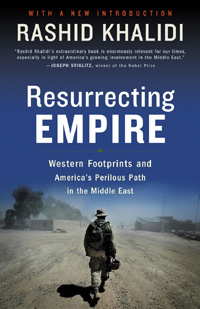
By Rashid Khalidi. Columbia University

The United States, and the world, now faces a situation of unprecedented difficulty in Iraq. There is deep resentment among Iraqis, including those grateful for the overthrow of the Ba’th regime, at the months of chaos in Iraq since the end of the war, at the unresponsiveness of the American occupation authorities, and at the slow pace of the move toward genuine self-government. American troops increasingly risk being received as are most occupation armies, and as were the British in Iraq after World War I: with hostility and ultimately with widespread armed resistance. The paralysis of the American authorities in Baghdad, which reflects the paralysis in Washington, as the administration’s factions struggle over decisions in Iraq, and the inflexible, highly ideological, and ultimately self-defeating line that has generally prevailed, have exacerbated the situation. Reliance on Pentagon-favored exiles loathed by most Iraqis, who see them as carpetbaggers, has already hurt the position of the United States in Iraq, an may lead to an even worse situation there when the inevitable backlash against their machinations sets in. This is only the tip of the iceberg, as is manifest from reporting in the non-American media on the situation on the ground in Iraq, one whose gravity has not been fully reflected in the American media—although American casualties in Iraq, and lengthy deployments of both regulars and reservists finally seem to be having an impact on American public opinion. Continue reading Resurrecting Empire in Iraq

The Wind and the Whirlwind


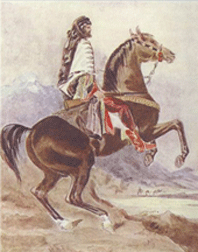
Wilfrid Scawen Blunt on Pharaoh, drawn by Lady Anne Blunt

[Note: The following poem was written by Blunt in response to the British occupation of Egypt in the late 19th century, but its words are apt for the present occupation of Iraq and Afghanistan today.]

by Wilfrid Scawen Blunt

I have a thing to say. But how to say it?
I have a cause to plead. But to what ears?
How shall I move a world by lamentation,
A world which heeded not a Nation’s tears?

How shall I speak of justice to the aggressors,
Of right to Kings whose rights include all wrong,
Of truth to Statecraft, true but in deceiving,
Of peace to Prelates, pity to the Strong?

Where shall I find a hearing? In high places?
The voice of havock drowns the voice of good.
On the throne’s steps? The elders of the nation
Rise in their ranks and call aloud for blood. Continue reading The Wind and the Whirlwind

BBC Reporter Johnston Freed

BBC NEWS, 2007/07/04 08:37:02 GMT

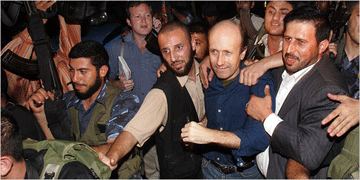
BBC correspondent Alan Johnston has been released after 114 days in captivity in the Gaza Strip. He describes the “appalling experience” at the hands of his captors, called the Army of Islam.

“I am hugely grateful to all the people – an amazing number of people that worked on the Palestinian side, the British government, the BBC from top to bottom, and a huge amount of support from BBC listeners and viewers.

I had a radio almost throughout, and was able to follow all the extraordinary level of support and interest in my case, and it was a huge psychological boost.

I am immensely grateful. It’s just the most fantastic thing to be free. Continue reading BBC Reporter Johnston Freed

Tuareg Blues


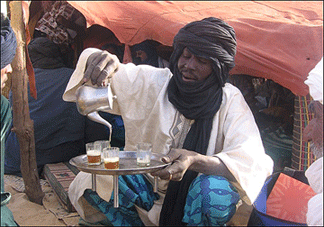
[Tuareg man serving tea; photo by Jane Greenhalgh for NPR.]

“Climate Connections” on today’s NPR website has a slideshow and brief article on recent changes in Tuareg lifestyle in southern Mali. Known as the “Blue Men” of the desert (for their indigo clothing) and serving as a prime ethnographic example of a society where the men (rather than the women) veil, life for the Tuareg is undergoing rapid change. In this case it is prolonged drought that has served as the main impetus for change. The slide feature is well worth a look.

The Little Rebellion that Was


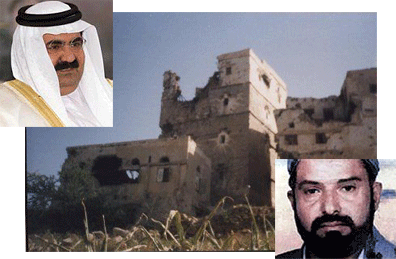
[Illustration: Emir Hamad Bin Khalifa al-Thani of Qatar, left; bombed out buildings in northern Yemeni town of Sa‘da in 2004 fighting, center; Husayn al-Houthi, right.]

In September, 2004, Yemen’s military captured and killed a Zaydi cleric in the northern part of their country. His name was Husayn al-Houthi and he is alleged to have started a rebellion with a strong anti-American thrust. Although claims were made that he was trying to revive the Zaydi imamate (which was toppled in 1962 in the revolution that formed a republic in North Yemen), such an al-Qaeda clone conspiracy theory are exaggerated. Nevertheless, his followers carried on a regional rebellion, lately under the leadership of his son Abd al-Malik, and as a result thousands of soldiers, rebels and civilians have died and tens of thousands of civilians have been displaced. It is not surprising that you may not have seen much about the fighting in the media. Indeed it has been a little rebellion compared to events in Iraq, Afghanistan or Gaza, and it certainly did not threaten the ruling government’s overall hold on the country. But it was certainly a big deal in Yemen. And now, with mediation by the Emir of Qatar, it appears that there will be an end to the armed conflict. Details are provided in today’s Yemen Observer.

Al-Houthi rebels descend the mountains, lay down their weapons

Written By: Nasser Arrabyee
Yemen Observer, Jun 30, 2007

Al-Houthi rebels have come down from the mountains of northern Yemen to put down their weapons and return home, as instructed by a Qatari-brokered agreement to end the five-month war between them and the government troops, said mediators Thursday. Continue reading The Little Rebellion that Was

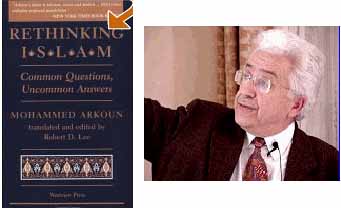
Reading the Qur’an: Mohammed Arkoun

By Jane Dammen McAuliffe
Dean of Arts and Sciences, Georgetown University
Professor, Department of Arabic and History

Mohammed Arkoun is the most honored French Islamicist alive today and continues to receive lecture invitations from around the world. His first language was Berber, and he learned Arabic and studied Islamic sources in French-speaking schools, first in Algeria and then in Paris (Gunther:127-131). Arkoun’s life-long project has been the sustained analysis of Islamic reason from the perspective of the contemporary epistemologies, both philosophical and social scientific. He is well-schooled in the successive forms of critical theory that have occupied humanistic scholarship for the last generation, particularly structural linguistics and semiotics. Continue reading Reading the Qur’an: Mohammed Arkoun