All posts by tabsir

At a Tomb in Abydos

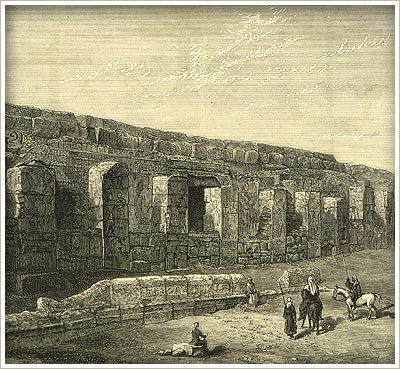
Temple at Abydos

by Augustus Wight Bomberger

How little hath life changed, O ancient King!
This fan so delicate and bracelet rare,
These dainty, jeweled trinkets for the hair,
Were thine own gifts, I know, and thine this ring.
And Bener-Ab, thy daughter, “Sweet of Heart,”
Who wore them once, was precious of a truth
And dear to thee in all her winsome youth,
Unspotted from the world, unspoiled of art:
So dear that thou at times didst reckon less
Thy royal sceptre than her soft caress;
Yet for that cause wert all the more a king,
Five thousand years ago when thou didst reign
In great Abydos — city of the plain.
And now — ah me, how close these symbols bring
Thy soul to mine across the vast of years – Continue reading At a Tomb in Abydos

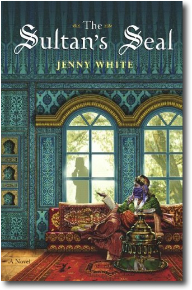
The Sultan’s Seal

“Your brush is the bowstring that brings the wild goose down.”

(Reviewed by Jana Kraus MAR 22, 2006)

Jenny White, an anthropologist and the author of numerous nonfiction works on Turkish society and politics, has written a real winner with her debut novel, The Sultan’s Seal. A historical mystery with a bit of romance thrown in, this book makes for an unputdownable read. Ms. White paints a remarkably vivid portrait of life in 19th century Turkey, from the luxurious sultan’s palaces to the most squalid slums of Istanbul, and writes intelligently of the political turmoil of the period. Continue reading The Sultan’s Seal

The Land and the Book #2: Smoke on the Water


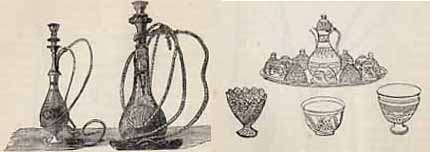
Water Pipes, left; coffee set, right; from Thomson’s “The Land and the Book”

The rustic American style pilgrim’s progress of Rev. William M. Thomson in the 1830s through the 1850s in Palestine was not just about places where the locals swore that Abraham bought a cave or Jesus preached. There were real people along the way and Thomson takes the reader inside a diwan from time to time. In one of his accounts he would be in good company with legislators who ban smoking in public places. Although cigarettes were just taking off in popularity, the traditional approach to tobacco in Syria and Palestine was smoke on the water to be followed by Turkish coffee. Let’s return a century and a half to this precursor of the modern sheesha bar. Continue reading The Land and the Book #2: Smoke on the Water

The Land and the Book #1: Looking for an Omnibus?


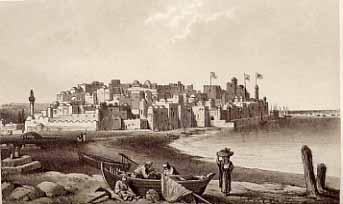
Jaffa from Thomson’s “The Land and the Book”

Almost 150 years ago one of the most popular travel accounts of the Holy Land was penned by an American missionary named William M. Thomson. Born in Ohio, my own home state, the 28-year old Thomson and his young bride arrived in Lebanon in 1834 as Protestant missionaries. This was a mere 15 or so years after the first American missionaries had made the Holy Land a mission field. At once an entertaining travel account and Sunday School commentary on the places and people of the Bible, this may have been one the most widely read books ever written by a Protestant missionary.

Reading Thomson is like reading one of the early English novels. The language is less familiar, although still thoroughly Yankee and the devotional tone has long since disappeared for a readership buying out The Da Vinci Code as soon as it hit the bookstores. The biblical exegesis, literalist yet frankly pragmatic at times, is intertwined with astute and at times humorous accounts of the people Thomson met along the way. But the style is not at all dry or discouragingly didactic. From the start Thomson engages in a dialogue with the reader, making the text (which stretches over 700 pages in the 1901 version) a rhetorical trip in itself.

Here is one of the forgotten books of a couple generations back. Easily dismissed as an Orientalist book, in the sense propounded and confounded by Edward Said, it is nevertheless a very good read. With this post I begin a series to sample the anecdotes and local color presented by Rev. Thomson. The times have indeed changed, but such textual forays into the night reading of a previous generation of Americans are well worth the effort. Let’s begin with the author’s own invitation. Continue reading The Land and the Book #1: Looking for an Omnibus?

When in Paris, Don’t Drink the Wine

There are numerous travel accounts by European and American writers who spent time in the Middle East. Many of them comment on Islam, whether as missionaries condemning a rival religion or admirers of what they often saw as a vibrant faith in the everyday life of people. But few people are aware of the writings by Muslim visitors to Europe. I am talking about real individuals, not the fictional characters like those in Montesquieu’s The Persian Letters. One of these travelers was the Moroccan Ahmad ibn Qasim al-Hajari, a translator for the sultan, who visited Paris in 1612. As translated by Nabil Matar, Ahmad provides a lively account of what he saw and the debates engaged in.

One of these revolved around the issue of drinking wine, a Christian custom that his French guests thought a kind of sacred duty. The visiting Moroccan set out to disabuse them of such a notion:

“One day before sunset, I walked to the judge’s house to attend to some formalities. The judge said, ‘Would you like to have dinner with us?’

‘I am not permitted to eat some of your foods,’ I replied. Continue reading When in Paris, Don’t Drink the Wine

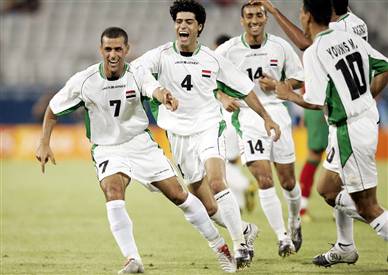
Soccer Diplomacy

Forget the World Cup head butt, football (soccer for those who think “football” is a foreign word for the world’s most popular sport) may now be one of the only bright spots in war-torn Iraq’s immediate future. In case you have not heard, the Iraqi National Team won the Asia Cup. They did it with Shi’a, Sunni and Kurd and without the threat of torture for a missed goal. Their star, Younis Mahmoud, scored the winning goal against Saudi Arabia. Soon after ordinary Iraqis took the streets with guns, but shot into the air in celebration rather than at each other. At least for one day. Simon Apter has a nice article about this in The Nation.

Iraq’s success in soccer is, perhaps, one of the few concrete triumphs to have come out of the quagmire. Call it a beneficent side effect. The WMDs were, indeed, not there, but the bastinado was, awaiting whomever Uday capriciously felt had embarrassed the country with a sub-par performance. Running possibly the only Ministry of Sport complete with a torture chamber and jail, Uday made Bob Knight look like Francis of Assisi. Continue reading Soccer Diplomacy

The Contribution of Overseas Doctors to Britain’s NHS


By Omar Dewachi

The recent failed terrorist plots that targeted the heart of London and Glasgow airport came as a shock for many as the identity and background of the suspects were revealed. Most of the detained were medical doctors who worked in Britain and who had Indian, Iraqi and Jordanian backgrounds. The fact that they were doctors was seen as a betrayal of the medical profession with its aim to save lives. However, the bigger shock in the UK was that these were overseas doctors who were working in Britain’s National Health Service (NHS), the main provider of health care to the country. As the new Labour prime minister, Gordon Brown, promised in his first press conference to review the NHS recruitment, more background checks and surveillance of overseas doctors is going to take place. However, one wonders how this surveillance is going to take place and who is going to pay its heavy price and consequences? Britain has always imported its medical staff from abroad using them as an expandable labor pool. In this wave of hysteria about background checks and surveillance, the contribution of the overseas medical population in building Britain’s NHS must not be forgotten. Continue reading The Contribution of Overseas Doctors to Britain’s NHS

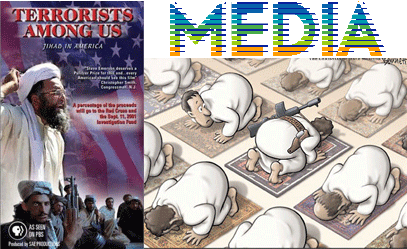
Exposing Extremism—No Matter Where It Is Found

By Bruce B. Lawrence

Robert Benchley, the American humorist, once quipped that “there are two categories of people in the world, those who constantly divide the people of the world into two classes, and those who do not.” Less funny, but persistent is the reflex to divide all approaches to Islam into two categories. The first are those who seek the truth in Islam. They ask: What are the various forms of Islam? How can we determine which is the true form of Islamic belief, and how do we know what are authentic norms for Islamic conduct? In opposition, there are those who have already decided there is no truth in Islam. Instead, they regard Islam itself as the true enemy—the enemy of global peace, the enemy of civil society and, above all, the enemy of Western civilization. Continue reading Exposing Extremism—No Matter Where It Is Found