All posts by tabsir

Sahara, My, My but it’s Dry

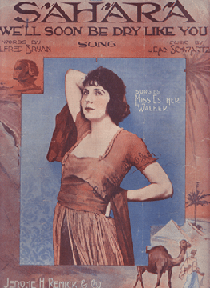
Vaudeville loved Orientalism. By the time Valentino played The Sheik, images of Middle Eastern scenes were well represented on stage and in music. Some of the lyrics from this time period are very clever. My personal favorite is a prohibition song from 1920 called “Sahara, We’ll Soon Be Dry Like You,” sung by the great comic singer Billy Murray. To hear this original Edison Diamond Disk recording in a digital format, click here.

Here are the words. Why not click above and sing along…


Sahara (We’ll Soon Be Dry Like You)

Words by Alfred Bryan, Music by Jean Schwartz

Verse 1: King Rameses went to pieces seven thousand years ago,
And pass’d a law that Egypt must go dry.
He took the liquors from the “shickers” all the way to Jericho,
But kept his little toddy on the sly.
The desert of Sahara flow’d with honey so they say,
Till prohibition came along and dried it up one day. Continue reading Sahara, My, My but it’s Dry
This Should Make You Quake


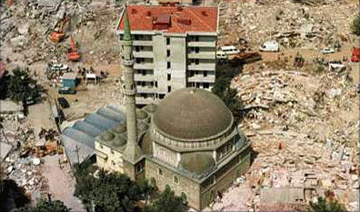
[A mosque still stands amidst the rubble of collapsed buildings in this aerial view of a neighborhood in the western Turkish town of Golcuk, 60 miles east of Istanbul, August 19, 1999.]

The recent earthquake in Peru, although not resulting in massive deaths, still has fallout which is more than nuclear. Turkey, Iran and Pakistan routinely have severe earthquakes, often resulting in the deaths of thousands. By an accident of sacred history, most of these victims are Muslim. In a number of ways these tragic events could be could be styled “an act of God.” To an insurance agent this would merely mean that it was one of those natural events which happen from time to time and are not covered in a standard policy. To Evangelical Christians, at least those who read KJV biblical prophecy as a Fox News documentary, it can easily become a special kind of act of God, not unlike the fire and brimstone that destroyed the wicked lot of Sodom and Gomorrah. But apocalyptic rhetor can boomerang, especially when the walls do not come tumbling down at the blasting away of the self-righteous. Continue reading This Should Make You Quake

This Split within Islam Must End

by Abdullah Al Rahim

What is it that makes people slaughter one another in the name of religion? Which among all these warriors can claim the integrity to dictate the terms by which God is to be venerated and who is to be slaughtered in God’s name? They call these sects Sunni and Shia. So I ask, which one of these post-Prophet innovations called sects did the holy Prophet Muhammad belong to? Which of these slaughters will he approve of, should he come back today?

We hear in mosques every time the word Bida’a [innovation] which is used to fight anything new we come up with, even if it is positive. So let me ask both, Sunnis and Shias: what are these sects? are they not innovations [Bida’a]? They are the most dangerous of all innovations which have never united but always divided the house of Islam. Continue reading This Split within Islam Must End

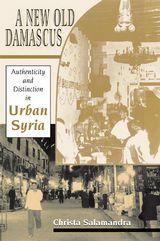
A New Old Damascus

by Christa Salamandra
Lehman College, CUNY

If you enter the Old City of Damascus at Bab Sharqi (the Eastern Gate), walk a few yards along a Street Called Straight, and turn down the first narrow alley on your right, you will find, jutting out from among the inward-looking Arab-style houses of this quiet residential quarter, a sign advertising “Le Piano Bar.” Enter through the carved wooden door, walk along the tile-covered foyer, under the songbird’s cage, past a display case strung with chunky silver necklaces, and step up a stone platform to the raised dining room. Here well-heeled Syrians sit at closely spaced tables, drinking arak and Black Label whiskey, and eating grilled chicken or spaghetti. The walls around are decorated, each in a different style. One features a collection of Dutch porcelain plates set into plaster. In another, strips of colored marble hold a series of mosaic-lined, glass-covered displays of wind instruments. A third wall features two floral wrought-iron gated windows draped in a locally produced striped fabric. Wrought-iron musical notes dance on the last. At the from of the long, arch-divided room is a huge mother-of-pearl-framed mirror. Set into the top of the mirror is a digital billboard across which Le Piano Bar’s menu and opening hours float repeatedly. Patrons listen politely as the proprieter sings “My Way” and other Frank Sinatra favorites to a karaoke backing tape. When he finishes, video screens tucked into corners feature Elton John song sing-alongs. Some nights a pianist and clarinetist play Russian songs as patrons clack wooden catanets. Continue reading A New Old Damascus

NYPD.EDU

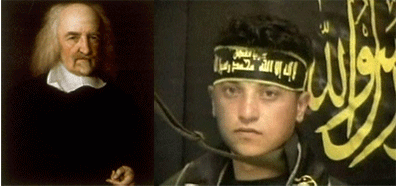
I write from the Syracuse International Airport, inside the security zone. Despite my guilty conscience, I passed the non-unionized TSA without a hitch. One guard even described my informal greeting as “the American way.” Would that other authorities so exercised their ethnographic faculties. But they do not, and recently two NYC cultural documents recalled our attention to this country’s addled take on religion, politics, and radicalism.

On Aug. 15, the NYPD published an “Intelligence Report,” which warns that Islamic radicalism is “permeating” (p. 66) New York City. Then on Aug. 19, Columbia University Professor Mark Lilla’s NY Times Magazine’s cover article ascribed the US-Islamic divide to the West’s advancement beyond, and Islam’s arrested adherence to, political theology. Continue reading NYPD.EDU

An Unbelievable White Man


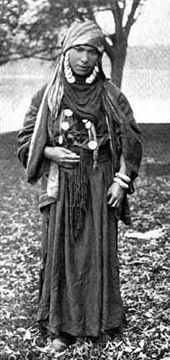
Syrian Bedouin girl at the 1893 Columbian Exposition

In his picturesque memoir of life in late 19th century Palestine, Philip J. Baldensperger recounts a number of adventures he had as a young man visiting his parent’s land with a Bedouin group. One of the foods loved by the Bedouin was the fruit of the doum palm. One day a group of Bedouin girls were surprised to see Philip’s white skin, something of a novelty at the time in rural Palestine. Here is his account:

“Being the only European, it was thought, in those days (1874), to be safer for me to wear Bedawi-clothing: a long shirt with broad, pointed sleeves hanging to the ground, a Sayé, and, on my head, a silken Kafiyé. With the exception of the girdle, which held the skirt and the Sayé together, the ‘Akal, or head-cird, wound around the Kafiyé, and a fringe of hair hanging over my forehead, in accordance with the fashion among Bedawîn youngsters, I was a figure in spotless white. In order to be able to walk more easily whilst on the march, I used to gather up the long folds of my dress and stick them in my girdle, leaving my legs bare. No wonder that one day four Bedawiyat, gathering Dôm-apples in the forest, fled with loud screams at my approach. Continue reading An Unbelievable White Man

Between Cairo and Oxford: An American Dilemma

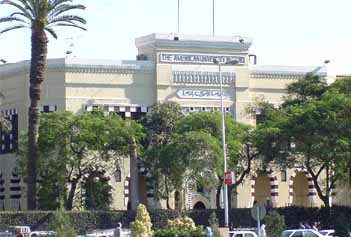
About seven years ago, I decided to accept an academic position at the American University in Cairo (AUC). This was well before 9/11, but it nonetheless sparked the same question from nearly every friend and relative: are you sure it’s safe? It was a reasonable question based on what little most Americans know about Egypt. “The Middle East” is known to be violent and volatile, hence Egypt must be so. Third World countries all hate Americans, so Egyptians must. And besides, Egypt is a desperately poor country, and we all know that poverty breeds violence.

Such perceptions have little to do with Egyptian realities. Continue reading Between Cairo and Oxford: An American Dilemma