All posts by tabsir

Open Letter to a Democratic President

by Richard W. Bulliet

January 21, 2009

Congratulations on your inauguration. May history remember your term in
office as the greatest political turn-around in American history.

Now to Iraq, the puzzle your predecessor has left for you to solve:

1. Compounding one botched war in Iraq with a second one in Iran would
sink your presidency before it starts. President Ahmadinejad of the
Islamic Republic of Iran will be up for reelection in seven months (August
2009). The Iranian people must be given an unfettered opportunity to
retire him to private life and elect someone of more liberal temperament.
His unpopularity in Iran already points in that direction. So, the United
States should do nothing that would enhance his prospects of reelection.
Diplomacy must replace saber rattling, and the “axis of evil” rhetoric
must be retired. Let us do what we can to give the Iranians a chance to
change leaders through their own electoral system.

2. Begin immediately the relocation of combat units to bases outside the
major cities of Iraq as a first step toward the withdrawal of ground
forces from the country. Announce that combat operations will henceforth
be restricted to fighting against those who attack American troops, supply
lines, or physical assets. Open negotiations with the Iraqi government
about the possibility of leaving a small number of combat units in the
country for a fixed and limited period to interdict the infiltration of
foreign fighters and — in joint operations with the Iraqi army — combat
groups that both the United States and the Iraqi government agree are
primarily composed of foreign terrorists. Continue reading Open Letter to a Democratic President
Keane on Mecca


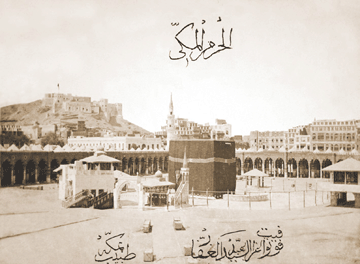
[Illustration: The ka‘ba in Mecca during the period of Ottoman Sultan Abdulhamit II.]

[Editor’s Note: As the holiest location in the Muslim World, the Arabian city of Mecca is prohibited territory for any non-Muslim. Over the years a number of travelers disguised themselves and visited the sacred enclosure of the ka’ba, most notably Johann Ludwig Burckhardt (1784-1817), who made his overture in 1812, and Richard Burton in 1853. In 1877 an Englishman named John Keane entered Mecca. His travel account is available online. Here is the story of that surreptitious visit, as told by Robin Bidwell.]

John Fryer Keane was the son of a clergyman and had run away to sea at the age of twelve. He spent most of the next nine years among Muslims, mainly as an officer on ships with Indian crews. He arrived at Jedda, attached himself to the suite of an Indian prince and after six weeks in Mecca felt as completely at home as if he had been there all his life. No one commented upon his fair skin for, as he said, the visitors were so varied that it looked like Madame Tussaud’s out for a walk and the spectacle of the Archbishop of Canterbury in a mitre would really have caused no comment. He wandered around happily, peering in through a school window to see the boys having the soles of their feet beaten in batches of five and chattering with a Muslim lady who, as Miss McIntosh, had been taken prisoner during the Indian Mutiny.

He was deeply impressed by the religious sincerity of the pilgrims and the deep spirituality that it engendered, but he cared much less for the resident population. Continue reading Keane on Mecca

On the Jihadwatch Watch

by Vernon Schubel, Kenyon College

I have been working on a book on Humanism in Islam and in an introductory chapter I dig deeply into Jihadwatch because I believe it is primarily designed to deny the humanity of Islam by reducing it to a totalitarian political system. I feel I need to bathe whenever I read Jihadwatch. Robert Spencer, David Horowitz and his compatriots often assert that they are not against Islam only “Islamo-facism.” But they in numerous places identify the two as the same. On its banner head, Jihadwatch.com has a link to a remarkable article by the author and film maker Gary P. Davis called “Islam 101,” which he describes as a summary of the ideas in his book, Religion of Peace? Islam’s War Against the World, and film, the equally ominously titled, Islam: What the West Needs to Know –an Examination of Islam, Violence and the Fate of the Muslim World. According to Davis, “Islam 101” is designed “to help people become better educated about the fundamentals of Islam and to help the more knowledgeable better convey the facts to others.” Davis warns his readers that Muslims and Muslim apologists will try to tell them that Islam is a “religion of peace.” But he tells them that this is not true. Instead he presents Jihad defined narrowly as armed warfare against non-Muslims as the core of Islam. And he argues that this is the case because Islam is not “a personal faith.” It is instead “a political ideology” that exists in a permanent state of war with non-Muslims. In fact Davis equates Islam with fascism saying:

The misbegotten term “Islamo-fascism” is wholly redundant: Islam itself is a kind of fascism that achieves its full and proper form only when it assumes the powers of the state.

In another place he states:

It is important to realize that we have been talking about Islam — not Islamic “fundamentalism,” “extremism,” “fanaticism,” “Islamo-fascism,” or “Islamism,” but Islam proper, Islam in its orthodox form as it has been understood and practiced by right-believing Muslims from the time of Muhammad to the present.

So it should be clear “Islamo-fascist awareness” is designed here to identify Islam with Fascism.

The fact that these people have access to power, media, and political campaigns is extremely serious. This needs to be challenged at every turn by pointing out that Islam cannot be reduced to isolated verses in its primary texts. Instead, Islam arises as the dialogue of Muslims with the Qur’an, the life of the Prophet and the events of its early history as they use those events to think and respond to their own current circumstances. Muslims are as diverse in their responses to their religious sources as any other religious tradition.

Image Wars and Westernization

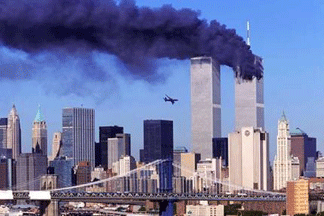
[On the sixth anniversary of the September 11 tragedy, it is worthwhile revisiting comments made soon after the event. The following is an excerpt from a commentary by Michael Sells, reflecting on events before Afghanistan was invaded and Iraq was occupied. His full reflections are available by clicking here.]

I’m been giving talks on the various components behind the current situation. Today’s rumination is sparked by an 8th grader question at a forum I was giving: “why can’t we find Bin Laden if he’s always on TV.” The question knocked me out. The 8th grader had hit upon a core problem.

Bin Laden is a guy living with the Taliban who have banned all images (except for identity card photos), blown up ancient Buddha’s, but who invite Western camera crews in to make videos of them themselves smashing TV’s, tearing up video and audio cassette film, and stomping on photographs. At the same time they encourage Bin Laden to make regular videos of himself to be shown throughout the world on a regular basis. And they invite Western media in to photography and image both Bin Laden and their ritual destruction of images and media. Continue reading Image Wars and Westernization

The Land and the Book #3: Under the Cedars of Lebanon

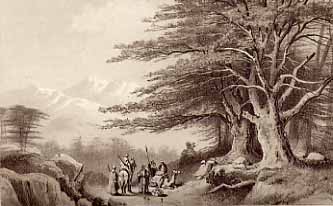
The Land and the Book by William Thomson revels in the open countryside, where the author would have the pilgrim join in under the stars, especially when the bed is stretched out in a grove of cedars on Mt. Lebanon. Here is the missionary’s description of the magic of the cedars over 150 years ago.

Have you ever visited these cedars?

Many times. They are situated high up on the western slope of Lebanon, ten hours south-east from Tripoli. Besherrah is directly west, in the romantic gorge of the Khadusha, two thousand feet below them, and Ehden is three hours distant on the road to Tripoli. In no other part of Syria are the mountains so Alpine, the proportions so gigantic, the ravines so profound and awful. You must not leave the country without visiting the cedars. Continue reading The Land and the Book #3: Under the Cedars of Lebanon

Debating Islamo-Fascism

[The message below was written by Marieme Hélie-Lucas, long time coordinator of the European Bureau of Women Living Under Muslim Laws, and was originally posted to the Women in Black (WIB) international list and reposted to ISLAMAAR, the discussion group on Islam of the American Academy of Religion, on September 6, 2007. Following her commentary is a response by Mohammed Fadel, who is on the faculty of the University of Toronto Faculty of Law. Both are commenting on the call by David Horowitz for an Islamo-fascism Awareness Week in October, posted upon earlier on Tabsir.]

Dear friends in WIB,
In response to the mail alerting us about this event against ‘islamo fascism’ led by conservative forces, I think there is a need for clarification from us, who lived under ‘islamo fascism’ :

First of all, let me say that the term ‘islamo fascism’ has been initially coined by Algerian people struggling for democracy, against armed fundamentalist forces decimating people in our country, then later operating in Europe, where a number of us had taken refuge. For us, it has never been equated to Islam, but it points at fundamentalists only : i.e. at political forces working under the cover of religion in order to gain political power and to impose a theocracy ( The Law – singular – of God, unchangeable, a-historical, interpreted by self appointed old men) over democracy ( i.e. the laws – plural – voted by the people and changeable by the will of the people). Continue reading Debating Islamo-Fascism