All posts by tabsir

Don’t Debate, Rehabilitate.

“Don’t debate religion with fundamentalists: what they need is rehabilitation”

by Saad A Sowayan

Fundamentalism is a cultural phenomenon, though it dons religious garbs. It is a mode of consciousness shaped by cultural values, not religious principles. Thus we can understand it only if we examine it in its cultural context as a sociological rather than a theological question.

So, I will begin by taking a close look at the social incubators most likely to hatch fundamentalism.

I understand by fundamentalism strong adherence to an archetypal point of view and a fierce conviction of its fundamental truth, to the exclusion of any other alternate idea. Any alternative is resisted by a fundamentalist and treated not as a legitimate substitute stemming from a rational free choice, but as a detrimental antithesis of the fundamental truth of the archetype. The archetype is a model to be emulated and reproduced, not dissected or scrutinized. Continue reading Don’t Debate, Rehabilitate.

Afghanistan: The Vaudeville Version

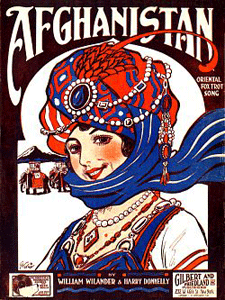
America not only flexes its military muscles and economic clout around the world, but at times takes the rest of the world for a song and dance. Vaudeville, the early 20th century dance hall and stage phenomenon, lyrically used and abused the world as a stage. But it seldom looked much like the real world of the time, and certainly not after almost a century later. Here was popular Orientalism, in the Valentino Sheik mode, for anyone who could afford sheet music. One of the wonderful nostalgic websites documenting this era is Parlor Songs, which publishes an online magazine.

If you would like to see how Vaudeville treated the Orient, check out the article by Richard A. Reublin in the 2005 issue. Among the songs discussed is “Afghanistan” written in 1920 by William Wilander and Harry Donnelly. Click here to listen to the song as you read the lyrics:

Afghanistan
A Romance of Asia
Words and Music by
William Wilander & Harry Donnelly
Published 1920 by Gilbert & Friedland, Inc.

[Verse 1]
In the land of Afghanistan,
There’s a Hindu maid and a man,
She swore by the stars up above her,
That he was the one to love her. Continue reading Afghanistan: The Vaudeville Version

Hip Hop Hijab Jabbing

To veil or not to veil: in Iran that is a question seemingly more relevant than getting an A-bomb. It is not so much the option of veiling as it is how to veil, how much to cover. With reports of a crackdown on what constitutes proper dress for Muslim women in public, the media has been flooded with stories of women with loose hijabs being harassed. For those who have bad feelings about Islam such stories add fuel to the fire of prejudice. But a toll is also taken on Muslims, especially in the West, who see themselves judged by the actions of an extreme case. Not surprisingly, some Muslims who do not see naked eye to veiled eye with the fashion enforcers in Iran are speaking hip hop to power.

Here on the Youtube Watch is an anti-hijab film by Mani Turkzadeh with a hip hop tune from GOZAR.

Creative Reckoning Today

[Note: If you are in the New York Metropolitan area, you may be interested in a lecture by Jessica Winegar at Alwan for the Arts this evening.]

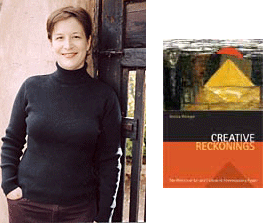
Creative Reckoning: The Politics of Art and Culture in Contemporary Egypt Creative Reckoning

Book Reading by Jessica Winegar

Tuesday, September 25, 2007 7 PM

Free and open to the public

Refreshments will be served

Creative Reckonings: The Politics of Art and Culture in Contemporary Egypt (Stanford University Press, 2006) is an ethnographic study of the intense debates over cultural authenticity and artistic value that occur in a postcolonial society undergoing market liberalization. Based on 33 months of fieldwork in Egypt, the book examines the creation, circulation, and commodification of art in the context of a globalizing cultural economy. Continue reading Creative Reckoning Today

Yemeni Tribes as Social Entities

Tribes should be social entities not political participants, says al-Dhaheri

Reported by Zaid al-Alaya’a, Yemen Observer, Sept. 22, 2007

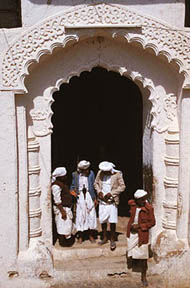
Dr. Mohammed Mohsen al-Dhaheri, chairman of the Political Sciences Department at Sana’a University, spoke with the Yemen Observer about the contemporary role of tribes in the governance of Yemen and the conflict between the traditional and modern authorities. He is the author of two books about the socio-political relationship between the tribes and the state in Yemen.

Yemen Observer: What do you think of the newly established National Solidarity Council, and what do you think prompted its establishment?

Dr. Mohammed al-Dhaheri: First, I would like to say that this is what we can call political meddling. Tribes in Yemen have certain mechanisms to demand their rights. For example, some tribes will block highways or kidnap foreigners to add urgency to their demands. I can not put this council in the frame of a tribal bloc. It is can not what I would call a tribal council nor is it a partisan council. You can see that politicians meet with the sheikhs and with the academics. The council represents a period in tribal meetings that Yemen has not witnessed before. You can not call it an opposition entity as it has many members from the GPC, and academics etc. As you see there is a sort of dichotomy that starts to prevail in Yemen. This council has encountered other gatherings from tribes led by Sheikh al-Shaif. Continue reading Yemeni Tribes as Social Entities

Astrolabes and Angels, Epigrams and Enigmas

AN INTRODUCTION TO THE DE REGIO MONTE CODE, CARDINAL BESSARION’S AGENDA, AND PIERO DELLA FRANCESCA’S ENIGMA

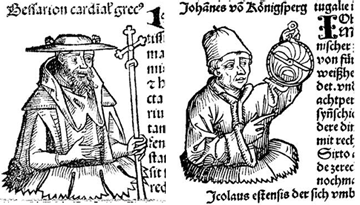
[The noted historian of Islamic science, David A. King, recently retired from his position as Professor of the History of Science at Frankfurt University, has published a new book on two of the most remarkable objects surviving from the Renaissance, one an astrolabe and the other a painting. The connection between the two is described in detail in his new book Astrolabes and Angels, Epigrams and Enigmas – From Regiomontanus’ Acrostic for Cardinal Bessarion to Piero della Francesca’s Flagellation of Christ, Stuttgart: Franz Steiner, 2007. An associated website is http://web.uni-frankfurt.de/fb13/ign/Code.htm.]

Only recently have we achieved a better understanding of two monuments to the intellectual genius of the Renaissance, both of which have caused scholars a lot of trouble over several decades. As it happens, the two are intimately related.


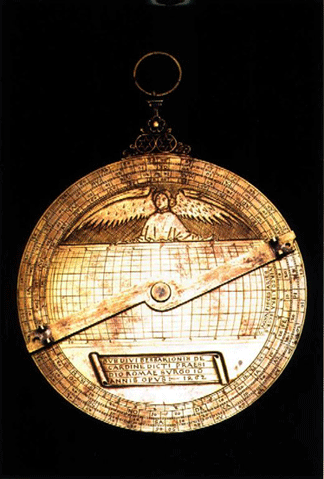
The back of the astrolabe made by Regiomontanus for Cardinal Bessarion, with an inscription or epigram and the image of an angel.

One is an astrolabe, presented to the ageing Greek Cardinal Bessarion in Rome, 1462, by his new protégé, the young German astronomer Regiomontanus. Continue reading Astrolabes and Angels, Epigrams and Enigmas

Bush BePHuDdled

I just finished watching Bush’s press conference on Thursday. At one point Bush said (and this is paraphrased a bit from memory), “It’s like I tell Condi. Look at who is the c-student and look at who is the Ph.D. . Now, look at who is the President and who is the advisor.” This was followed by lots of laughter from the press corps. Leaving aside that George W. Bush seems to think he could have attained the presidency as a c-student if he was not a DKE, a millionaire, and the son of a president I am tired of hearing higher education derided by people in power.

I think we need to defend the concept of the Ph.D., especially with regard to the study of Islam. Continue reading Bush BePHuDdled

The Mess in Mesopotamia


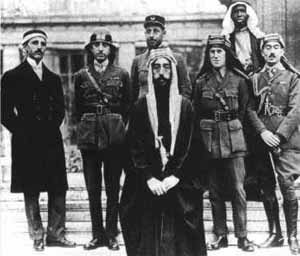
King Feisal, center, with Colonel Lawrence next to him to the right


[Given the surge in bad news from Iraq these days, it may be useful to reflect on the assessment of the British involvement in Iraq as a mandate almost nine decades ago. The words of T. E. Lawrence resonate with the situation today.]

22 August, 1920
A Report on Mesopotamia by T.E. Lawrence
Ex.-Lieut.-Col. T.E. Lawrence,
The Sunday Times, 22 August 1920

[Mr. Lawrence, whose organization and direction of the Hedjaz against the Turks was one of the outstanding romances of the war, has written this article at our request in order that the public may be fully informed of our Mesopotamian commitments.]

The people of England have been led in Mesopotamia into a trap from which it will be hard to escape with dignity and honour. They have been tricked into it by a steady withholding of information. The Baghdad communiques are belated, insincere, incomplete. Things have been far worse than we have been told, our administration more bloody and inefficient than the public knows. It is a disgrace to our imperial record, and may soon be too inflamed for any ordinary cure. We are to-day not far from a disaster. Continue reading The Mess in Mesopotamia