All posts by tabsir

Secrecy and Anthropology

by Elizabeth Redden, Inside Higher Ed, December 3

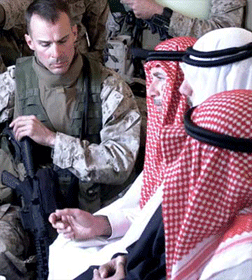
With debate over the role of anthropologists in aiding the military machine a theme threading through their annual meeting, scholars voted Friday to demand that the American Anthropological Association reinstate strict language from its 1971 code of ethics prohibiting secret research. Members at the meeting – who, for the second time in about 30 years and the second year in a row constituted a quorum in excess of the required 250 — also voted overwhelmingly to oppose “any covert or overt U.S. military action against Iran.”

The language anthropologists want reinstated on secrecy – which, the resolution’s sponsor affirmed would apply to anthropologists doing work for corporations too – stipulates that “no reports should be provided to sponsors that are not also available to the general public and, where practicable, to the population studied.” Like every item of business discussed Friday other than the resolution on Iran, the resolution on secrecy was not filed for consideration 30 days in advance, as is required under association rules, and so will be submitted to the association’s executive board on an advisory basis only.

But Friday’s vote only strengthens a recommendation contained in a new report from the AAA Commission on the Engagement of Anthropology with the U.S. Security and Intelligence Communities, which suggests that the membership or ethics committee “should consider” reinstating those same sections (1.g, 2.a, 3.a, and 6) of the 1971 code. The report centers on whether the association’s ethical standards bar ties to the military or intelligence agencies. The commission’s short answer: Not necessarily, although more scrutiny is needed. Stressing the diversity of roles anthropologists can play in military and intelligence apparatuses, the panel determined that while certain interactions would violate the ethical code, members also “see circumstances in which engagement can be preferable to detachment or opposition.” On issues of secrecy, for instance, the commission offered one particularly complex dilemma as illustration: “Some situations might be counterintuitive for most of us: consider a situation in which a research project is kept secret from the scholarly community, but not from the local population or community under study – as when an anthropologist employed by a government agency helps a special operation to get medical supplies to a remote town in northern Afghanistan.” Continue reading Secrecy and Anthropology

The Ninth International Symposium on Comparative Literature

Call for Papers
The Ninth International Symposium on Comparative Literature
November 4-6, 2008
Department of English Language and Literature, Cairo University
“Egypt at the Crossroads: Literary and Linguistic Studies”
Deadline for abstracts: March 15, 2008

Because of its geographical, historical, and cultural placement, Egypt has been—since time immemorial—both literally and metaphorically at the crossroads. Enjoying the strategic location that it does—at a meeting point between Africa and Asia, facilitating contact between the two continents and Europe, and at a juncture between the Mediterranean and the Red Sea—Egypt is a rich amalgam of diverse cultural heritages: Ancient Egyptian, Greek, Roman, Persian, Coptic, Islamic. Influenced by all these and, in modern times, the French and British, the inhabitants are in the happy position of being hybrid—African, Arab, Mediterranean—but indubitably and inimitably Egyptian. It is, perhaps, this unique situation that inspired the Egyptian geographer Gamal Hamdan (1928-1993) to write of Egypt as having a “natural gift” which may explain “the secret of Egypt’s survival and vitality through the ages and in spite of the ages.” Continue reading The Ninth International Symposium on Comparative Literature

A Royal Ransom for the Book of Kings

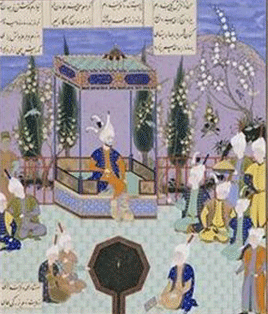
Looking for the perfect Christmas or Eid present? Well, if you have little spare cash but love rare books, why not mortgage the farm and go for one of the most beautiful illustrated manuscripts of all time, The Shahnameh of Shah Tahmasb Safavi in its Houghton manuscript form. This facsimile set of two volumes was edited by Martin Bernard Dickson and Stuart Cary Welch in 1981 and published by the Fogg Art Museum of Harvard University. And it is available for only $1495.00 plus shipping. Here are the details and it can be ordered by clicking here:
Continue reading A Royal Ransom for the Book of Kings

Keeping Mecca Flu Free

Bird Flu Measures in Place

by Faleh Al-Thibyani, The Saudi Gazette, Sunday, 25 November 2007

RIYADH – Measures will be in place to prevent an outbreak of avian flu in Makkah and Madina during the upcoming Haj season, a Ministry of Health spokesperson said.
Pilgrims coming from the Central Region, where the disease broke out last week, will undergo stringent medical checks, the spokesperson said.

Health Minister Dr. Hamad Al-Manie is due to attend a meeting of the Haj Preparation Committee in this regard Sunday.

Minister of Agriculture Dr. Fahd Balghunaim, meanwhile, said the public would be promptly informed about ongoing efforts to prevent the disease from spreading further.

So far, 3.5 million chickens and other birds have been culled since the disease was detected at a farm in Al-Kharj, and the ministry would not hesitate to eliminate all chickens in the Kingdom in order to protect its citizens and residents, Dr. Balghunaim said. Continue reading Keeping Mecca Flu Free

Al Qaeda’s generational split

by Gregory D. Johnsen
The Boston Globe, November 9, 2007

RECENT CONFUSION over the status of Jamal al-Badawi, one the masterminds of the attack on the USS Cole in Yemen in 2000, illustrates the difficulties of containing an increasingly fractured jihadist movement. Badawi, who escaped from prison early last year, had surrendered to the Yemeni government in early October, only to be released as part of a plea deal. These events have sparked confusion and anger in the United States.

In Yemen, meanwhile, authorities have continued to make misleading and ambiguous statements about his whereabouts. It would be easy to assume, as many have done, that the country’s reaction was that of a reluctant ally eager to shirk its responsibility in the war against Al Qaeda. This reading, as Rudy Giuliani suggested, demands that the United States threaten Yemen with a reduction in aid.

But what to the United States is a cohesive organization bound together by a common hatred is to Yemen a fragmented movement that is rife with infighting and dissension. Continue reading Al Qaeda’s generational split

A footnote in history

By Clayton Swisher, Al-Jazeera, November 26, 2007

The decision by all Arab governments – including Saudi Arabia and Syria – to partake in the Annapolis meeting is a significant advance, and likely to form a footnote in history. Unfortunately, I believe that is as far as it will go.

There are three primary reasons why I do not believe the Annapolis meeting will succeed in establishing a Palestinian state by the end of the US president’s term in office.

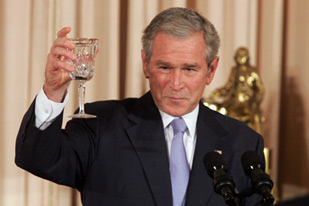
The first is that this is not George Bush’s clearly stated objective. Whatever Condoleezza Rice, the US secretary of state, may intend, it is the president who is in charge.

Little understanding

Bush’s beliefs are steadfast, and they reflect little understanding of Palestinian realities: On the one hand, Bush seeks mileage out of the false claim that he is the first US president to call for the creation of a Palestinian state, and he emphasises his plans to “lay the foundation” for the said state. Continue reading A footnote in history

Darkness Falls on the Middle East

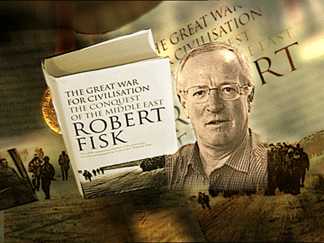
by Robert Fisk
The Independent, 24 November 2007

In Beirut, people are moving out of their homes, just as they have in Baghdad.

So where do we go from here? I am talking into blackness because there is no electricity in Beirut. And everyone, of course, is frightened. A president was supposed to be elected today. He was not elected. The corniche outside my home is empty. No one wants to walk beside the sea.

When I went to get my usual breakfast cheese manouche there were no other guests in the café. We are all afraid. My driver, Abed, who has loyally travelled with me across all the war zones of Lebanon, is frightened to drive by night. I was supposed to go to Rome yesterday. I spared him the journey to the airport.

It’s difficult to describe what it’s like to be in a country that sits on plate glass. It is impossible to be certain if the glass will break. When a constitution breaks – as it is beginning to break in Lebanon – you never know when the glass will give way. Continue reading Darkness Falls on the Middle East

Pakistan’s tribal chieftains exploit state collapse to assert local power

[Editor’s Note: there is an interesting new post by Hamid Hussain on Saudi Debate about the current strife in Pakistan and its relation to the situation in Afghanistan. Here is an excerpt from the end of his commentary, the full version available at http://www.saudidebate.com/index.php?option=com_content&task=view&id=952&Itemid=181.]

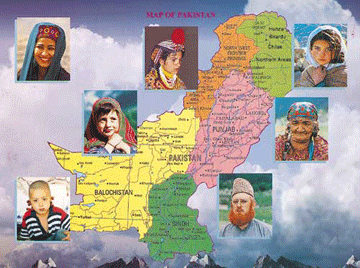
In general, Pakistani society is in a state of denial refusing to acknowledge the looming threat to the very national fabric of the society. Majority see current conflict only through the prism of anti-Americanism. In the absence of reliable information, opinions are being formed on the basis of rumors, suspicions and conspiracy theories. On one end of the spectrum is the opinion of use of overwhelming force to crush the challenge to government authority and on the other end some are advocating that government simply abandon its primary responsibility and pull out all security forces. Everyone is mute about what will happen next; i.e. after large scale destruction from a sledgehammer approach or after pulling security forces out without any mechanism in place and giving free hand to militants. Average citizen wakes up every morning to see another horrific case of brutality and wanton violence. Continue reading Pakistan’s tribal chieftains exploit state collapse to assert local power