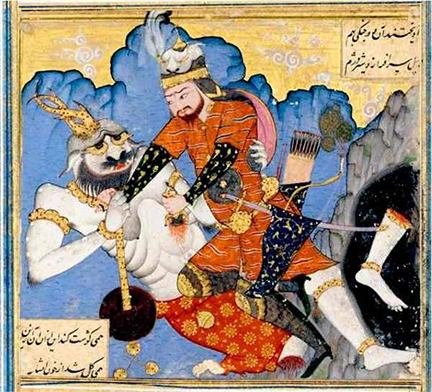
Rustam fighting a Jinn from a medieval Islamic manuscript
Anyone who has read about Aladdin knows about the genie in a lamp. The English term “genie” stems from the Arabic “jinn,” a reference to spirits in various physical forms that are said within traditional Islamic theology to have been created from fire. Artistic representations of the jinn are varied, but often show monstrous and distorted bodies. A collection of illustrations can be found online here. From our modern perch, such depictions belong to fantasy and science fiction. But literalists who seek to return to the way of thinking, although selectively, of what they think was thought at the time of the Prophet seem to believe in the jinn as part of an apocalyptic scenario for the end of the world.
While denouncing those who would walk into a bar and order gin and tonic, the extreme salafi belief in a real-life jinn is just as toxic, and not simply to one’s sobriety. I grew up in a Fundamentalist Baptist church where belief in the Devil, evil spirits and angels was prominent. It was convenient to have the Devil. a.k.a. Satan, around to explain why bad things kept happening to otherwise good people. The philosophical question of the “problem of evil” and how a just and loving God could allow such evil in the world was evaded by saying that God was allowing Satan to control the world. Life, thus, was a test and one that no one could win alone. Hence the need to put a “Jesus saves” bumper sticker on your car and condemn the “unsaved.”
There are few greater evils in the world today than belief in an unseen evil power that serves as the excuse to explain why there is so much hatred, prejudice, violence and killing. The Christian doctrine of “original sin” shifts the blame back to a naked Adam and Eve, who dared to seek the knowledge of good and evil. Islam avoids original sin, but nevertheless there have been many Muslims who justify evil in this life. Reports of ISIS fanatics who rape Yazidi women as a duty to their faith is a case in point. So is the mantra that the caliph or ruler must be obeyed, no matter how unfair, corrupt and evil he is. The old Manichean dualism of an eternal battle of good vs. evil is not only maintained, but magnified.
I wish there really were jinn and that they would show themselves so that modern day Rustam’s could battle them and conquer the fear of such beasts. It is the fear of the invisible that is the greatest fear to overcome.