All posts by tabsir

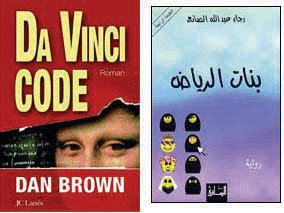
The Da Vinci Code and the Girls of Riyadh

By Hussein Shobokshi for the Yemen Observer, June 27, 2006

Dan Brown’s novel The Da Vinci Code has been translated into 40 languages, including Arabic. The book has been adapted into a film showing all over the world, reaping millions of dollars. The story, as the majority of people know, questions the life of Jesus and claims that he married Maria Magdalene and fathered her child.

The suggestion has caused much controversy and has been strongly condemned by various Christian sects, which eventually led to the film being banned in Egypt and Lebanon (the book is sold in Egypt, but is censored in Lebanon). What was noticeable however was that the request for censorship in the Egyptian Parliament was made by Muslim MPs, who wanted to express their solidarity with the Copts and to defend Jesus. Continue reading The Da Vinci Code and the Girls of Riyadh
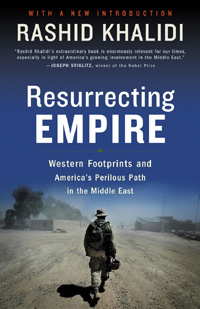
Resurrecting Empire in Iraq

By Rashid Khalidi, Columbia University

The United States, and the world, now faces a situation of unprecedented difficulty in Iraq. There is deep resentment among Iraqis, including those grateful for the overthrow of the Ba’th regime, at the months of chaos in Iraq since the end of the war, at the unresponsiveness of the American occupation authorities, and at the slow pace of the move toward genuine self-government. American troops increasingly risk being received as are most occupation armies, and as were the British in Iraq after World War I: with hostility and ultimately with widespread armed resistance. The paralysis of the American authorities in Baghdad, which reflects the paralysis in Washington, as the administration’s factions struggle over decisions in Iraq, and the inflexible, highly ideological, and ultimately self-defeating line that has generally prevailed, have exacerbated the situation. Reliance on Pentagon-favored exiles loathed by most Iraqis, who see them as carpetbaggers, has already hurt the position of the United States in Iraq, an may lead to an even worse situation there when the inevitable backlash against their machinations sets in. This is only the tip of the iceberg, as is manifest from reporting in the non-American media on the situation on the ground in Iraq, one whose gravity has not been fully reflected in the American media—although American casualties in Iraq, and lengthy deployments of both regulars and reservists finally seem to be having an impact on American public opinion. Continue reading Resurrecting Empire in Iraq

Twain on the New Year

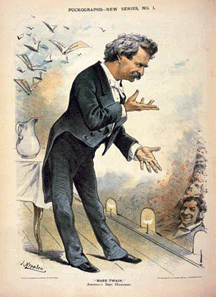
The more things change, the more they remain the same. Mark Twain did not say that, but consider his greeting from the 19th to the 20th century, published in the New York Herald on December 30, 1900:

I bring you the stately nation named Christendom, returning, bedraggled, besmirched, and dishonored, from pirate raids in Kiao-Chou, Manchuria, South Africa, and the Philippines, with her soul full of meanness, her pocket full of boodle, and her mouth full of hypocrisies. Give her soap and towel, but hide the looking glass.

Who Owns the Holy Land?

As another year draws to a close, it is hard not to think in larger terms of the course of the last century. The world has seen two world wars and far too many atrocities since 1908 to think of our technological and commercially driven age as golden. But in it all there has been humor. Believe it or not, the American writer Mark Twain was still alive one hundred years ago. His greatest books belong to the century before, from the mother of all Holy Land travelogues, Innocents Abroad, to Huckleberry Finn and his adventurous friend Tom Sawyer. Surely one of the greatest humorists ever, Mark Twain did more than tell funny stories. His work survives in part because it uses humor to remind us of the unfairness and unwavering mundaneness of life.

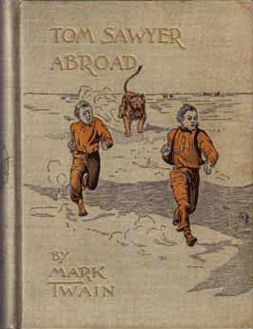
In Tom Sawyer Abroad Twain offers a vivid critique of the kind of Orientalism that Edward Said rightly views as a style for dominating the Orient. Continue reading Who Owns the Holy Land?

The Seller of Sweet Words

[Note: The most notable, at least in the Nobel laureate sense, Arab writer of literature is the Egyptian Naguib Mahfouz, who passed away in 2006 . Among his many novels, several of which are available in English translation by Doubleday Press, is the classic “Midaq Alley”, written more than six decades ago, but still a vibrant testament to the universality of human foibles in a literary mirror. Below is one of my favorite character descriptions in the novel. If you have not yet read “Midaq Alley”, then do so as soon as you can, and taste the sweet words (even in translation) for yourself.]

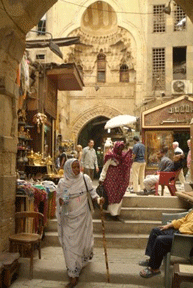
Many things combine to show that Midaq Alley is one of the gems of times gone by and that it once shone forth like a flashing star in the history of Cairo. Which Cairo do I mean? That of the Fatimids, the Mamlukes, or the Sultans? Only God and the archaeologists know the answer to that, but in any case, the alley is certainly an ancient relic and a precious one. How could it be otherwise with its stone-paved surface leading directly to the historic Sanadiqiyya Street. And then there is its café known as Kirsha’s. Its walls decorated with multicolored arabesques, now crumbling, give off strong odors from the medicines of olden times, smells which have now become the spices and folk cures of today and tomorrow…

Although Midaq Alley lives in almost complete isolation from all surrounding activity, it clamors with a distinctive and personal life of its own. Fundamentally, and basically, its roots connect with life as a whole and yet, at the same time, it retains a number of the secrets of a world now past. Continue reading The Seller of Sweet Words

While in the Other Manger …


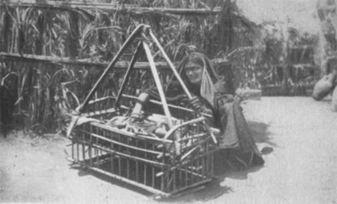
Date Stick Cradle, from Zwemer’s book.

Christmas Eve is the time for reflecting on a baby in a manger in Bethlehem, three kings bringing spices and shepherds blinded by angel light. Christians around the world celebrate this scene, but what do they think of all those other babies who were not destined to become religious icons? Back in 1902 the Christian missionary Samuel Zwemer and his wife Amy teamed up to write a children’s book about Topsy-Turvy Land. For more information on this apologetic diatribe against Islam and Arabs, click here. As the authors claim, “In Topsy-turvy Land all the habits and customs are exactly opposite to those in America or England.” And where is this mythical garden of play for good Christian children? Arabia, specifically an Arabia in which the Ottoman Empire still had steam. For a good-old-boy, old-fashioned religion view of the “Arab” child as a topsy-turvy other, this is as prime a piece of apologetic and Orientalist dismissal as you can find. So take a look in the other manger, as the evangelistic Zwemers did a mere century ago…

ARAB BABIES AND THEIR MOTHERS

An Arab baby is such a funny little creature! In Christian lands babies, as soon as possible, are given a warm bath and dressed with comfortable clothing. But in Arabia the babies are not washed for many days, only rubbed over with a brown powder and their tiny eyelids painted round with collyrium. They are wound up in a piece of calico and tied up with a string, just like a package of sugar. Continue reading While in the Other Manger …