All posts by tabsir

Islam and Jesus

An Opportunity to Discuss Our Knowledge of Mohammed and Jesus
by Dr. Zein Al Abdeen Al Rekabi, Asharq Alawsat, Tuesday 08 January 2008

The Archbishop of Canterbury, Dr. Rowan Williams, has urged Muslims to learn about Christian culture. This appeal, diplomatic as it is, is based on the assumption that Muslims are “ignorant” of Christianity, or at least know very little about it.

To begin with, we should welcome, and even accept any invitation to further our knowledge because, for the respectable and wise, it is a perpetual pursuit. Moreover, God has urged Muslims to know other peoples and nations and interact with them. This is explicit in the following verse: “Oh mankind! We created you male and female and divided you into tribes and nations, so that you may come to know each other,” (Surat al Hujurat 49:13). In this global human acquaintance and interaction endorsed by the Quran, learning of other nations’ cultures is a primary asset among others.

At the beginning of this commentary or discussion we present to the Archbishop a supreme truth: knowledge of Jesus son of Mary, and belief in him are integral to the Islamic faith, since they are pillars of the faith, and a Muslim’s faith is considered incomplete without it. What follows is verification from the Quran and Sunnah: Continue reading Islam and Jesus
Out-of-Print CCAS Occasional Papers now Available Online

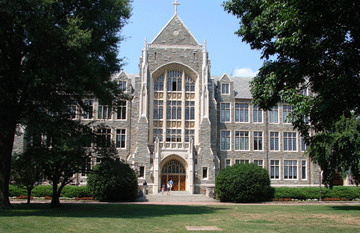
By L. King-Irani, Georgetown Center for Contemporary Arab Studies, October 22, 2007

Dissemination of information and analyses within and beyond the scholarly community is a key priority for the Center for Contemporary Arab Studies. The Center’s Multimedia, Research and Publications office publishes a prestigious Occasional Paper series featuring works by scholars, journalists, policy makers and field experts three to four times each year. This series now includes nearly 100 works covering a wide variety of subjects and perspectives on the Arab world. In addition, the series also includes transcripts of discussions among key players in the U.S. and the Arab world, such as Uncovered: Arab Journalists Scrutinize Their Profession, which features prominent Arab journalists’ analyses of press freedom and responsibility across the region. Forty of the Center’s Occasional Papers are now online.

The following six Occasional Papers have just been added to the group available in PDF format, two of them, Talal Asad’s The Idea of an Anthropology of Islam, and the late Hanna Batatu’s The Egyptian, Syrian and Iraqi Revolutions: Some Observations on Their Underlying Causes and Social Character, have been among the most popular and requested Occasional Papers over the last two decades. Continue reading Out-of-Print CCAS Occasional Papers now Available Online

Cannons of the Past


Woman and a Fish, Asma al Fayoumi, Syria 1993

by Najeeb Nusair. Translated by Christa Salamandra and Suhail Shadoud
from Artenews, October, 2007

However much we moan and groan, however much we lament, reminisce, mull over, write, dig up, represent, glorify, venerate—even if we use the entire vocabulary of literature and science to conjure it up, the past will not return. Even if we cry, kick the ground with our feet like temperamental children, beg people, societies and nations, even if we consult scholars, historians, doctors, and feminists… the past will not return.

Instinctively we remember, as we practice our everyday cultural life, lavishly praising the past, and seeking to retrieve it in any possible way. But the past is within us; it has not and will not leave us. Asking for it to return is asking for what has fallen away, is gone, because it no longer works and has expired. The past is a gigantic mass, some of which is relatively good, and remains within us, and much of which time has consumed and flung aside, like lines in an arcane, long forgotten book. Continue reading Cannons of the Past

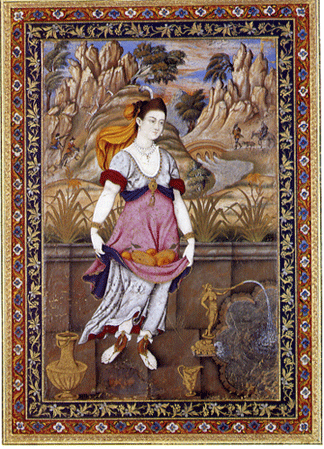
Woman by a Fountain

We are accustomed to Persian miniatures which depict the “Oriental” face, but later Persian art at times draws on Italianate style. The example above is entitled “Woman by a Fountain” and was painted by ‘Ali-Qoli Beyg Jebadar, around 1660 ce, probably in Isfahan.

Illustration from Abdolala Soudavar, Art of the Persian Courts (New York: Rizzoli, 1992), p.370.

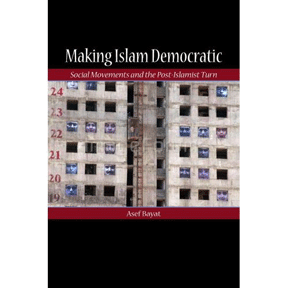
Making Islam Democratic: Social Movements and the Post–Islamist Turn

Book Review of Making Islam Democratic: Social Movements and the Post–Islamist Turn (Asef Bayat)

by Richard Bulliet
Published on NYU Center for Dialogues website

Discussions of contemporary Islam in the United States tend to be held in black and white, with the religion depicted either as a backward, dangerous and hateful force, or as a misunderstood and moderate foundation for peaceful living. Discussions in Europe range over a somewhat larger spectrum because they are often based on experiences with immigrant communities, and usually engage cultural issues in addition to security–related ones.

The most colorful and useful expositions for readers in search of a deep understanding of Islam today, however, are those based on detailed and long–term observations made in Muslim–majority countries, where interactions with Euro–American sensibilities do not confound the issue. Having said that, the drawback with such in–depth analyses is that they typically examine a single country, leaving it to readers to decide how similar or dissimilar Muslim life in Morocco, say, is from that in Bangladesh or Somalia. Continue reading Making Islam Democratic: Social Movements and the Post–Islamist Turn

Research Fellowship on Muslim Modernities

2008 DPDF Research Field:
Muslim Modernities

Research Directors: Charles Kurzman and Bruce B. Lawrence

Islamic fundamentalists and Western Orientalists often emphasize pre-modern resonances in contemporary Muslim communities. Over the past generation, by contrast, an interdisciplinary set of scholars has come to emphasize the ways in which Islamic historical heritages are extruded, redefined, or invented through modern processes. We label this emerging field “Muslim Modernities.”

The idea of modernity was invented in Western Europe to distinguish the region from the rest of the world, including Muslim societies. Scholars disagreed about what modernity consisted of — capitalism, division of labor, rationalization, reflexivity, etc. — but broadly agreed that these were characteristics of the West and not of other societies. Increasingly, however, the study of Muslim communities has contributed to a re-thinking of the West’s monopolistic claims to modernity. Instead of measuring modernization as the adoption of Western institutions and norms, these studies have explored the development of alternative forms of modernity. These alternative forms are modern in three potentially distinct ways: their proponents claim that they are modern; they are recent, not found in “tradition,” though sometimes imposed retroactively on tradition; and they exhibit characteristics frequently associated with Western modernity, such as universalism, rationalization, and reflexivity. Continue reading Research Fellowship on Muslim Modernities

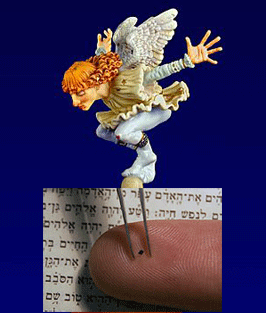
Pin the Biblical Tale on …

Riddle of the day (stretching back a bit): How many angels can dance on the head of a pin? Before you answer, here is what the theologian St. Aquinas had to say:

Q. 52, a. 3 – “Whether Several Angels Can Be At The Same Time In the Same Place? There are not two angels in the same place. The reason for this is because it is impossible for two complete causes to be immediately the causes of one and the same thing. This is evident in every class of causes. For there is one proximate form of one thing, and there is one proximate mover, although there may be several remote movers. Nor can it be objected that several individuals may row a boat, since no one of them is a perfect mover, because no one man’s strength is sufficient for moving the boat; the fact is rather that all together are as one mover, in so far as their united powers all combine in producing the one movement. Hence, since the angel is said to be in one place by the fact that his power touches the place immediately by way of a perfect container, as was said (Q. 52, a. 1) there can be but one angel in one place.”

So the devout answer would be “one,” assuming it was an angel who knew how to dance.

Next riddle: How many Bible tales can you inscribe on the head of a pin? Here is what the BBC has to say: Continue reading Pin the Biblical Tale on …

Yemen College of Middle Eastern Studies


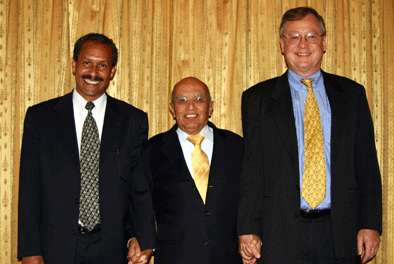
left to right, Sabri Saleem, founder; Dr. ‘Abd al-Karim al-Iryani; Dr. Steven Caton, Dean

by Bradley Heinz, Yemen Observer, January 5, 2008

Sana’a may well be on its way to hosting the leading center for scholarship of the contemporary Middle East, so say members of the Board of Governors of the newly organized Yemen College of Middle Eastern Studies (YCMES). In preparation for the inaugural year, prominent scholars, businessmen, and diplomats from Yemen and beyond met Thursday to discuss the logistics and direction for Yemen’s newest teaching and learning center. The meetings are set to last through Saturday and are being held at the Taj Shiba Hotel.

“These meetings are extremely important. They’re the beginning of the realization of an educational vision in the making for years,” said Steve Caton, Dean of the new college and an anthropologist who studied the role of poetry in Yemeni society. Continue reading Yemen College of Middle Eastern Studies