All posts by tabsir

Norma’s Take on Carthage

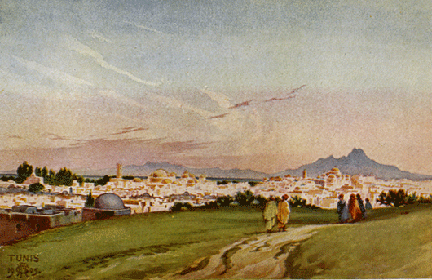
Thousands of English and American travelers have written about their experiences in the Arab World. Quite a few are worth reading, but the majority deserve obscurity. In a recent book sale at my university library, a pitiful travel account of the roaring 20s was remaindered. It bodes well for my institution that it was never checked out, although I wonder how it entered the stacks in the first place. The book in question is By the Waters of Carthage, by Norma Octavia Lorimer, following on her By the Rivers of Sicily and By the Rivers of Egypt. Why she never set sail down the Tigris by the reggae-beloved rivers of Babylon is anyone’s guess. This baneful little volume about a fickle English lady set loose in Tunis represents just about everything wrong with Orientalist inferiorizing of cultures in the Middle East. The only redeeming features are the colorful frontispiece (shown above) and black-and-white photographs of life in Tunisia around 1920.

Sometimes it is useful to read bad text in order to appreciate good travel writing all the more. There is probably no bias that does not surface in Lorimer’s diary-prone prose, all the more chauvanized by her style of filling her chapters with letters to her dear husband. Consider the following tidbits… Continue reading Norma’s Take on Carthage


A Rose for the Last Days

by Rana al-Tonsi [Translated from Arabic by Sinan Antoon]

On one foot
like a humiliated beggar I limp
past all the swinging doors
and the flags that are taken down from their masts . . .
The sidewalk was never my friend
but it embraced me those times
when the crying was tough and bitter

In my country
soldiers go to a war
where they never fight
In every coffeehouse or square
under the feet of the sick, the sad and insane
you can glimpse the trace of a rose
thrown into the arms of nurses
in lonely rooms inhabited by wailing,
a rose drawn in blood. Continue reading A Rose for the Last Days

The Girl of Qatif


Saudi judge ignores Quranic rights in harsh decision over the ‘Girl of Qatif’

By Khalid Chraibi
Arablife.org, Tuesday, 22 January 2008

In a memorable scene in Ingmar Bergman’s movie Wild Strawberries, Isak, the central character, dreams that he is standing in court, waiting to be sentenced. But he has no clue as to the charges against him. When the judge declares him guilty, he asks, bewildered: “Guilty of what?” The judge replies flatly: “You are guilty of guilt”. “Is that serious?” asks Isak. “Unfortunately,” replies the judge.

The verdict in the case of the ‘Girl of Qatif’, as the incident has become known worldwide, is as bewildering to most people as the judge’s verdict was to Isak. How can a young bride of 18 who has been subjected to the harrowing experience of being blackmailed by a former ‘telephone boyfriend’, then gang-raped 14 times in a row by seven unknown assailants, be further brought to trial for the offence of khalwa and condemned to 90 lashes? How does one justify raising the punishment to 200 lashes and 6 months in jail when she appealed the first sentence?

The case had all the necessary ingredients to become an instant cause célèbre, when word of it reached the global news agencies. It received very large coverage in the media, with the verdict being criticized by commentators, politicians and citizens in all walks of life, within the region and in far away countries.

Amnesty International protested against the flogging verdict (which was also applicable to the men involved in the case), observing that “the use of corporal punishment constitutes cruel, inhuman and degrading punishment.” It added that “the criminalisation of khalwa is inconsistent with international human rights standards, in particular, an individual’s right to privacy.” The sentence against the ‘Girl of Qatif’ and the boy who sat with her in the car “should therefore be declared null and void”. Continue reading The Girl of Qatif

Suharto’s Legacy

By Timothy Daniels

Former President Suharto, long-time dictator of Indonesia, has passed away on January 27, 2008. He came to power during a shadowy “coup” in 1965 which resulted in the charismatic first president, Bung Sukarno, being unseated and imprisoned and in the massacre of thousands of people in what came to be known as the “year of living dangerously.” Bung Sukarno was a leader of the non-aligned movement during the Cold War era and architect of an unifying ideology (nasakom) which sought to include nationalists, religious organizations, and communists—the three main streams of the anti-colonial movement—within national governing units. US political officials viewed Bung Sukarno as a threat to the “free” and “democratic” First World and Suharto, an opportunistic lower-ranked colonel, as the military strongman to keep Indonesia under western influence. Continue reading Suharto’s Legacy

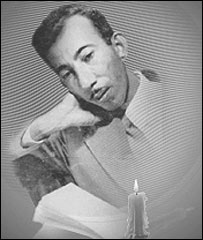
The Letters of Badr Shakir al-Sayyab:#11


The Iraqi Poet Badr Shakir al-Sayyab

[Note: This is the eleventh in a series of translations of selected letters of the noted Iraqi poet Badr Shakir al-Sayyab. For more information on the poet, click here.]

Letter #11

My Dear Adunis, (1)

First of all, I hope you will forgive me for writing to you on this kind of paper. It is all I have in the house right now since I have just returned from night school. Perhaps you will now understand the reason why I have been tardy in responding to your letter. Working day and night does not give me any time to write.

I received the final version of your poem. I notice that you have paid attention to what I wanted to alert you to concerning the earlier version of the poem: namely, the excess use of rhymed paragraphs among those that are written in prose. Your poem that was published in the latest issue of “Shi’r” was more successful in this regard. Haven’t you seen how the versifiers have exploited free verse? Continue reading The Letters of Badr Shakir al-Sayyab:#11

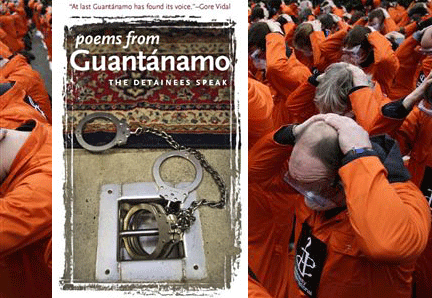
Poems from Guantánamo: The Detainees Speak

Since 2002, at least 775 men have been held in the U.S. detention center at Guantánamo Bay, Cuba. According to Department of Defense data, fewer than half of them are accused of committing any hostile act against the United States or its allies. In hundreds of cases, even the circumstances of their initial detainment are questionable. Poems from Guantánamo: The Detainees Speak (The University of Iowa Press, 2007) conveys the voices of men held at Guantánamo. Available only because of the tireless efforts of pro bono attorneys who submitted each line to Pentagon scrutiny, Poems from Guantánamo brings together twenty-two poems by seventeen detainees, most still at Guantánamo, in legal limbo. The collection is edited by Marc Falkoff, who has worked on behalf of many detainees from Yemen, and contains a preface by Flagg Miller, an anthropologist and professor of religious studies at the University of California, Davis. Miller’s essay combines an overview of Muslim prison poetry throughout history to an analysis of the poems in the collection, and is entitled “Forms of Suffering in Muslim Prison Poetry.” An afterward is written by Ariel Dorfman, a Chilean American poet, novelist, and human rights activist who teaches at Duke University. Continue reading Poems from Guantánamo: The Detainees Speak

A 16th Century Caravan

The title of this watercolor painting by ‘Abdol-‘Aziz is “Zal is sighted by a Caravan” and is part of a scene from the Shahname in which the hero Rostam’s father, known as Zal, was born an albino and exiled by his superstitous father to the top of a mountain, where he was rescued by the legendary bird known as a simurgh. The caravan, shown here, saw Zal and reported this to his royal father, who was glad his son was alive and would be the ehir to the throne. The painting was done in Tabriz around 1525 CE.

Illustration from Abdolala Soudavar, Art of the Persian Courts (New York: Rizzoli, 1992), p.370.

Veiled Voices


Brigid Maher, Director of “Veiled Voices”

Veiled Voices is a one-hour documentary that investigates the grassroots movement of Muslim women in the Middle East who act as religious leaders. It introduces the viewer to a world rarely seen by outsiders: the world of devout Arab Muslim women leading other women in prayers and lessons. Veiled Voices concentrates primarily on Ghina Hammoud, a divorced mother separated from her children, who has a television program and a charitable foundation in Lebanon, and Huda al-Habash, who has a loving and supportive husband and children, and runs lessons and programs in a mosque in Syria. Veiled Voices also travels to Egypt, where women struggle for public recognition in roles of authority over men; this is contrasted with Syria, where some male religious authorities, such as the Grand Mufti, are encouraging of women in leadership roles. The film shows women empowered, while exploring the struggles they face on both a personal and a public level. Continue reading Veiled Voices