All posts by tabsir

An American in Baghdad

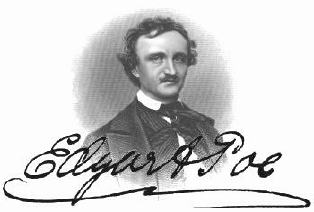
Editor’s Note: The Baghdad I am referring to is that of the Arabian Nights fantasy and the American is the extraordinary man of letters, Edgar Allen Poe. Among his humorous short stories is a tale called “The Thousand-and-Second Tale of Scheherezade,” archived online at http://www.online-literature.com/poe/45/. Here is a taste of the tale, but I suggest you read the whole story online.


Truth is stranger than fiction.
Old saying.

HAVING had occasion, lately, in the course of some Oriental investigations, to consult the Tellmenow Isitsoornot, a work which (like the Zohar of Simeon Jochaides) is scarcely known at all, even in Europe; and which has never been quoted, to my knowledge, by any American — if we except, perhaps, the author of the “Curiosities of American Literature”; — having had occasion, I say, to turn over some pages of the first — mentioned very remarkable work, I was not a little astonished to discover that the literary world has hitherto been strangely in error respecting the fate of the vizier’s daughter, Scheherazade, as that fate is depicted in the “Arabian Nights”; and that the denouement there given, if not altogether inaccurate, as far as it goes, is at least to blame in not having gone very much farther.

For full information on this interesting topic, I must refer the inquisitive reader to the “Isitsoornot” itself, but in the meantime, I shall be pardoned for giving a summary of what I there discovered. Continue reading An American in Baghdad
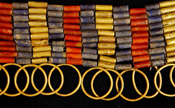
Style in the Dawn of Civilization


Belt made of lapis lazuli, gold and carnelian worn by Queen Pu-abi, who was buried in the Royal Tombs of Ur.

The frenzy caused by New York Fashion Week and red-carpet style at the Oscars may give the impression that contemporary society is particularly clothes-obsessed, but the research of Aubrey Baadsgaard, an anthropology doctoral student at Penn, shows that the concept of fashion is as old as human history itself. Baadsgaard is writing her dissertation on how clothing and ornamentation both reflected and helped construct gender and gender roles in ancient Mesopotamia during the Early Dynastic Period (circa 2900 – 2100 B.C.), considered to be one of the ‘cradles of civilization.’

For the rest of this article, with pictures, click here.

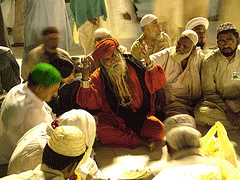
Sufi Film on Link TV


A Sufi qawall offering his devotional music in Lahore

Sufi Soul – The Mystic Music of Islam
U.K., 50 minutes

Director: Simon Broughton

Appearing on Link TV, Saturday, February 23. Visit the site for a preview.

With a dogmatic and fundamentalist view of Muslims increasingly predominant in the Western media, there has never been a more important time to show an alternative view of Islam. Sufism is the mystical dimension of Islam that preaches peace, tolerance and pluralism, while encouraging music as a way of deepening one’s relationship with God. This documentary explores Sufism and its music in different parts of the Islamic world, including Syria, Turkey, Pakistan and Morocco.

Sufi Soul reveals the views and beliefs of devotees while examining the growing threat from fundamentalist Islam and showcasing fantastic performances from some of the world’s greatest Sufi musicians.

For a review of the film, click here.

God’s Crucible Reviewed

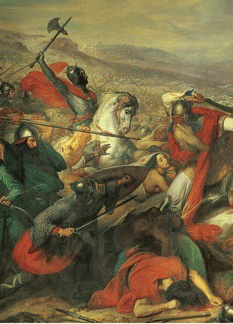
Detail of Carl von Steuben’s depiction of the Battle of Poitiers, fought in 732, the year Muslim armies crossed the Pyrenees.

A Better Place

What if the Muslim armies hadn’t been stopped at the French border?

by Joan Acocella, The New Yorker, February 4, 2008

In 610 A.D., Muhammad ibn Abdallah, a forty-year-old man from a prosperous merchant family in Mecca, repaired to a cave on nearby Mt. Hira to meditate—a retreat he had made many times. That year, though, his experience was different. An angel appeared and seized him, speaking to him the words of God. Muhammad fell to his knees and crawled home to his wife. “Wrap me up!” he cried. He feared for his sanity. But, as the voice revisited him, he came to believe that it truly issued from God. It called on him to reform his society. Poor people were to be given charity; slaves were to be treated justly; usury was to be outlawed. Muhammad’s tribesmen, the Quraysh, were polytheists, like most people in the Arabian Peninsula at that time, but this God, Allah, proclaimed that he was the only God. He was the same deity that the Jews and the Christians worshipped. Jesus Christ wasn’t his son, though. Christ was just a prophet, like the prophets of the Old Testament. Their word was now superseded by Muhammad’s, as their creeds were supplanted by this new one, Islam. Continue reading God’s Crucible Reviewed

International Conference: The New Draft Constitution of Turkey

The conference entitled “The Draft of the New Turkish Constitution” will bring together academics and politicians who have drafted the new constitution with scholars of democratic theory and comparative constitutions in a way that both side exchange critical views and share them with the public audience. The declared aim of the new constitution project is to contribute to the process of liberalization of Turkey’s political and legal systems as part of its integration to the European Union.

Monday, March 3rd: 9:00-6:30
International Affairs Building, Room 1501

This conference is sponsored by the Center for the Study of Democracy, Toleration, and Religion (CDTR) and the Institute for Religion, Culture and Public Life (IRCPL) at Columbia University, and Turkish Cultural Center (TCC).

For more information, please contact Ahmet Kuru: ak2840@columbia.edu Continue reading International Conference: The New Draft Constitution of Turkey

The Letters of Badr Shakir al-Sayyab: #15


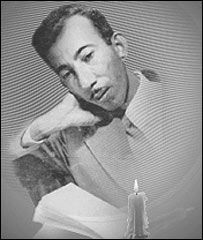
The Iraqi Poet Badr Shakir al-Sayyab

[Note: This is the 15th in a series of translations of selected letters of the noted Iraqi poet Badr Shakir al-Sayyab. For more information on the poet, click here.]

Letter #15

Basra 3/16/1962

My Dear Brother Yusuf (al-Khal),

I miss you very much, but we will meet soon, God willing. I received a telegram from Simon Jarji in which he asks me if I can be in Beirut between the 10th and the 17th of April. He also says that the International Organization for the freedom of Culture will bear the expense of my travel and lodging. I will be in Beirut between these dates, with God’s help.

I now have “21” new poems, and I will strive to find a buyer for these poems in Beirut. I am in extreme poverty and will come to Beirut carrying only a few Dinars in my pocket. Perhaps you will be able to arrange something for me while I am in Beirut. As for waiting for a month, this is extremely difficult. I will write the “The Iraq Message” for you while I am in Beirut. All the literary news is in Baghdad…I will visit Baghdad on my way and will gather from there all the news that fits to be included in the “Message.” Continue reading The Letters of Badr Shakir al-Sayyab: #15

Dreams Stifled, Egypt’s Young Turn to Islamic Fervor

By MICHAEL SLACKMAN
The New York Times, February 17, 2008

CAIRO — The concrete steps leading from Ahmed Muhammad Sayyid’s first-floor apartment sag in the middle, worn down over time, like Mr. Sayyid himself. Once, Mr. Sayyid had a decent job and a chance to marry. But his fiancée’s family canceled the engagement because after two years, he could not raise enough money to buy an apartment and furniture.

Mr. Sayyid spun into depression and lost nearly 40 pounds. For months, he sat at home and focused on one thing: reading the Koran. Now, at 28, with a diploma in tourism, he is living with his mother and working as a driver for less than $100 a month. With each of life’s disappointments and indignities, Mr. Sayyid has drawn religion closer.

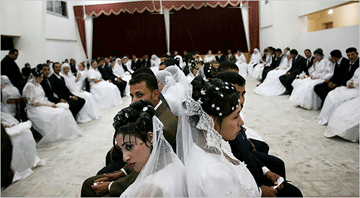
Here in Egypt and across the Middle East, many young people are being forced to put off marriage, the gateway to independence, sexual activity and societal respect. Stymied by the government’s failure to provide adequate schooling and thwarted by an economy without jobs to match their abilities or aspirations, they are stuck in limbo between youth and adulthood. Continue reading Dreams Stifled, Egypt’s Young Turn to Islamic Fervor