All posts by tabsir

Georgetown Conference on Alternative Perspectives of the Gülen Movement


CALL FOR PAPERS
ISLAM IN THE AGE OF GLOBAL CHALLENGES:
Alternative Perspectives of the Gülen Movement
October 17 – 18, 2008
Georgetown University

Conference Website

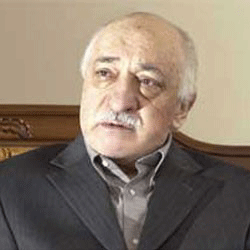
Georgetown University President’s Office, Alwaleed bin Talal Center for Muslim Christian Understanding at Georgetown University, The Institute of Turkish Studies, and Rumi Forum would like to invite you to participate in a conference that explores alternative perspectives of the Gülen Movement within the larger framework of Islam in the Age of Global Challenges. The conference will take place at the Georgetown University on October 17 – 18, 2008. Continue reading Georgetown Conference on Alternative Perspectives of the Gülen Movement

Deoband’s Anti-Terrorism Convention: Some Reflections

by Yoginder Sikand, March 11, MADRASA REFORMS IN INDIA

The mammoth ‘Anti-Terrorism Convention’ organised at Deoband late last month, which brought together ulema from all over the country, has received wide media coverage. While smaller conventions of this sort have been organized by other ulema bodies in recent years, this one, unlike others, caught the attention of the media particularly because it was organized by the Dar ul-Ulum Deoband, probably the largest traditional madrasa in the world, which large sections of the media have been unfairly berating as the ‘hub’ of ‘terrorism’.

The speeches delivered at the convention have been considerably commented on in the press. By and large, the non-Muslim press has focused almost wholly on the resolutions that were passed that labeled ‘terrorism’ as ‘anti-Islamic’, leaving out other crucial issues that were raised by numerous ulema who spoke on the occasion, particularly about Western Imperialism and Zionism as major factors behind global ‘terrorism’, and the hounding of Muslim youth and mounting Islamophobic offensives across the world, including India, in the name of countering ‘terror’. Muslim papers have dealt with these issues fairly extensively, but, following most of the speakers at the convention, they have placed the blame for ‘terrorism’ almost entirely on what they identify as ‘enemies of Islam’, thus presenting a very one-sided picture. In short, media reporting about the convention, by both the Muslim and non-Muslim media, has been inadequate and somewhat imbalanced. The same can be said of several of the speeches made at the convention. Continue reading Deoband’s Anti-Terrorism Convention: Some Reflections

The Letters of Badr Shakir al-Sayyab: #17


The Iraqi Poet Badr Shakir al-Sayyab

[Note: This is the 17th in a series of translations of selected letters of the noted Iraqi poet Badr Shakir al-Sayyab. For more information on the poet, click here.]

Letter #17

Basra…..(1)

My Brother Jabra (Ibrahim Jabra),

Only yesterday I received your letter dated, 4/ 29/1963. I was overjoyed especially because your news has been disrupted for a while now. In a letter to me from Taoufik Sayigh, he inquires about the reason for your absence from him and from “Hiwar.” I hope you will write to him.

I continue to improve, but at the same slow pace. I am still waiting for my improvement to reach a certain stage so I can come to Baghdad and remain for a week or two.

Bahij ‘Uthman has not yet sent me my personal copies of “ al-Ma’bid al-Ghariq” and “Manzil al-Aqnan.” Perhaps they will arrive soon, and then I will send you your two copies.

Enclosed with this letter, you will find two new poems which I hope will earn your approval. I am ready to translate any article you send. Continue reading The Letters of Badr Shakir al-Sayyab: #17

Anthropology in Arabic

As is true of many fields of academic study, there are Arabic introductions to the subjects. Many of these are little more than perfunctory translations of English-language textbooks. For a refreshing Arabic text introducing the whole field of Anthropology to Arabic readers, there is now an online work in progress by Saad Sowayan at http://www.saadsowayan.com/articles/anthropology.html.

Here is The Table of Contents

Introduction
02 بداية الحياة على الأرض Begining of Life
03 أحافير الرئيسيات Primate Fossils
04 الرئيسيات المعاصرة Modern Primates
05 البشريات Hominids
06 الأسس البيولوجية للثقافة Biological Bases
07 الإيكولوجيا الطبيعية Natural Ecology
08 الإيكولوجيا الثقافية Cultural Ecology
09 النسق الاقتصادي Economic System
10 النسق الديني Religion

Dr. Sowayan, who has conducted ethnographic and linguistic research in Saudi Arabia and is the editor of a massive volume on Arabian folklore, has made available much of his academic work online at his main website, with sections in Arabic and English.

The Bad Business of Badal

A Palestinian filmmaker, Ibtisam Mara’ana, has recently made a film on badal (exchange) marriage from her own personal experience. Although in Arabic, it has English subtitles. To watch a five-minute clip from the film, click here.

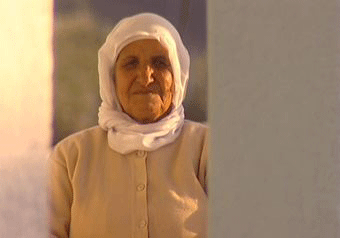
Director Ibstisam Mara’ana was predestined, like most of her relatives, to be married off through the badal, a kind of package deal in which a brother and sister from one family marry a sister and brother from another. This marriage exchange is mainly aimed at providing less marriageable daughters with a husband. Mara’ana was told that she was too old and dark, and too ugly due to a scar on her hand, and that without the godsend of the badal, she would fall by the wayside. She refused to cooperate. Instead, she made this award-winning documentary to show how women oppress women. Continue reading The Bad Business of Badal

The $2 Trillion Nightmare

By BOB HERBERT, The New York Times, March 4, 2008

We’ve been hearing a lot about “Saturday Night Live” and the fun it has been having with the presidential race. But hardly a whisper has been heard about a Congressional hearing in Washington last week on a topic that could have been drawn, in all its tragic monstrosity, from the theater of the absurd.

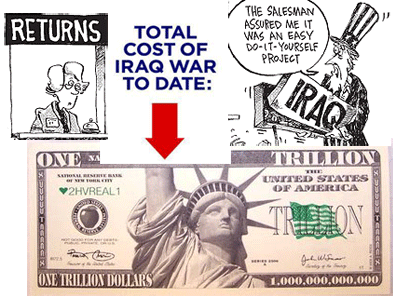
The war in Iraq will ultimately cost U.S. taxpayers not hundreds of billions of dollars, but an astonishing $2 trillion, and perhaps more. There has been very little in the way of public conversation, even in the presidential campaigns, about the consequences of these costs, which are like a cancer inside the American economy.

On Thursday, the Joint Economic Committee, chaired by Senator Chuck Schumer, conducted a public examination of the costs of the war. The witnesses included the Nobel Prize-winning economist, Joseph Stiglitz (who believes the overall costs of the war — not just the cost to taxpayers — will reach $3 trillion), and Robert Hormats, vice chairman of Goldman Sachs International. Continue reading The $2 Trillion Nightmare

How Do You Prove You’re a Jew?


Illustration by Elisabeth Moch for the New York Times

By GERSHOM GORENBERG, the New York Times, March 2, 2008

One day last fall, a young Israeli woman named Sharon went with her fiancé to the Tel Aviv Rabbinate to register to marry. They are not religious, but there is no civil marriage in Israel. The rabbinate, a government bureaucracy, has a monopoly on tying the knot between Jews. The last thing Sharon expected to be told that morning was that she would have to prove — before a rabbinic court, no less — that she was Jewish. It made as much sense as someone doubting she was Sharon, telling her that the name written in her blue government-issue ID card was irrelevant, asking her to prove that she was she. Continue reading How Do You Prove You’re a Jew?

An Iranian Laptop Dance

Iran Nuke Laptop Data Came from Terror Group

by Gareth Porter, from IPS

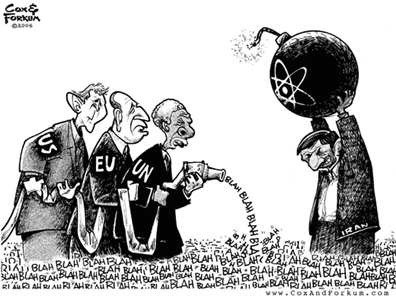
WASHINGTON, Feb 29 (IPS) – The George W. Bush administration has long pushed the “laptop documents” — 1,000 pages of technical documents supposedly from a stolen Iranian laptop — as hard evidence of Iranian intentions to build a nuclear weapon. Now charges based on those documents pose the only remaining obstacles to the International Atomic Energy Agency (IAEA) declaring that Iran has resolved all unanswered questions about its nuclear programme. But those documents have long been regarded with great suspicion by U.S. and foreign analysts. German officials have identified the source of the laptop documents in November 2004 as the Mujahideen e Khalq (MEK), which along with its political arm, the National Council of Resistance in Iran (NCRI), is listed by the U.S. State Department as a terrorist organisation.

There are some indications, moreover, that the MEK obtained the documents not from an Iranian source but from Israel’s Mossad. Continue reading An Iranian Laptop Dance