All posts by tabsir

Iraq, $5,000 Per Second?

By NICHOLAS D. KRISTOF, The New York Times, March 23, 2008

The Iraq war is now going better than expected, for a change. Most critics of the war, myself included, blew it: we didn’t anticipate the improvements in security that are partly the result of last year’s “surge.”

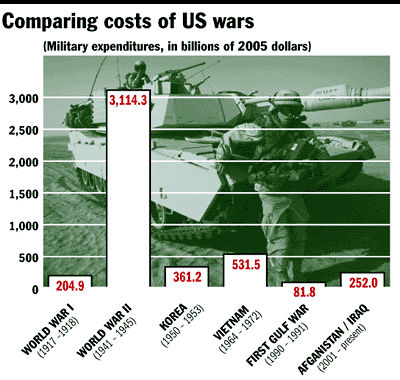
The improvement is real but fragile and limited. Here’s what it amounts to: We’ve cut our casualty rates to the unacceptable levels that plagued us back in 2005, and we still don’t have any exit plan for years to come — all for a bill that is accumulating at the rate of almost $5,000 every second!

More important, while casualties in Baghdad are down, we’re beginning to take losses in Florida and California. The United States seems to have slipped into recession; Americans are losing their homes, jobs and health insurance; banks are struggling — and the Iraq war appears to have aggravated all these domestic woes. Continue reading Iraq, $5,000 Per Second? →

The UCC and the Iraq War


[Note: Given the media feeding frenzy on the post 9/11 remarks by Dr. Jeremiah Wright of Trinity UCC Church in Chicago, it is important to note that the UCC has been a leader in opposing the current war in Iraq. Here is a statement issued some nine months ago.]

A Pastoral Letter on the Iraq War From the Collegium of Officers of the United Church of Christ

Written by Collegium of Officers, United Church of Christ, June 22, 2007

“God expected justice, but saw bloodshed; righteousness, but heard a cry.”
(Isaiah 5.7)

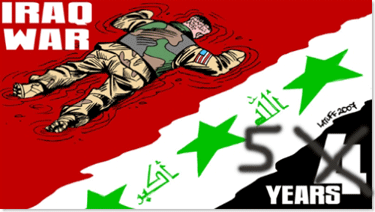
The war in Iraq is now in its fifth year. Justified as a means to end oppression, this war has imposed the new oppression of terror on the people of Iraq. Justified as the only way to protect the world from weapons of mass destruction, this war has led to the massive destruction of communal life in Iraq. Justified as a means to end the rule of terror, this war has bred more terror. Every day we look for justice, but all we see is bloodshed. Every day we yearn for righteousness, but all we hear is a cry.

Thousands of precious American lives have been lost; thousands more have been altered forever by profound injuries. We grieve each loss and embrace bereaved families with our prayers and compassion. Tens of thousands more innocent Iraqi lives are daily being offered on the altar of preemptive war and sectarian violence. They, too, are precious, and we weep for them. In our name human rights have been violated, abuse and torture sanctioned, civil liberties dismantled, Iraqi infrastructure and lives destroyed.. Billions of dollars have been diverted from education, health care, and the needs of the poor in this land and around the world. Efforts to restrain the real sources of global terrorism have been ignored or subverted. Trust and respect for the United States throughout the world has been traded for self-serving political gain. Every day we look for justice, but all we see is bloodshed. Every day we yearn for righteousness, but all we hear is a cry. Continue reading The UCC and the Iraq War →

Ahmadinejad and the Twelfth Imam

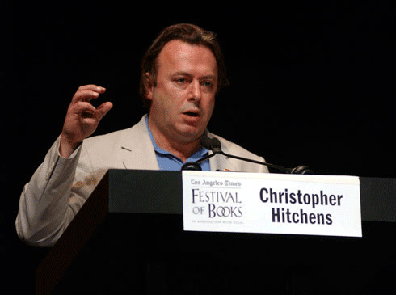
by Christopher Hitchens

[Excerpt from Christopher Hitchens, god is not Great (New York: Hachette, 2007), pp. 278-280.]

On a certain day in the spring of 2006, President Ahmadinejad of Iran, accompanied by his cabinet, made a procession to the site of a well between the capital city of Tehran and the holy city of Qum. This is said to be the cistern where the Twelfth or “occulted” or “hidden” Imam took refuge in the year 873, at the age of five, never to be seen again until his long-awaited and beseeched reappearance will astonish and redeem the world. On arrival, Ahmadinejad took a scroll of paper and thrust it down the aperture, so as to update the occulted one on Iran’s progress in thermonuclear fission and the enrichment of uranium. One might have thought that the imam could keep abreast of these developments wherever he was, but it had in some way to be the well that acted as his dead-letter box. One might ad that President Ahmadinejad had recently returned from the United Nations, where he had given a speech that was much covered on both radio and television as well as viewed by a large “live” audience. On his return to Iran, however, he told his supporters that he had been suffused with a clear green light — green being the preferred color of Islam — all through his remarks, and that the emanations of this divine light had kept everybody in the General Assembly quite silent and still. Private to him as this phenomenon was — it appears to have been felt by him alone — he took it as a further sign of the immanent return of the Twelfth Imam, not to say a further endorsement of his ambition to see the Islamic Republic of Iran, sunk as it was in beggary and repression and stagnation and corruption, as nonetheless a nuclear power. But like Aquinas, he did not trust the Twelfth or “hidden” Imam to be able to scan a document unless it was put, as it were, right in front of him. Continue reading Ahmadinejad and the Twelfth Imam →

We are not that

It has been said that music is able to soothe the savage soul, so perhaps it can help reduce the bias that assume Muslim souls are innately savage. A recent video, called Yeh Hum Naheem, with several Pakistani pop stars, has been released and can be seen on YouTube.

Here is the description from the website:

Yeh Hum Naheen has become a truly unprecedented musical movement. Featuring the vocal talents of some of Pakistans biggest music artists, including Haroon, Ali Haider, Ali Zafar, Shufqat, Strings, Shuja Haider and Hadiqa Kiani, uniting to sing out the message the world needs to hear.

Written by Ali Moeen, Pakistans foremost lyricist, with music composed by Shuja Haider, its the central message of the song that has compelled so many people to become involved. It is a message of reconciliation, a message of peace and a message of truth. Capturing the imagination of people across the board, Yeh Hum Naheen has given a voice to the silent majority, those in the Muslim world who have for too long been mis-represented. These are the people who although not appearing on our television screens are saddened and shocked at the high-jacking of Islam by terrorists, and want to stand up and shout “This is Not Us”. The song is the brainchild of Waseem Mahmood, author and media consultant, who took inspiration for the project from his children. They were tired at the way a minority of misguided young people were vehemently putting forward a message of radicalization and terrorism which was at odds with what the majority of Muslims believe. It is time to re-address the imbalance, and from the smallest child to the oldest person, Yeh Hum Naheen seeks to give a voice to the voiceless.

The Letters of Badr Shakir al-Sayyab: #18


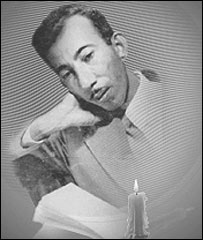
The Iraqi Poet Badr Shakir al-Sayyab

[Note: This is the 18th in a series of translations of selected letters of the noted Iraqi poet Badr Shakir al-Sayyab. For more information on the poet, click here.]

Letter #18

al-Ma’qil
20 July, 1963

My Dear Brother Abu Arwad (Adunis),

Your letter made me very happy because it came to me from my dearest friend after a long interruption. It also brought me the news that I have long been hoping for. It is rather a pity, Adunis, that the starlings should soar in the sky of poetry while the eagles remain with their wings folded and for no good reason other than incrimination and falsification.

My health is improving extremely slowly; nevertheless, there is an improvement. I hope it improves enough so I can come to Beirut this winter.

Currently, I am not writing anything. I am experiencing a period of stagnation after the period of that worthy activity in England where I produced “ Manzil al-Aqnan,” which has already been published. I will send your copy as soon as my personal copies arrive. I also have a new poetry collection still waiting for a publisher.
Perhaps it will be the best that I have written so far. [He is referring to “Shanashil Ibnat al-Halabi.”] Continue reading The Letters of Badr Shakir al-Sayyab: #18 →

The Experts Speak on Iraq

by Victor Navasky & Christopher Cerf
The Nation, March 17, 2008 (web only)

Who said the Iraq War would pay for itself? Why, the experts did.

To mark the fifth anniversary of America’s Iraq debacle, The Nation offers daily words of wisdom from those who led us there, courtesy of a new book by Christopher Cerf and Victor Navasky, Mission Accomplished! Or, How We Won the War in Iraq: The Experts Speak (Simon & Schuster).

Here’s our thought for today:

Things are better and there are encouraging signs. I have been here many years–many times over the years. Never have I been able to drive from the airport, never have I been able to go out into the city as I was today. The American people are not getting the full picture of what’s happening here.

Senator John McCain
at a news conference in the Green Zone
after completing a “walking tour” of the Shorja market
April 1, 2007.

More pearls of wisdom from Navasky and Cerf:

More people get killed in New York every night than get killed in Baghdad. The fact of life is that there will never be such a thing as one hundred percent security–it doesn’t exist.

L. Paul Bremer III
Director of the Coalition Provisional Authority
August 2003.

“Iraq is a very wealthy country. Enormous oil reserves. They can finance, largely finance the reconstruction of their own country. And I have no doubt that they will.”

Richard Perle, chair
The Pentagon’s Defense Policy Board
July 11, 2002 Continue reading The Experts Speak on Iraq →
The Iraq experience has laid bare the limits of raw military power

by Max Hastings, The Guardian, Monday, March 17 2008

[This article appeared in The Guardian on Monday March 17 2008 on p32 of the Comment & debate section. It was last updated at 00:05 on March 17 2008].

The Iraq war has shown how high is the pain threshold of the west. Five years after the 2003 invasion, the daily roll call of Iraqi suicide bombings, murders, firefights and body-bags has become as familiar a part of our landscape as traffic jams on the M1 and Los Angeles freeway.

The media class on both sides of the Atlantic is deeply engaged, indeed impassioned. The war is much discussed in the US presidential election campaign. But most Americans and Europeans display vastly less interest in the Middle East than in troubles closer to home – the global banking crisis foremost among them.

They have grown used to Iraq in the way they do to a chronic personal ailment. It is there. It is nasty. They wish that it would go away. But it does not inflict the sort of agonising pain that causes democracies to force urgent action upon their governments. Continue reading The Iraq experience has laid bare the limits of raw military power →