All posts by tabsir

Turkey’s Secular Fundamentalist Threat


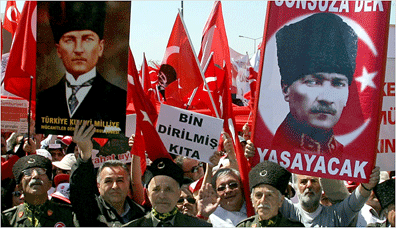
Photograph: April, 2007 demonstration supporting the secular state Reuters

by Alfred Stepan, Project Syndicate

NEW YORK — The Chief Prosecutor of Turkey’s High Court of Appeals recently recommended to the country’s Constitutional Court that the ruling Justice and Development Party (AKP) be permanently banned. Only last July, the AKP was overwhelmingly re-elected in free and fair elections to lead the government. The Chief Prosecutor also formally recommended that Prime Minister Recep Erdogan, President Abdullah Gul, and 69 other leading politicians be banned from politics five years.

Clearly, banning the AKP would trigger a political crisis that would end Turkey’s efforts to join the European Union in the foreseeable future and threaten its recent strong economic growth. So the Chief Prosecutor’s threat should not be taken lightly – all the more so given that the Constitutional Court has banned 18 political parties (including the AKP’s predecessor party) since the current constitution was introduced in 1982. Indeed, the recent call to ban the AKP is directly related to its efforts to change Turkey’s constitution.

The underlying charge in the Chief Prosecutor’s indictment is that the AKP has been eroding secularism. But the origins of the current Constitution, and its definition of secularism, are highly suspect. Continue reading Turkey’s Secular Fundamentalist Threat
Jihadi studies


The obstacles to understanding radical Islam and the opportunities to know it better

by Thomas Hegghammer, Times Literary Supplement, April 2, 2008

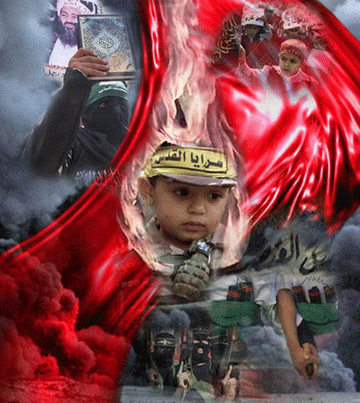
We were all frightened by the destruction caused on 9/11. Yet most of us, regardless of political orientation, assumed that there would be people in the intelligence services or in academia who possessed detailed knowledge about the jihadists. It might take time, and we might disagree on the methods, but the experts would eventually bring the perpetrators to justice. How wrong we were. Of course, the CIA knew the basics about al-Qaeda, such as the location of the Afghan training camps and the approximate whereabouts of the top leadership. But as Osama bin Laden slipped out of Tora Bora one foggy morning in early December 2001, al-Qaeda left the realm of tactical intelligence and became the complex organization-cum-movement which, six years later, we are still struggling to understand. For a few years, the commanders of the so-called War on Terror enjoyed the benefit of the doubt. After all, we did not know what they knew. However, it has become increasingly clear how little was known about al-Qaeda back in 2001, and how long it will take for us thoroughly to understand the dynamics of global jihadism. Continue reading Jihadi studies

Engels on the Ottomans

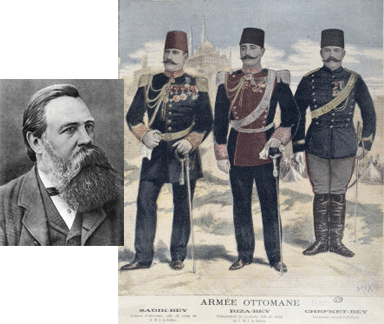
The Communist Manifesto, published by Karl Marx and Frederick Engels in 1848, stands as one of the most important political tracts ever written. It was written at a time when Europe had emerged as the dominant world force, economically and militarily. But even in the mid-19th century, the view in an Oriental direction proved more cluttered with opposition than casual readers of European history might think. The Ottoman Empire, not yet in the throes of its “sick man of Europe” stage, still thrived. In 1855 Engels published a series of articles in Putnam’s Monthly on “the Armies of Europe,” including his assessment of the Turkish army. Given the recent knocking on the EU door by modern Turkey, a re-read of Engel’s commentary is worthwhile…

I. The Turkish Army

by Frederick Engels (1855)

The Turkish army, at the beginning of the present war, was in a higher state of efficiency than it had ever reached before. The various attempts at reorganization and reform made since the accession of Mahmud, since the massacre of the janissaries, and especially since the peace of Adrianople, had been consolidated and systematized. The first and greatest obstacle — the independent position of the pashas in command of distant provinces — had been removed, to a great extent, and, upon the whole, the pashas were reduced to a discipline somewhat approaching that of European district commanders. But their ignorance, insolence, and rapacity remained in as full vigor as in the best days of Asiatic satrap rule; and if, for the last twenty years, we had heard little of revolts of pashas, we have heard enough of provinces in revolt against their greedy governors, who, originally the lowest domestic slaves and “men of all work,” profited by their new position to heap up fortunes by exactions, bribes, and wholesale embezzlement of the public money. That, under such a state of things, the organization of the army must, to a great extent, exist on paper only, is evident. Continue reading Engels on the Ottomans

Rethinking Secularism: Why Shariah?


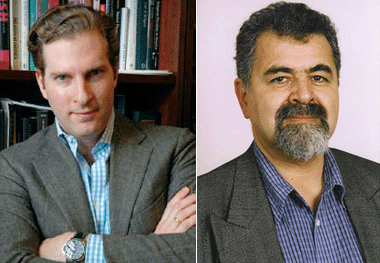
Noah Feldman, left; Said Arjomand, right

by Saïd Amir Arjomand, from The Immanent Frame

Noah Feldman prefaces his plea for the Shariah in his recent article for The New York Times Magazine (”Why Shariah?“) with a reference to the proposal recently made by the Archbishop of Canterbury to allow the Shariah and Jewish law to be considered in voluntary family and arbitration courts. The Archbishop and the Professor are addressing very different issues, however. The situation of a Muslim religious minority having the option of voluntary recourse to arbitration or court settlement in Europe, as proposed by the former, cannot be responsibly compared with that of a Muslim majority using the coercive power of the state to stone women accused of adultery in Nigeria, or to perpetuate patriarchal domination in Pakistan by keeping even those women who are eventually acquitted by superior courts in shackles and behind bars for many years.

In this article, presumably as a forerunner of his new book, Feldman extends the paternalism of the failed American empire in What We Owe Iraq to the entire Muslim world by telling the Muslims how good they really are; surely they would not realize this without the American law professor telling them. In telling them, he displays one of the worst examples of Orientalism. Continue reading Rethinking Secularism: Why Shariah?

Dancing in the Garden


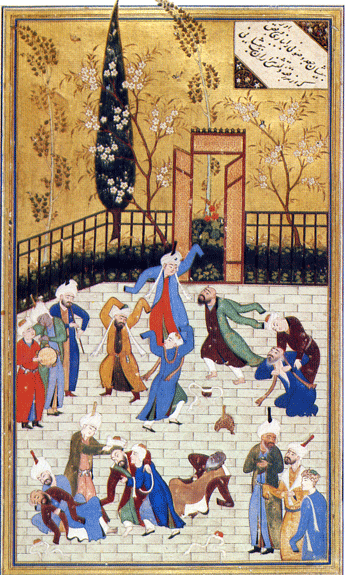
Scene from the Divan of Hafiz, Herat School, 1523, Freer Gallery of Art, Washington, D.C.

O beautiful wine-bearer, bring forth the cup and put it to my lips
Path of love seemed easy at first, what came was many hardships.
With its perfume, the morning breeze unlocks those beautiful locks
The curl of those dark ringlets, many hearts to shreds strips.
In the house of my Beloved, how can I enjoy the feast
Since the church bells call the call that for pilgrimage equips.
With wine color your robe, one of the old Magi’s best tips
Trust in this traveler’s tips, who knows of many paths and trips.
The dark midnight, fearful waves, and the tempestuous whirlpool
How can he know of our state, while ports house his unladen ships.
I followed my own path of love, and now I am in bad repute
How can a secret remain veiled, if from every tongue it drips?
If His presence you seek, Hafiz, then why yourself eclipse?
Stick to the One you know, let go of imaginary trips.

Hafiz, Divan, Ghazal 1

Iraq, $5,000 Per Second?

By NICHOLAS D. KRISTOF, The New York Times, March 23, 2008

The Iraq war is now going better than expected, for a change. Most critics of the war, myself included, blew it: we didn’t anticipate the improvements in security that are partly the result of last year’s “surge.”

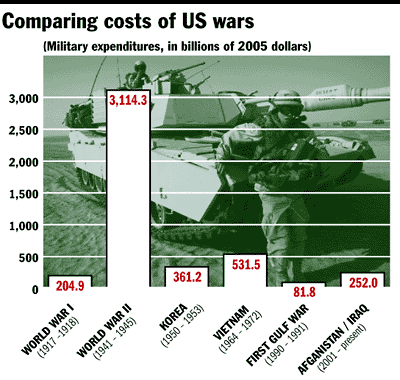
The improvement is real but fragile and limited. Here’s what it amounts to: We’ve cut our casualty rates to the unacceptable levels that plagued us back in 2005, and we still don’t have any exit plan for years to come — all for a bill that is accumulating at the rate of almost $5,000 every second!

More important, while casualties in Baghdad are down, we’re beginning to take losses in Florida and California. The United States seems to have slipped into recession; Americans are losing their homes, jobs and health insurance; banks are struggling — and the Iraq war appears to have aggravated all these domestic woes. Continue reading Iraq, $5,000 Per Second?

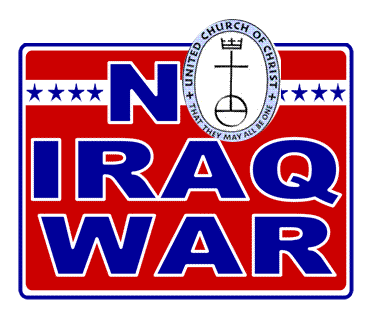
The UCC and the Iraq War


[Note: Given the media feeding frenzy on the post 9/11 remarks by Dr. Jeremiah Wright of Trinity UCC Church in Chicago, it is important to note that the UCC has been a leader in opposing the current war in Iraq. Here is a statement issued some nine months ago.]

A Pastoral Letter on the Iraq War From the Collegium of Officers of the United Church of Christ

Written by Collegium of Officers, United Church of Christ, June 22, 2007

“God expected justice, but saw bloodshed; righteousness, but heard a cry.”
(Isaiah 5.7)

The war in Iraq is now in its fifth year. Justified as a means to end oppression, this war has imposed the new oppression of terror on the people of Iraq. Justified as the only way to protect the world from weapons of mass destruction, this war has led to the massive destruction of communal life in Iraq. Justified as a means to end the rule of terror, this war has bred more terror. Every day we look for justice, but all we see is bloodshed. Every day we yearn for righteousness, but all we hear is a cry.

Thousands of precious American lives have been lost; thousands more have been altered forever by profound injuries. We grieve each loss and embrace bereaved families with our prayers and compassion. Tens of thousands more innocent Iraqi lives are daily being offered on the altar of preemptive war and sectarian violence. They, too, are precious, and we weep for them. In our name human rights have been violated, abuse and torture sanctioned, civil liberties dismantled, Iraqi infrastructure and lives destroyed.. Billions of dollars have been diverted from education, health care, and the needs of the poor in this land and around the world. Efforts to restrain the real sources of global terrorism have been ignored or subverted. Trust and respect for the United States throughout the world has been traded for self-serving political gain. Every day we look for justice, but all we see is bloodshed. Every day we yearn for righteousness, but all we hear is a cry. Continue reading The UCC and the Iraq War