All posts by tabsir

Obama’s Indonesian Lessons

By Roger Cohen, The New York Times, April 14, 2008

When Barack Obama’s Indonesian classmates are asked to recall the boy they all called “Barry” (pronounced “Berry”), their description is unanimous: “chubby.”

He was the tall, chubby kid in Bermudas who joined their 4th grade class at the Besuki elementary school in 1970, the boy with the white mother and Indonesian stepfather who brought his own sandwiches to school (odd to a noodle-eating crowd) and, strangest of all, wrote with his left hand.

“It was so weird that he was left-handed,” recalled Ati Kisjanto, now a marketing consultant. “That was considered impolite here, and you were forced to write with your right hand.”

A dozen of Obama’s classmates were gathered at the house of Sandra Sambuaga, exchanging stories over Indonesian delicacies. Continue reading Obama’s Indonesian Lessons


Pollsters in Iran


Ayatollah Ali Khamenei

Iranians Favor Direct Talks with US on Shared Issues,

Mutual Access for Journalists, More Trade

Poll Finds Diminished Perception of US Threat,

General Thawing of Hostility

World Public Opinion, April 7, 2008

College Park, MD—A new poll finds that although Iranians continue to view the United States negatively, they strongly support steps to improve US-Iran relations including direct talks on issues, greater access for each others’ journalists, increased trade and more cultural, educational and athletic exchanges.

While majorities of Iranians think the United States threatens Iran and is hostile to Islam, these numbers have diminished over the past year. A growing number—now two out of three—believe it is possible for Islam and the West to find common ground. Continue reading Pollsters in Iran

The Qat ate your visa

U.S. Embassy to Qat Chewers: quit now if you want an immigrant visa

By Sarah Wolff, Yemen Times,

SANA’A, March 31 — The United States Embassy in Yemen recently introduced a new provision for Yemenis seeking permanent residence in the U.S. Its message? Lay off your qat if you want to live in America.

Under this new stipulation, the U.S. Embassy will not issue immigration visas to anyone who is addicted to qat. Unites States law defines an “addict” as anyone who has used a drug for other than experimental purposes, i.e., more than one-time usage. This means that anyone in Yemen who has chewed qat more than once will have to medically prove that they are no longer using it in order to live in the United States.

U.S. law qualifies qat as a Schedule I controlled substance because it contains the chemical cathinone, which is a narcotic with addictive properties and has no known medicinal benefits. Abuse of Schedule I drugs is considered a “Class A” medical ineligibility under the Immigration and Nationality Act. Continue reading The Qat ate your visa

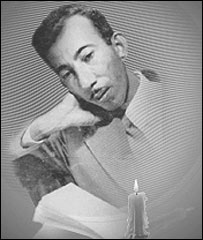
The Letters of Badr Shakir al-Sayyab: #20


The Iraqi Poet Badr Shakir al-Sayyab

[Note: This is the 20th in a series of translations of selected letters of the noted Iraqi poet Badr Shakir al-Sayyab. For more information on the poet, click here.]

Letter #20

al-Ma’qil 10/15/1963

My Dear Brother Jabra (Ibrahim Jabra),

Welcome to Iraq. I hope you enjoyed your summer in Lebanon. I am certain that you continued your literary activities while there. Besides Taoufiq Sayigh and Yusuf al-Khal, with whom did you meet? Did you see Salma al-Khadra’ al-Jayusi and Laila ba’albaki? Can you write me the details of the different phases of literary activities in Lebanon?

I heard, actually, I read, that you are going to deliver a series of literary lectures on Baghdad Radio. This is a good thing. Something like rust has begun to cling to literary life here, and it is the duty of great writers to remove this now when the field is wide open for those who are creative and innovative. Continue reading The Letters of Badr Shakir al-Sayyab: #20

The occupation has frozen Iraq.

by Simon Jenkins, The Guardian, April 9 2008

The British troops encamped outside Basra resemble Davy Crockett’s colleagues in the Alamo. Nobody will come to their rescue. Their position is hopeless. They cannot win. They cannot escape. Their boss, the defence secretary Des Browne, has emphasised their political entombment by reneging on Gordon Brown’s pledge to reduce their numbers by a half this spring. The American general, David Petraeus, yesterday said the same of his troops. He wants 140,000 of them to remain at the end of the current surge, dashing hopes that their numbers might come down. The occupation of Iraq is now officially indefinite. Too many politicians have too much to lose by contemplating retreat. Continue reading The occupation has frozen Iraq.

Human rights violations in the name of religion

by Wazhma Frogh, from Persian Mirror

As the world is witness of Afghanistan stepping into development and rehabilitation phase, but experiences have revealed that no country can ever develop without a sound base for human rights issues. Afghans are suffering from a very harsh situation and human values are worthless in many parts of the region. As I am a researcher on women issues in Afghanistan and I travel frequently to different parts of the region to find out the living circumstances of women.

Some three months before I has a visit to an eastern south province of Afghanistan and observed the situation of women and children, their rights have been massacred entirely under the shadow of ignorance those who call themselves Muslims. In this province, in every 10 families , 9 of them have sold their daughters at a value equivalent to 300 US $. Continue reading Human rights violations in the name of religion

“There is no such thing as an Islamic state”


Prof. an-Naim speaking at Harvard in October, 2007

The Christian Science Monitor recently published an article about Emory law professor Abdullahi Ahmed an-Naim and the “Muslims Heretics Conference” held in Atlanta a week ago. Here is a brief excerpt, but click here for the whole article.

Abdullahi Ahmed an-Naim has seen what can happen to an Islamic reformer: His mentor was executed in 1985 in Sudan; he himself had to flee the country. Still, the self-described “Muslim heretic” has no trouble traveling the Islamic world spreading his controversial message:

There is no such thing as an Islamic state.

A secular state and human rights are essential for all societies so that Muslims and others can practice their faith freely, he tells his co-religionists.

“My motivation is in fact about being an honest, true-to-myself Muslim, rather than someone complying with state dictates,” says Mr. Naim, a professor of law at Emory University in Atlanta since 1999. “I need the state to be neutral about religious doctrine so that I can be the Muslim I choose to be.”

So committed is this scholar to opening the door to free debate within his faith that he helped organize the first “Muslim Heretics Conference” in Atlanta over the weekend. Some 75 Muslims, engaged in various reform projects, gathered to discuss issues related to sharia (Islamic law), democracy, and women’s rights – and how to cope with dissent and its consequences.

“We celebrate heresy simply to promote innovative thinking,” he says. “Every orthodoxy was at one time a heresy.”

The Ecstatic Faith of Rumi

NPR has archived its December 13, 2007 program on the Persian mystic poet Rumi. At the main website you can download the podcast, read the script for the program, watch a video of a Rumi performance at Stanford University and more. This is a treat for all Rumiphiles. By the way, last September 30 was the 800th anniversary of the birth of Rumi.