All posts by tabsir

Battle in Brooklyn

Battle in Brooklyn | A Principal’s Rise and Fall
Her Dream, Branded as a Threat

By ANDREA ELLIOTT, The New York Times, April 28, 2008

Debbie Almontaser dreamed of starting a public school like no other in New York City. Children of Arab descent would join students of other ethnicities, learning Arabic together. By graduation, they would be fluent in the language and groomed for the country’s elite colleges. They would be ready, in Ms. Almontaser’s words, to become “ambassadors of peace and hope.”

Things have not gone according to plan. Only one-fifth of the 60 students at the Khalil Gibran International Academy are Arab-American. Since the school opened in Brooklyn last fall, children have been suspended for carrying weapons, repeatedly gotten into fights and taunted an Arabic teacher by calling her a “terrorist,” staff members and students said in interviews. Continue reading Battle in Brooklyn

Open season on Egypt’s opposition, but Islam is not the solution

By Andrea Teti, Department of Politics and International Relations, University of Aberdeen

Following a wave of strikes and an equally spectacular tsunami of price increases in a range of essential goods over recent months, the April 8th local elections seemed for a brief moment to have become a focus for Egypt’s diverse opposition. A few days before a general strike proclaimed for April 6th, the coalition for democratic change Kifaya! (Enough!) published a statement saying it expected the Muslim Brotherhood’s active support. In the event, the Brotherhood defended Kifaya!’s right to strike, but did not participate in it. Then, following a wave of pre-election arrests and dirty tricks by the ruling National Democratic Party – resulting in a mere 21 MB candidates making it onto ballots out of the 5,754 put forward – the MB declared the elections beyond repair, and boycotted them. The NDP’s electoral victory (97% of posts) was as striking as the estimated 5% voter participation rate. Continue reading Open season on Egypt’s opposition, but Islam is not the solution

Khalil Gibran International Academy

August 23, 2007

Jews for Racial and Economic Justice (JFREJ) on Debbie Almontaser’s Resignation and the targeting of the Kahlil Gibran International Academy

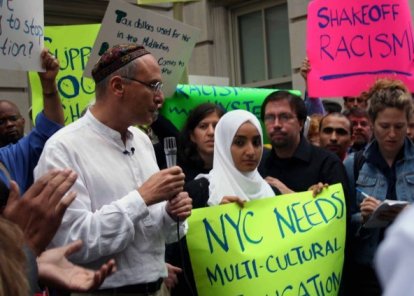
As parents, students, teachers, New Yorkers, and Jews, we are outraged by the series of events that have culminated in Debbie Almontaser’s resignation as principal of the Kahlil Gibran International Academy. We are particularly disturbed that Mayor Bloomberg, Joel Klein, the Chancellor of the Department of Education, and Randi Weingarten, the President of the United Federation of Teachers, bowed to right-wing pressure and did not strenuously resist and condemn the unjustified attacks on Ms. Almontaser, which fed on and fostered anti-Arab and anti-Muslim prejudice. We call for Debbie Almontaser to be reinstated to her position as principal if that is what she wishes, and for full support for the Kahlil Gibran International Academy. Continue reading Khalil Gibran International Academy

Tolerance takes a hit in Indonesia

Among Muslim majority states, Indonesia has a reputation for being one of the more tolerant, given the variety of religious persuasions in this multi-island nation. But recently there has been a flare up against the Ahmadiyya order. As reported on the BBC, the government of Indonesia is considering a ban on the Ahmadiyya:

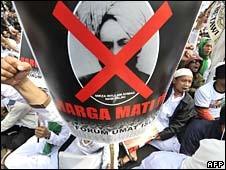
About 2,000 people have gathered in the Indonesian capital, Jakarta, to protest against a minority Muslim sect, the Ahmadiyya community.

Speakers outside the presidential palace demanded the group be banned.

That was what a government panel recommended last week, saying the Ahmadiyya’s beliefs went against Islam as practised in Indonesia.

But the Ahmadiyya argue that, like other minorities, they are protected under the Indonesian constitution.

The Ahmadis believe their own founder, Mirza Ghulam Ahmad, who died in 1908 in India, was a prophet.

That contradicts the belief of most Muslims, who think the Prophet Muhammad was the last prophet.

The Ahmadiyya face persecution in many countries.

Less than a month ago, an Ahmadiyya mosque was destroyed by protesters, as can be seen in video. This is not a new situation, as persecution of Ahmadiyya has previously been reported for Indonesia.

Human Rights Watch has called on the Indonesia government not to issue the ban on the Ahmadiyya, a ban which would contradict the state’s constitution on religious liberty. For a pro-Ahmadiyya view of the situation, click here.

Woman Reading

Shadi Ghadrian
Untitled (Qajar Series), 1998
Silver bromide print, Los Angeles County Museum of Art.

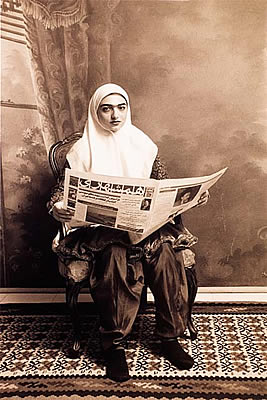
Shadi Ghadirian (Iran, b. 1974), who works in the medium of photography, uses her art to express herself as an Iranian and as a woman. Ghadirian’s best-known body of work, the Qajar Series, was inspired by nineteenth-century studio portraits of women depicted in the fashion of the day: thick, black eyebrows; headscarves; and short skirts worn over baggy trousers. In order to re-create the earlier photographic settings, Ghadirian employed painted backdrops and dressed her models in vintage clothing from the late 1800s. She added modern objects to these traditional scenes, such as a Pepsi can, a boom box, or, as in these two images (figs. 61, 62), a bicycle and an avant-garde Tehran newspaper. She has said of her work, “My pictures became a mirror reflecting how I felt: we are stuck between tradition and modernity.”

For the full exhibit on Islamic Art at the Los Angeles Museum of Art, click here.

God is Green

“O Children of Adam: Beautify yourselves for every act of worship, and eat and drink [freely], but do not waste: truly, He loves not the wasteful.” (Qur’an: 7:31)

by Ayesha Mattu for Religion Dispatches, April 22, 2008

In Islamic tradition it is considered that humans were created as khalifas (trustees) of the earth and of its animal, mineral and plant resources. As caretakers, it is said, we may utilize these resources as long as we respect the balance that must be maintained in all aspects of our lives –spiritual, physical and mental.

There is extensive support for environmental protection in Islamic theology – from the Prophet Muhammad’s self-practice and repeated exhortations to plant trees or to not waste water, to the stern limitations on military engagement stating that civilians, animals, trees and water sources were not to be harmed. And this theology was regularly put into official practice over the centuries. As American Muslim scholar Zaid Shakir has said: “The protection of natural habitat, the well-being of animals, and related responsibilities were often overseen by appointed officials, members of the world’s first environmental protection agencies.”

Dr. Derek Wall of the UK’s Green Party has remarked (in an article for the UK’s Guardian titled “Green Islam”) that contemporary Muslim scholars like George Washington University’s Seyyed Hossein Nasr have been advocating Islamic environmentalism since the 1970s while Swiss academic Tariq Ramadan has been evolving a thoughtful understanding of “spiritual ecology”.

Some might say, rightly, that our green legacy has been forgotten as the race to industrialization has created environmental devastation and dead zones in more- and less-developed countries alike. Some may even suspect the environmental movement of being another Western initiative to impede the progress of Muslim nations. In spite of this, we are beginning to see Muslim community-based organizations in the global North and non-governmental organizations in the global South reviving these deep-rooted green practices in a manner informed both by modern realities and Islamic principles.

For the rest of this article, click here.

Bint al-Shati’: A Female Voice In Islamic Law

from al-Ahram, July 2004

Aisha Abdel-Rahman, better known as Bint Al-Shati’, might have become famous for her fiction and poetry but it was her stories on rural Egypt which launched her writing career in Al-Ahram. The “Daughter of the Shore”, writes Professor Yunan Labib Rizk, had a weak spot for the countryside and its people

From the outset of her career, Aisha Abdel-Rahman, a prominent scholar and writer, preferred to go by the name Bint Al-Shati’ (Daughter of the Shore). She adopted this pen-name, which alludes to her birthplace in Damietta, out of respect for her family’s customs — her father was a scholar in a religious institute in that northern Egyptian coastal city — and because it was also a custom of that age for women writers to conceal their true identities.

Bint Al-Shati’ first made her mark in Al-Ahram in the summer of 1935 when the newspaper allocated considerable front-page space to the problems of rural Egypt. She was only 23 at the time (she was born in 1913), which is not so odd in itself — it was Al-Ahram ‘s policy to give a chance to young and talented aspiring writers, of whom some later became its prominent featured writers and literary and intellectual celebrities. What was odd, given her conservative family background, was the level of education she attained. Her father, an Azharite, would not allow her “modern schooling” so he educated her himself, and so solid was his instruction that she came out first among all the female students who sat for the competency certificate for teachers “from their homes” in 1929. Thus encouraged, she received her secondary school baccalaureate in 1934. This was the only certificate she was armed with when she began writing for Al-Ahram the following year. But then whoever said that degrees make a writer? Continue reading Bint al-Shati’: A Female Voice In Islamic Law

The Habib and Remy Show

Many things are not funny, but most things can be poked fun at. Certainly the ongoing violence, destruction and daily killing in Iraq is not funny. But when we stop belonging to Homo ludens as a species, we lose yet another part of our humanity. There is a lot of prejudice against Arabs, Iranians, and Muslims in general. This is no more funny to most Arabs, Iranians, and Muslims than Black Sambo is to African Americans or Chief Wahoo to Native Americans. But there are times when laughing at yourself is a way of dealing with tragedy. In the real world Arabs are not a bunch of bearded, hook-nosed, camel-smelling harem masters, so making fun of the stereotype can at times be like streaking naked in front of a boring commencement speaker. Such raw moments are provided by Habib, an Iraqi, and Remy, a Virginian, in a YouTube rap video called A-R-A-B: the Rap. Continue reading The Habib and Remy Show