All posts by tabsir

STAND UP for Muslims Comics

America at a Crossroads, PBS, May 11, 2008

It’s an age-old American tradition: immigrant groups take up comedy to fight against discrimination. One path to understanding is to make people laugh. Now Muslim-Americans have come forward to help dismantle the stereotypes and hatred that have surged since September 11, 2001.

STAND UP: Muslim American Comics Come of Age is the story of five comedians: Ahmed Ahmed, Tissa Hami, Dean Obeidallah, Azhar Usman and Maysoon Zayid.
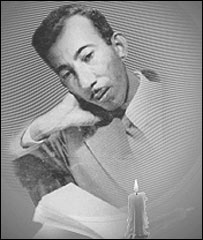
Tissa Hami

Each of these artists felt the aftershock of 9/11 personally. At a time when people of Middle Eastern origin were advised to lay low, they all chose to stand up — and tell jokes. This film explores how they are responding to 9/11, each in a different way, but all using humor to define who they are.

STAND UP is the story of Ahmed’s battle to get beyond playing “Terrorist No. 4.” It’s about Obeidallah’s journey to discover his Arab heritage. It’s about Zayid’s resolve to turn being “a Palestinian Muslim woman virgin with cerebral palsy from New Jersey” into a career asset. It’s about Usman’s quest to become the Muslim comedy role model he himself never found. It’s about Hami’s determination to challenge American conceptions about Muslim women. Continue reading STAND UP for Muslims Comics
Yemen: Fighting in North Hampers Humanitarian Work


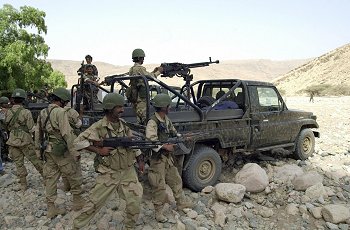
Yemeni soldiers patrolling in Saada, 150 miles north of the capital, Sana’a. A Yemeni Member of Parliament accused of being a leader of a deadly three-year uprising by the Zaidi minority in the northern mountains warned in remarks published on Feb. 25 that rebels might widen their campaign. (Photo: Khaled Fazaa / AFP-Getty Images)

Integrated Regional Information Networks, United Nations, May 6, 2007

The I.C.R.C. and Red Crescent came under attack in the Saada region of northern Yemen. (Photo: Afif Sarhan / IRIN)

A humanitarian aid convoy of the International Committee of the Red Cross (I.C.R.C.) and the Yemen Red Crescent Society came under heavy gunfire on May 2 in the governorate of Saada, north Yemen, the I.C.R.C. has reported.

The incident took place in al-Saifi area, 18 kilometers north of Saada city.

Fighting between government forces and followers of rebel leader Abdul-Malik al-Houthi in Saada governorate is still going on, causing thousands of people to leave their homes, said aid workers. Continue reading Yemen: Fighting in North Hampers Humanitarian Work

A Turkmen Dismantles Reminders of Old Ruler


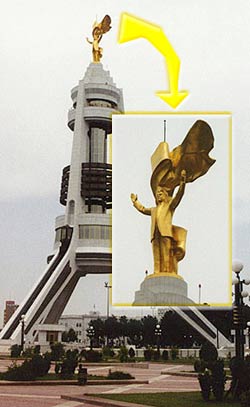
Statue of Saparmurat Niyazov, Turkmenistan’s former president, soon to be removed

by By DAVID L. STERN, The New York Times, May 5, 2008

ALMATY, Kazakhstan — A 246-foot tall, rocket ship-like monument to the late ruler of Turkmenistan, topped with a golden statue of himself that rotates to always face the sun, will be removed from the center of the Turkmen capital, state news media there have reported.

A decision by President Gurbanguly Berdymukhammedov to move the monument was his latest step in dismantling the personality cult of Saparmurat Niyazov, whose often bizarre decrees turned the isolated, energy-rich country into the punch line of a bad international joke.

The president had already reversed Mr. Niyazov’s order renaming the days of the week and months of the year in honor of himself and his family. He had also ended the bans on opera, ballet and the circus, which Mr. Niyazov had decreed un-Turkmen, and lifted restrictions on the Internet. Continue reading A Turkmen Dismantles Reminders of Old Ruler

Sanaa’s Grand Mosque stands for 1400 years

by Mohammed al-Qiri, Yemen Observer, April 8, 2008

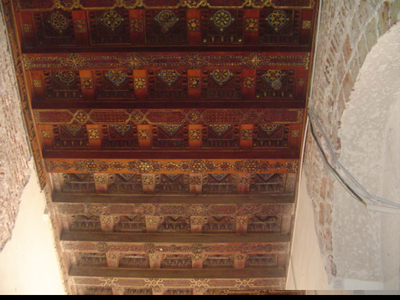
The Grand Mosque of Sana’a is considered to be the oldest in the Islamic world. It was built by order of the Prophet Mohamed (PBUH) in the sixth Hijri year, corresponding to 627 C.E.. It is located in the Bathan garden, between Ghamdan palace and the Malmlamah rock.

Over the course of history, there have been many additions made to the original building. The mosque was extended in the eighth century by the Amawi Khalif al-Walid ibn Abdulmalik (705- 715 C.E.) and at the beginning of the Abasi dynasty in the eighth century C.E., doors were added by Governor Omar ibn Abdulmajeed al-A’dawi, in addition to other overhauls in 745 C.E under his watch. Continue reading Sanaa’s Grand Mosque stands for 1400 years

TO BANISH THE “LEVANTINE DUNGHILL” FROM WITHIN

TO BANISH THE “LEVANTINE DUNGHILL” FROM WITHIN: TOWARD A CULTURAL UNDERSTANDING OF ISRAELI ANTI-IRAN PHOBIAS

By Haggai Ram, International Journal of Middle East Studies 40 (2008), 249–268.

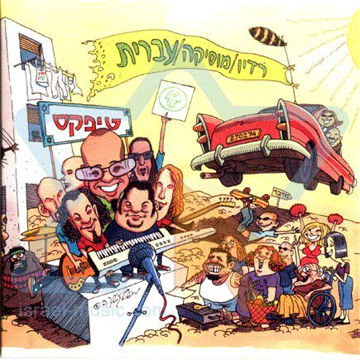
Held since 1956, the Eurovision Song Contest is an annual event traditionally dedicated to the eternal themes of love, peace, and harmony. Yet Israelis asked to pick a song for the 2007 contest in Helsinki paid little heed to these themes. Instead, they settled for “Push the Button,” a controversial number by an Israeli punk group called Teapacks; the song is generally understood as a description of life under the threat of a nuclear-armed Iran with its “crazy rulers.” Meanwhile, an Israeli fashion house (Dan Cassidy) commissioned a series of photos at a construction site in southern Tel Aviv that showed a topless model lying in a pit. The project was designed as a warning against the “holocaust” that would follow Iran’s possible nuclear attack on Israel; the pit, as the project’s creative director explained, represented “the mass grave of complacent Tel Aviv residents.” Continue reading TO BANISH THE “LEVANTINE DUNGHILL” FROM WITHIN

The Letters of Badr Shakir al-Sayyab: #21


The Iraqi Poet Badr Shakir al-Sayyab

[Note: This is the 21st in a series of translations of selected letters of the noted Iraqi poet Badr Shakir al-Sayyab. For more information on the poet, click here.]

Letter #21

Al-Ma’qil, 9/17/1964

My Brother, Adunis. Dearest Beloved (along with Muhyi al-Din Muhammad). May I be lucky enough to find Muhammad.

O Dearest Friend,

How are you? Correspondence between us has stopped for about nine months now. The two reasons for this are bad luck and my incurable disease. My general health is not bad, but my two paralyzed legs are still the same. My soul is overflowing with poetry, but it is poetry that flows from the fountain of deep pain and dejection, not of delight. Just yesterday, I wrote a poem void of sadness, despair, and pain because our brother, ‘Ali al-Sabti, met with my loved ones in Lebanon and carried joyful news about them to me with a promise that they will send me a letter. Continue reading The Letters of Badr Shakir al-Sayyab: #21