All posts by tabsir

Idolatrous Jews, Muhammadans, and Papists


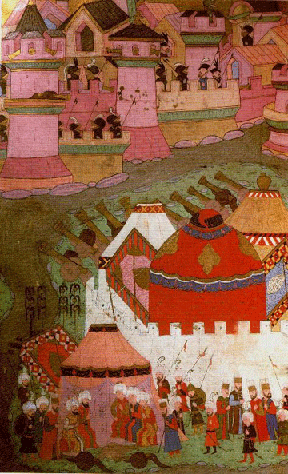
The Ottoman army besieging Vienna (1529). Book Illustration, Nakkas Osman 1588.

The recent controversies over pastoral remarks that pit Christianity vs Islam, whether generated by Pope Benedict or McCain’s jeremiad-in-the-making over Rev. Parsley or Rev. Hagee’s hazardous raising of Hitler and the Holocaust to acts of divine retribution, are not unique. Interfaith harmony and ecumenical amenities have been the exception in a historical trajectory of damning the faith of the other in both monotheisms, not to mention how Judaism has been denigrated as well. An earlier reform-minded Protestant had reason to fear Muslim Ottoman Turks, who had invaded Christian dominions in Europe and who had attracted more than a fair share of converts. A little more than a decade after Ottoman army besieged Vienna, Martin Luther wrote a preface to a German translation of the Quran. In this he targets “idolatrous Jews, Muhammadans and Papists” as instruments of the Devil, the kind of religious intolerance that easily spills over into the secular arena as ethnic hate bating.

Here is Luther’s “Preface to Bibliander’s Edition of the Qur’an” (1543):

Many persons have authored small tracts describing the rites, beliefs, and customs of Jews of this day for the very purpose of more easily refuting their manifest lies and exposed errors and ravings. There is no doubt that, when pious minds bring the testimony of the prophets to bear on the delusions and blasphemies of those people, they are greatly confirmed in faith and in love for the truth of the gospel and are fired with a righteous hatred of the perversity of the Jewish teachings. Continue reading Idolatrous Jews, Muhammadans, and Papists
Hometown Baghdad

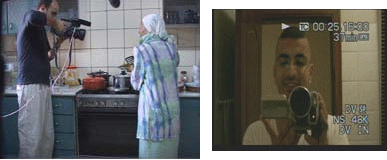
Hometown Baghdad is an online web series about life in Baghdad. It tells the stories of three young Iraqis struggling to survive during the war.

The series premiered on March 19th 2007 and the final episode went live on June 17. All episodes are viewable here.

The series was acclaimed in press throughout the world. See the press page for more.

Hometown Baghdad was produced by global youth dialogue company, Chat the Planet. Find out more about Chat here.

Hijab Scene #7

by Mohja Kahf

No, I’m not bald under the scarf
No, I’m not from that country
where women can’t drive cars
No, I would not like to defect
I’m already American
But thank you for offering
What else do you need to know
relevant to my buying insurance,
opening a bank account,
reserving a seat on a flight?
Yes, I speak English
Yes, I carry explosives
They’re called words
And if you don’t get up
Off your assumptions
They’re going to blow you away.

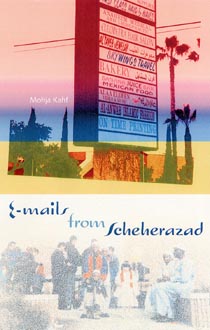
From Mohja Kahf, E-Mails from Scheherazad (Gainesville: University Press of Florida, 2003), p. 39.

The State of Statements on the Islamic State

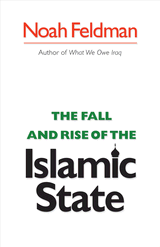
In the latest New York Review of Books, Malise Ruthven offers a cogent review of nine recent books about Islam and terrorism. Here is a brief excerpt about Noah Feldman’s The Fall and Rise of the Islamic State. Check out the online article for the full review.

Excerpt from Malise Ruthven, “The Rise of the Muslim Terrorists,” New York Review of Books, Volume 55, Number 9, May 29, 2008

Jihadis are not the only political activists seeking an Islamic state that will restore the Sharia—the holy law of Islam—to the position it held in pre-colonial times. In a short but masterful exposition, The Fall and Rise of the Islamic State, Noah Feldman seeks to answer a question that puzzles most Western observers: Why do so many Muslims demand the “restoration” of a legal system that most Occidentals associate with “medieval” punishments such as amputation for theft and stoning for sexual transgressions? What do they mean by, and expect from, an Islamic state?

Feldman’s analysis focuses on the crucial responsibility of the Ottoman state for the decline of the Sharia. Pre-modern Islamic societies were for the most part governed according to an informal division of authority between the military rulers (often outsiders such as the Mamelukes, recruited from warrior societies, which were far removed from Islam’s cultural centers) and the religiously trained class of legal scholars conversant with the law. The informal compact comparable to, but different from, the feudal arrangements in the West conferred legitimacy on the military men on condition that they upheld the authority of the scholars. The system of scholarly control over law encouraged “stability, executive restraint, and legitimacy.” Continue reading The State of Statements on the Islamic State

For Israelis, an Anniversary. For Palestinians, a Nakba

By ELIAS KHOURY, The New York Times, May 18, 2008

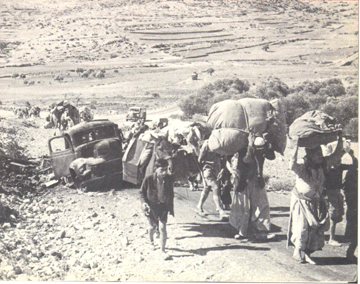
IN 1948, during the war known to the Israelis as the war of independence, the historian Constantine K. Zurayk wrote the book “Ma’na al-Nakba,” later translated as “The Meaning of the Disaster.” The title struck a resounding chord, and nakba (catastrophe) became the term Palestinians used for the cataclysm that befell them that year.

I always considered the word “catastrophe” inappropriate. It rendered the perpetrator anonymous, and it exempted the vanquished from bearing any responsibility for their defeat. Like many members of my generation, born around the time of the war, I tended to place the blame for our defeat on the traditional Palestinian leadership under the sway of the mufti of Jerusalem, and the Arab regimes of the day. Continue reading For Israelis, an Anniversary. For Palestinians, a Nakba

McCain’s Pastor Problem: The Video

Washington Dispatch: In a taped sermon, the preacher McCain calls a “spiritual guide” calls on America to see the “false religion” of Islam “destroyed.” Still, the candidate won’t reject Rod Parsley’s endorsement.

By David Corn, Mother Jones, May 8, 2008

During a 2005 sermon, a fundamentalist pastor whom Senator John McCain has praised and campaigned with called Islam “the greatest religious enemy of our civilization and the world,” claiming that the historic mission of America is to see “this false religion destroyed.” In this taped sermon, currently sold by his megachurch, the Reverend Rod Parsley reiterates and amplifies harsh and derogatory comments about Islam he made in his book, Silent No More, published the same year he delivered these remarks. Meanwhile, McCain has stuck to his stance of not criticizing Parsley, an important political ally in a crucial swing state.

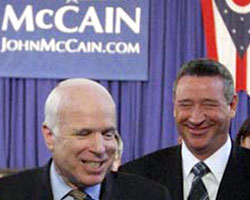
In March 2008—two weeks after McCain appeared with Parsley at a Cincinnati campaign rally, hailing him as “one of the truly great leaders in America, a moral compass, a spiritual guide”—Mother Jones reported that Parsley had urged Christians to wage a “war” to eradicate Islam in his 2005 book. McCain’s campaign refused to respond to questions about Parsley, and the presumptive Republican presidential nominee declined to denounce Parsley’s anti-Islam remarks or renounce his endorsement. At a time when Barack Obama was mired in a searing controversy involving Reverend Jeremiah Wright, McCain escaped any trouble for his political alliance with Parsley, who leads the World Harvest Church, a supersized Pentecostal institution in Columbus, Ohio. Parsley, whose sermons are broadcast around the world, has been credited with helping George W. Bush win Ohio in 2004 by registering social conservatives and encouraging them to vote. McCain certainly would like to see Parsley do the same for him—which could explain his reluctance to do any harm to his relationship with this anti-Islam extremist.

Here’s a video—produced by Mother Jones and Brave New films—highlighting Parsley’s remarks and McCain’s praise of the pastor: Continue reading McCain’s Pastor Problem: The Video

Hezbollah.. The Ugliest Picture

By Tariq Alhomayed, Asharq alawsat, 11/05/2008

Exposing falsehoods and uncovering deception; it is indeed true that a picture is worth a thousand words.

In his speech after the coup on Lebanon and its infrastructure, Hassan Nasrallah claimed that millions of dollars were spent in an effort to defame him and distort the image of the “divine party.” However it was the actions of his party that exposed the armed resistance lie and the falsehood of Hassan Nasrallah’s enthusiasm for Lebanon and the unity of its composition.

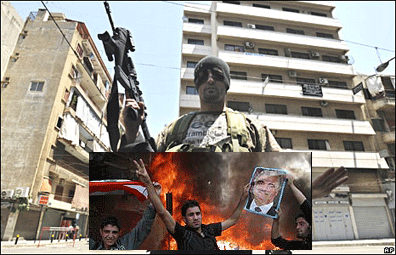
How horrible were the images carried by international news agencies, which showed Hezbollah’s gunmen and Amal forces stomping and burning pictures of the late Rafik Hariri, and then replacing them with a portrait of Syrian President Bashar Assad.

No less hideous were the images of handcuffed and blindfolded pro-government Lebanese citizens paraded in front of “Al Manar” cameras, the television channel that propagates Iran and Hezbollah venom. Moreover the images came across as if these were Israeli captives fallen in the hands of Hassan Nasrallah and not fellow Lebanese brought together by one homeland, of which the most important guarantee is that everyone has the right to live. Continue reading Hezbollah.. The Ugliest Picture