All posts by tabsir

Moroccan Gold in Bahrain

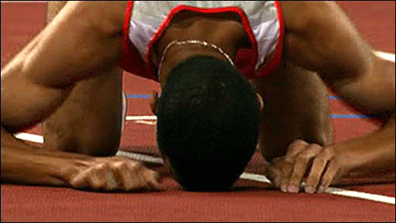
Ramzi storms to 1500m gold medal

BBC News, 19 August, 2008

Bahrain’s Rashid Ramzi held off Kenya’s Asbel Kipruto Kiprop down the final straight to win gold in the 1500m.

Ramzi hit the front with 200m to go and although Kiprop, who set the pace for the first two laps, burst clear of the pack he could not hunt Ramzi down.

Nicholas Willis of New Zealand came third while Great Britain’s Andrew Baddeley finished down in ninth.

Ramzi, who used to compete for his native Morocco, claimed Bahrain’s first Olympic gold medal. Continue reading Moroccan Gold in Bahrain →

A Century Ago in Biskra


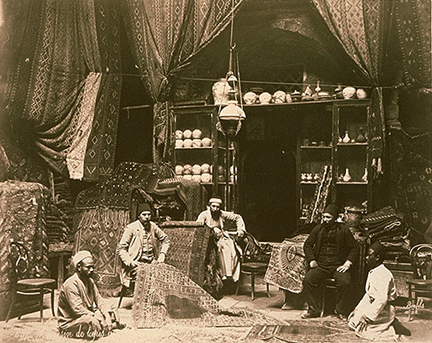
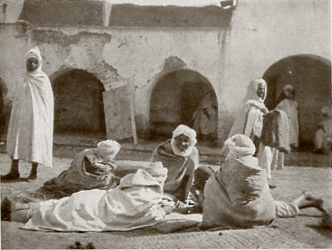
Outside a café: Biskra

A century brings change, yet memories of the past can still bring life to a quickly forgotten past. Exactly one hundred years ago, if you were to visit your doctor and pick up the latest issue of National Geographic Magazine, you would find a story about Biskra, the oasis in Algeria. Pre-Valentino’s The Sheik, this is rather pedestrian travel dialogue from an author who survives in the text only as a Mrs. But the pictures are truly marvelous and make returning to this century-old magazine well worthwhile. Webshaykh

A visit to the market place during the morning is one of the sights of the town and oriental in every tone. Squatting groups and bronzed-legged Bedouins, in brown and white camel’s-hair burnouses, are selling cous-cous, dried peppers, and of course dates. Bunches of fresh grass and green barley and thistles are heaped in one corner of the inclosure, Moorish slippers here and a pile of red fezzes there, and souvenirs for the tourist not lacking. For fifty centimes one may purchase a set of graceful gazelle horns, and curious knives and Arabian guns tempt the collector on the way. An ebon negress is selling oranges, an Arab boy in a red fez, and not much else, carries a basket of purple fruit in green leaves, while cloaks, burnouses, turbans, and yakmahs, purple, blue, deep red, and spotless white all crushed together, make a kaleidoscopic color in the whitewashed square. Bags of henna leaves, for staining the nails in Arab fashion, send forth their pungent odor, and the aroma of coffee and cigarettes fills the air. A Kabyle girl in red gown, tattooed bluely as to her forehead and cheeks, stained yellow as to her finger tips, passes us, cigarette in mouth, her bangles and anklets clanking as she goes. Continue reading A Century Ago in Biskra →

Animal House in the 15th Century: Part 2

The late 14th century Egyptian savant al-Damiri was introduced in a previous post. His massive Hayat al-hayawan, mostly unknown in English texts, is a treasure trove of esoterica. One way of looking at esoterica is that it is useless information, frivolous and entertaining with little or no pedagogical value. I suppose the same could be said for many of the subjects taught on college campuses, past or present. The previous post focused on remarks about camels, but al-Damiri is not without his pragmatic advice for humans. After all, animals should be our friends and not just our dinner. The following recipe may have few takers in contemporary society, especially the overweight citizens of America; but just in case you ever wanted to know, here is advice on how to get fat:

If you wish a woman to become fat, take the fat of a goose (female), pound it and mix with it borax, Karmânî cummin-seed, and the flour of fenugreek, then mix all together with water, make it into bullets and get a black fowl to swallow them for seven consecutive days, after which it is to be killed and roasted; whoever partakes of it or its gravy will become so fat, as almost to be overpowered by the fat, whether the eater is a man or a woman; but if you wish a person to be still fatter than that, take human bile and place it over as much wheat as can be easily prepared with a little water, then wait until the wheat swells out, after which feed a black fowl on it, and do with the fowl as described before; whoever partakes of that fowl whether a man or a woman will see a wonder of wonders in the shape of obesity and fatness, so much so that he or she will not be able even to stand up; this is a wonderful and tried secret.

Given obesity rates in the United States, I would say that either al-Damiri’s secret is out or it really would be useless advice today.

Issues in the Islamic Calendar


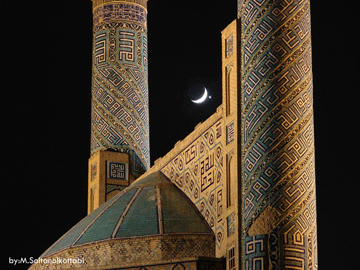
Full Moon on lunar eclipse and Venus, dated June 18, 2008 – Photo by Mohamad Soltanolkotabi

by Khalid Chraibi

“The sun and the moon follow courses (exactly) computed;”

(Koran, Ar-Rahman, 55 : 5)

“It is He Who made the sun to be a shining glory and the moon to be a light (of beauty), and measured out stages for it; that ye might know the number of years and the count (of time).”
(Koran, Yunus, 10:5)

“The ulamas do not have the monopoly of interpretation of the shariah. Of course, their advice must be sought in the first place on shariah matters. (But) they do no make religious law, in the same way that it is not the law professors who make the law, but parliaments.” (Ahmed Khamlichi, Point de vue n° 4)

Issue # 1: Why do Muslims observe the new moon to determine the beginning of months?

When the Messenger was asked by his Companions for a method to determine the beginning of the month of fasting, he told them to begin fasting with the observation of the new moon (on the evening of the 29th day of sha’aban) and to end fasting with the new moon (of the month of shawal). “If the crescent is not visible (because of the clouds), count to 30 days”. (1)

At that time, the Bedouins didn’t know how to write or how to count. They knew nothing about astronomy. But, they were used to observe the stars, at night, in order to find their way in the desert, and to observe the birth of the new moon to determine the beginning of months. The Messenger’s recommendation fitted perfectly with the specifics of their situation.

Issue # 2: Why is the new moon visible, at its birth, in some regions of the world only? Continue reading Issues in the Islamic Calendar →
Yemen sleepwalks into water nightmare

By Alistair Lyon, Special Correspondent, Environmental News Network, March 1, 2008

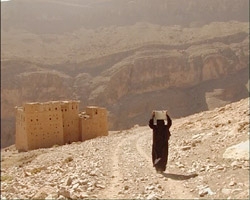
BEIT HUJAIRA, Yemen (Reuters) – Black-clad women trudge across a stony plateau in the Yemeni highlands to haul water in yellow plastic cans from wells that will soon dry up.

“We come here three or four times a day,” says Adiba Sena, as another woman draws water six metres (20 feet) to the surface and pours it into jerry cans lashed to her grey donkey. “We use it to clean, cook, wash — we have no pipes that reach us.”

These women are at the sharp end of what Yemen’s water and environment minister describes as a collapse of national water resources so severe it cannot be reversed, only delayed at best. Continue reading Yemen sleepwalks into water nightmare →

Chickens Come Home to Roost in Georgia

William O. Beeman, New America Media, Aug 12, 2008

Editor’s Note: The Bush Administration’s push for access to oil from the Caspian Sea and it’s desire to isolate Iran precipitated the Russian invasion of Georgia. William O. Beeman is professor and chair of the department of anthropology at the University of Minnesota. He has lived and worked in the Middle East region for more than 30 years.

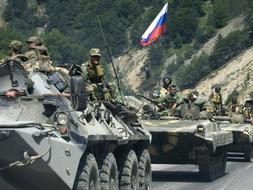
No one should be surprised that U.S. interference in the Caucasus has led to the Russian invasion of South Ossetia. By mixing into the volatile politics of the Caucasus, and trying to recruit the governments there to become American “plumbers” for a variety of purposes, the United States has only drawn Russian fire.

The Caucasus was one of the last territories added to the Russian Empire in the 19th century. It was captured from the Qajar Empire of Iran. The Caucasians never were fully incorporated into Greater Russia, and maintained a fierce cultural separatism. Georgia in particular was proudly nationalistic, with a distinctive language, cuisine, literary tradition and writing system. Continue reading Chickens Come Home to Roost in Georgia →

Mahmoud Darwish Dies

Al-Jazeera, August 9, 2008
Mahmoud Darwish, the renowned Palestinian poet, has died after open heart surgery at the Memorial Hermann medical centre in Texas.

Ann Brimberry, Memorial Hermann’s spokeswoman, confirmed to Al Jazeera that Darwish died at 1.35pm (1835GMT).

Siham Daoud, a fellow poet and friend of Darwish, 67, had asked not to be resuscitated if the surgery did not succeed.

She said Darwish departed for the US ten days ago for the surgery, and he had undergone two operations for heart problems before Saturday’s surgery.

Best known for his work describing the Palestinian struggle for independence, the experience of exile and factional infighting, Darwish was a vocal critic of Israeli policy and the occupation of Palestinian lands. Continue reading Mahmoud Darwish Dies →