All posts by tabsir

African and Arab Media Conference

The Arab Media Centre is pleased to inform you that its next conference will take place on 30-31 March, 2009 at the University of Westminster in London.

CALL FOR PAPERS
African and Arab Media Audiences:
Shared Agendas for Research

Conference jointly organised by the Africa Media Series, Arab Media Centre and Audiences Group, Communication and Media Research Institute (CAMRI), University of Westminster

Dates: 30-31 March, 2009

Venue: University of Westminster, New Cavendish Campus,
115 New Cavendish Street, London W1

THE TOPIC

Media research to date has largely neglected the fast growing and diverse media audiences in African and Arab countries. These countries share painful histories of colonization and broadly comparable experiences of post-independence media development. Today they share the challenge of adjusting to global trade and investment regimes that affect local media production and distribution systems but are crafted elsewhere. Yet when we speak of media reception in the Global South, we tend to think in terms of isolated geographies: of ‘Latin America’, ‘Africa’, or the ‘Middle East’. By contextualizing primarily in terms of place, we overlook memories, issues and features that media users in different regions have in common. We foster artificial boundaries and separate research agendas. As a result, opportunities for productive joint debates about Arab and African media consumption are missed. Continue reading African and Arab Media Conference →
Maliki drops the mask


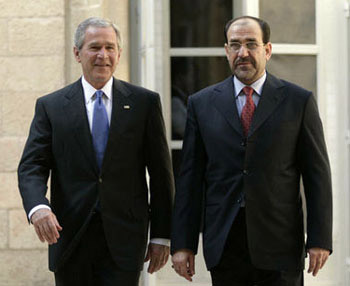
U.S. President George W. Bush walks with Prime Minister Nouri al-Maliki Tuesday, June 13, 2006, at the U.S. Embassy in Baghdad, Iraq.

Maliki drops the mask
Jonathan Steele in Baghdad, The Guardian, Friday September 5, 2008

What’s up with Nouri al-Maliki? As security anxieties subside in this slowly calming city, political speculation has rarely been so intense. First, it was Maliki’s demand that all US troops leave Iraq by the end of 2011. Then came signs that his government wants to undermine the Sunni tribal militias, known as the Awakening councils, on whom the Americans have relied to defeat al-Qaida in Iraq. Now there are moves to take on the powerful Kurdish peshmerga troops and push them out of disputed areas in the strategic central province of Diyala.

Why is the prime minister doing this? Is “the puppet breaking his strings”, as one Arab newspaper put it? Or is the more appropriate metaphor “dropping the mask”? Those who knew Maliki in exile in Syria during Saddam Hussein’s time now recall that he opposed the US-led invasion. His Daawa party did not attend the eve-of-invasion conference of US- and UK-supported exiles in London, and he opposed the party’s decision six months later to join the hand-picked “governing council” set up by the first occupation overlord, Paul Bremer. Continue reading Maliki drops the mask →

Congress is about to pour lighter fluid on Iran

Congress is about to pour lighter fluid on Iran

By WILLIAM O. BEEMAN, Star Tribune, Minneapolis/St. Paul, September 3, 2008

The U.S. Congress may inadvertently lay the foundations for war against Iran when it reconvenes in Washington this month.

Two essentially identical nonbinding resolutions call upon President Bush to “immediately and dramatically increase the economic, political and diplomatic pressure on Iran to verifiably suspend its nuclear enrichment activities.”

The House resolution has more than 200 cosponsors, including Minnesota Reps. Michele Bachmann, John Kline and Jim Ramstad. The Senate resolution has more than 30 cosponsors, including both Minnesota senators, Norm Coleman and Amy Klobuchar.

The methods for increased pressure differ slightly in the two resolutions. The House resolution calls for “stringent inspection requirements” of all goods entering or leaving Iran. The Senate resolution does not call for the inspection of all goods but joins the House resolution in calling for an embargo of refined petroleum products to Iran, which lacks the refining capacity to meet its need for gasoline. Achieving either goal would require a naval blockade — a de facto act of war on the part of the United States, though paradoxically both resolutions explicitly exclude authorization for military action. Continue reading Congress is about to pour lighter fluid on Iran →

Praise God and Pass the Nomination

[Much was made of Obama’s former church and his controversial Pastor, Rev. Wright. In the case of Governor Palin, it’s not the chickens that are coming home to roost but the dinosaurs that she no doubt believes Noah carried on his ark. Here is some sobering commentary on Palin’s apocalyptic dimensions. Webshaykh.]

From the Daily Kos, September 2, 2008

New information re Palin’s church…and what it could mean for you

In my original post, I noted Sarah Palin’s membership in a “stealth Assemblies” congregation, Juneau Christian Center–that is, an Assemblies of God church that tries very hard to hide the fact from outsiders that it is, in fact, an Assemblies of God church. This is pretty much a danger sign in and of itself, especially to those of us familiar with the Assemblies and its increasingly strident calls from district leaders for literal holy war with the rest of America.

However, a recent Harper’s Magazine article reveals just WHY she shouldn’t be near a borough dogcatcher position, much less a literal heartbeat away from the office of President.

For starters, JCC maintains very close relations with John Hagee’s “Christians United For Israel”. Continue reading Praise God and Pass the Nomination →

New Life for the Dead Sea Scrolls


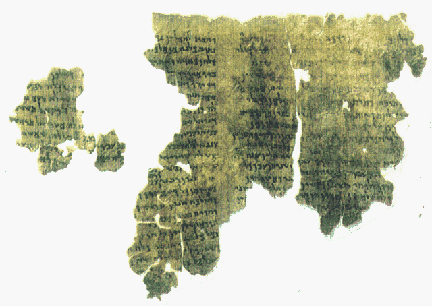
Book of Enoch, Copied ca. 200-150 B.C.E.


Israel to Display the Dead Sea Scrolls on the Internet

By ETHAN BRONNER, The New York Times, August 27, 2008

JERUSALEM — In a crowded laboratory painted in gray and cooled like a cave, half a dozen specialists embarked this week on a historic undertaking: digitally photographing every one of the thousands of fragments of the Dead Sea Scrolls with the aim of making the entire file — among the most sought-after and examined documents on earth — available to all on the Internet.

Equipped with high-powered cameras with resolution and clarity many times greater than those of conventional models, and with lights that emit neither heat nor ultraviolet rays, the scientists and technicians are uncovering previously illegible sections and letters of the scrolls, discoveries that could have significant scholarly impact. Continue reading New Life for the Dead Sea Scrolls →