All posts by tabsir

Preserving Yemen’s Oral Heritage

Dr. Jean Lambert: Adopting a National Strategy for Preserving Yemen’s Oral Heritage is Necessary

Sheba Center for Strategic Studies
, November 2008

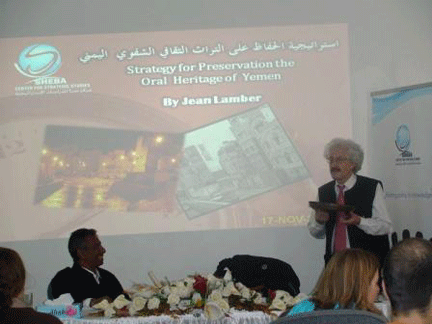
In his lecture delivered on Nov. 11, 2008, at the SCSS, French researcher and anthropologist Jean Lambert prompted the adoption of a national strategy for preserving Yemeni oral heritage and recording it in a well-studied methodology. He pointed out that Yemen’s cultural heritage contains a long and rich list of the narrated heritage which is falling into oblivion and facing extinction as a result of carelessness. He also pointed out that the areas rich with this culture are overlapped and interconnected, making it clear that singing is related to tales, stories and different walks of daily life such as poetry, dancing, and afternoon and evening entertaining sessions, and that all of these areas are fertile grounds for determining the features of any culture. Continue reading Preserving Yemen’s Oral Heritage

Civil Society minus the visas

Academics Struggle for Civil Society in Iraq

by David Moltz, Inside Higher Ed, November 25, 2008

WASHINGTON – Two of the three scholars invited from Iraq to share analysis of academic conditions there could not get visas to attend this week’s meeting of the Middle East Studies Association. Those gathered at the annual meeting for a panel on “the role of academics in building civil society in Iraq” had to settle for having the papers paraphrased to them by a colleague. This twist of fate, however, prompted the remaining panelists to reflect on the challenges that still exist for students and scholars in a post-Saddam Iraq.

Though Riyadh Aziz Hadi, a high-ranking administrator at Baghdad University, and Amer Qader, a professor at Kirkuk University, were unable to attend the event, their scholarly work was presented before the panel.

“This is kind of good for the event in a sinister way,” said Abbas Kadhim, professor of Islamic studies at the Naval Postgraduate School, in Monterey, Cal. and a product of Iraqi higher education. “This shows you some of the difficulties that remain for Iraqi academics. If someone cannot attend an event like this — because of a denied visa with one year’s notice [the case for Hadi and Qader] — you’re looking at a sequestered group of people.” Continue reading Civil Society minus the visas

Reproductive Health in Yemen


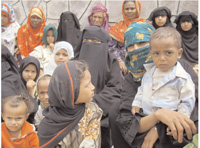
Despite the fact that fertility rate in Yemen is still one of the highest in the world, due to national efforts to promote family planning the projected population for Yemen in 2050 is now 58 million, 1.5 million less than expected in 2007. Yemen Times Photo by Amira Al-Sharif

Integrating culture into development strategy for reproductive health
By: Salma Ismail, Yemen Times, November 19, 2008

SANA’A, Nov. 19 — The United Nations Population Fund (UNFPA) last week released its annual State of the World Population Report for 2008 worldwide. The launching of the report in Yemen took place at Sana’a University and was attended by a number of representatives from the ministries of health and information, the National Population Council, as well as a number of academia and researchers.

Coinciding with the 60th anniversary of the Universal Declaration of Human Rights, the fifth report of the UNFPA, entitled Reaching Common Ground: Culture, Gender and Human Rights, focuses on cultural politics and development, and examines gender inequality and cultural differences with regards to reproductive health. It asserts the importance of cultural interaction with development strategies. Continue reading Reproductive Health in Yemen

The Anthropologist’s Son

The Anthropologist’s Son
by Ruth Behar, Chronicle of Higher Education, November 28, 2008 and History News Network

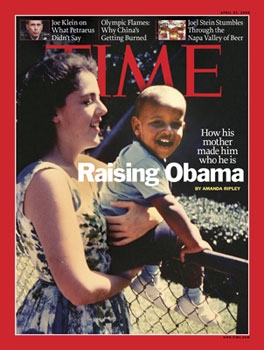
Stanley Ann Dunham Soetoro earned a Ph.D. in anthropology with an 800-page dissertation about blacksmithing in Indonesia. She spent long stretches of time learning to love and rescue the cultures and communities of total strangers, at the cost of not always being around while her son was coming of age in Hawaii. Yet she had an indelible impact on him, teaching him to appreciate cultural diversity and have faith in people’s ability to understand each other across borders and identities. Continue reading The Anthropologist’s Son

An Internationalist President


Professor John Esposito


An internationalist president

by John Esposito, The Immanent Frame, SSRC Blogs, November 7, 2008

Barack Obama’s campaign victory was epic-making in America and across the Muslim world. On November 4, as soon as the election was called for Barack Obama, I began to receive congratulatory emails from friends in the Middle East, South and Southeast Asia, and Europe. Some had stayed up through the night to hear the final results. Of course, I wasn’t surprised at the global interest and support, which had been evident on recent visits to Europe, the Middle East and Southeast Asia. Wherever I spoke, regardless of the topic, someone in the audience would ask me a question about Obama and his prospects. Privately, it was the topic of conversation. So what will all this mean?

In the Muslim world, as in Europe and much of the world, Obama is welcomed as an internationalist president. His Kenyan father, early schooling in Indonesia, race and name symbolize for many a unique internationalist presidential profile, one that contrasts sharply with his predecessor. Indeed, he is seen as the antithesis of George W. Bush-internationally informed, experienced, aware and sensitive, a measured and articulate statesman-not, as Bush is often regarded, as a swaggering Texas cowboy. Continue reading An Internationalist President

Friend of Israel


Let’s hope Obama won’t be a ‘friend of Israel’

By Gideon Levy, Haaretz,
November 9, 2008

The march of parochialism started right away. The tears of excitement invoked by U.S. president-elect Barack Obama’s wonderful speech had not yet dried, and back here people were already delving into the only real question they could think to ask: Is this good or bad for Israel? One after another, the analysts and politicians got up – all of them representing one single school of thought, of course and began prophesizing.

They spoke with the caution that the situation required, gritting their teeth as though their mouths were full of pebbles, trying to soothe all the fears and concerns. They searched and found signs in Obama: The promising appointment of the Israeli ex-patriots’ son, whose father belonged to the Irgun, and maybe also Dennis Ross and Dan Kurtzer and Martin Indyk, who may, God willing, be included in the new administration.

But in the background, a dark cloud hovered above. Careful, danger. The black man, who had associated with Palestinian expats, who speaks of human rights, who favors diplomacy over war, who even wants to engage Iran in dialogue, who will allocate more funding for America’s social needs than to weapons exports. He may not be the sort of “friend of Israel” that we have come to love in Washington, the kind of friend we have grown accustomed to. Continue reading Friend of Israel