All posts by tabsir

Gaza aid diary: Nowhere is safe


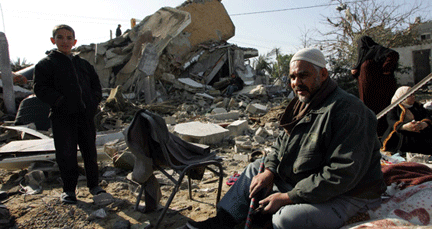
Many Gazan families are in need of aid, but NGOs are struggling to reach them all [GALLO/GETTY]


Gaza aid diary: Nowhere is safe

by Salwa El Tibi in Gaza, Al-Jazeera, Tuesday, January 6, 2009

Yesterday was the first time in nine days that I was able to leave my house.

It is about a 10 minute journey from my home to the warehouse where the Save the Children food parcels are stored – but even as I drove the Save the Children car to work, I felt very afraid.

The noise from the bombings was so loud. There were very few cars on the roads and all of the shops were closed.

I saw three buildings that had been completely destroyed.

Dangerous work

At the warehouse I waited for our volunteer staff who help to distribute our food parcels across different parts of the Gaza Strip.

When we distribute the parcels we work in groups because it is so dangerous. Continue reading Gaza aid diary: Nowhere is safe

Murder in ‘Amran


Children of deceased Masha Nahari, playing in their front yard. Because of hostility against them and fear of harm they remain indoors as must as possible. (YT Photo by Amira Al-Sharif)

While Gaza crisis causes more hostility against Yemeni Jews,
murdered Jewish family demands transferring trail to Sana’a

by Mohammed bin Sallam, Yemen Times, January 4, 2009

SANA’A. During the second court session of the trial of Abdul Aziz Al-Abdi, who is accused of murdering Jewish citizen Masha Al-Nahari this past December 31, journalists and lawyers said that “the court session was full of chaos and quarrels. A soldier was attacked by one of the family members of the accused. In addition, the Jewish family received death threats from the murderer’s relatives.”

Advocates of Al-Nahari demanded to transfer the case and trial to Sana’a due to lack of proper security at the Amran Court and dominance of Al-Abdi’s relatives who �control the events of the session and create chaos inside the court hall,” said Abdul Rahman Barman, a lawyer from Allaw Law Foundation which volunteered to defend Al-Nahari’s case in the court. Continue reading Murder in ‘Amran

The Siege of Gaza


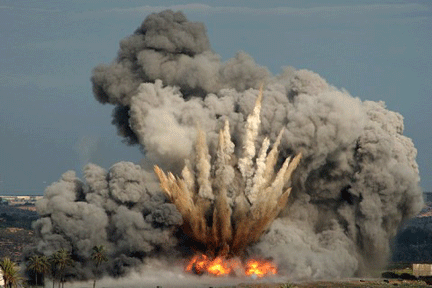
A bomb dropped by an Israeli air force F-16 jet exploding in Beit Hanoun, north of the Gaza Strip.

The Siege of Gaza: Barack Obama’s First ‘Test’?
John L. Esposito, Middle East Online, December 31, 2008

Until the Israeli government gets a message that the international community will hold Israel to the same standards as it does other nations and the Palestinians, there can be no hope for peace negotiations to work.

While some had predicted Barack Obama would be “tested” early in his administration by America’s enemy Osama, Obama’s first major foreign policy “test” has instead come from America’s ally, Israel. Continue reading The Siege of Gaza

Is Israel Repeating Mistakes of the Past?


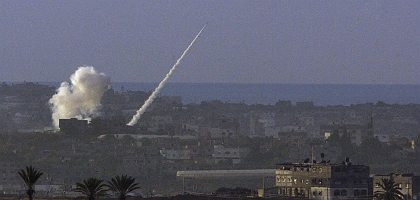
A rocket fired from the Gaza Strip takes off toward Israel. AP

Is Israel Repeating Mistakes of the Past?

By Yassin Musharbash, Der Spiegel, December 31, 2008

Israel has promised a “war to the bitter end.” Yet history is full of examples showing that battling an organization like Hamas is almost futile. It is a lesson Israel learned just two short years ago.

It was almost a century ago when the British soldier T.E. Lawrence described for posterity the World War I revolt of the Arabs against the Ottoman Empire in the Middle East. Lawrence helped organize the revolt, and he famously said that combating such an uprising was “like eating soup with a knife.”

A rocket fired from the Gaza Strip takes off toward Israel.
His adage may not be perfectly applicable to the current Israeli offensive against Hamas in the Gaza Strip. Hamas, after all, is more than just a rebel group. It is simultaneously a political party, a social-services organization and a terrorist group. It is a sworn enemy of Israel, and it continues to incessantly fire rockets across the border, hoping to kill Israeli civilians at random. The group has a civilian and a military component.

Still, the maxim uttered by Lawrence — who was later immortalized in the film “Lawrence of Arabia” — does have a present-day application when speaking of the ongoing fight against terror groups like the Taliban, Hezbollah, al-Qaida. And Hamas. Lawrence was essentially describing the problems that result when a regular army comes up against an irregular fighting force. In military parlance, such a conflict is called “asymmetrical.” Continue reading Is Israel Repeating Mistakes of the Past?

God’s Equal Curse


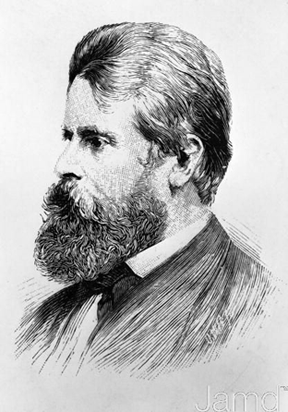
English poet and traveller Wilfrid Scawen Blunt (1840 – 1922), circa 1880.

Webshaykh’s Note: Given the ongoing crises in the Middle East, it is useful to return to earlier commentaries. In the excerpt below the voice of Wilfrid Scawen Blunt echoes with resonance for events currently in the news about Gaza, Iraq and Afghanistan. Let us all hope that the new year brings tolerance and peaceful intentions for us all.

Wealthy and well connected Wilfrid retired from the foreign service in 1869 and soon the traveling Blunts went east. As Wilfrid noted about his first visit to Egypt in 1879, he was still “a believer in the common English creed that England had a providential mission in the East.” After learning about Bedouin customs firsthand in Syria Lady Anne spoke for both travelers about their interest in no longer looking at the people “with the half contemptuous ignorance” of Europeans. Not only were the Blunts aware and appalled at Eurocentric attitudes, but Wilfrid wrote of Islam as a “true religion,” which certainly had far more to offer African converts than Christianity. In 1881 Blunt bought an estate in Cairo, where he became a neighbor and friend of the Islamic reformer Muhammad ‘Abduh. On a visit to England Blunt arranged a visit between ‘Abduh and the reigning social philosopher, Herbert Spencer; the Egyptian reportedly told Spencer that the East was learning the evil rather than the good from the West, but the best of both was the same.

Blunt was perhaps the most famous aristo-critic of British imperialism in Egypt. With the impunity his elite upbringing bequeathed at the time he admonished Lord Cromer, whose “wrong-headed administration” only served to Anglicize Egypt. He used his impeccable social connections to lobby British politicians, including Prime Minister Gladstone, whose “Oriental” policies he deplored. Blunt’s radical critique of the colonial transgressions committed by the burdensome white race is second to none, including Fanon and Césaire. Consider his prescient diary note at the close of the nineteenth century:

The old century is very nearly out, and leaves the world in a pretty pass, and the British Empire is playing the devil in it as never an empire before on so large a scale. Continue reading God’s Equal Curse

Excommunicating Dead Terrorists


A lithographic painting depicting a Muslim funeral procession in India, circa 1888.

Excommunicating Dead Terrorists
by Leor Halevi, On Faith, Washington Post, December 29, 2008

Recently the Muslim Council of India sent an important message to the world’s Muslims. It asked one of the country’s largest Muslim graveyards, Marine Lines Bada Qabrastan, where unclaimed bodies are often interred, to deny burial rites to the nine men who died after terrorizing Mumbai. Refusal to bury the terrorists in a Muslim cemetery signifies not just that terrorist attacks are un-Islamic, a contention often heard, but that their perpetrators become, by carrying these acts, non-Muslim. “They cannot be Muslims or followers of Islam,” declared Muslim Council president Ibrahim Tai, “so they cannot have a final resting place anywhere
on sacred Mother India.”

The question then arises, what should India do with the dead bodies? Continue reading Excommunicating Dead Terrorists

Gaza: the cycle can be broken


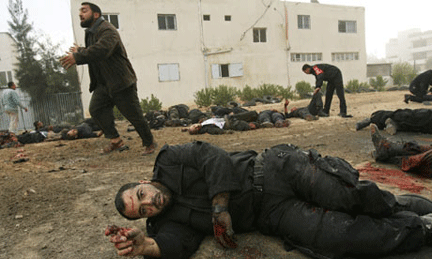
Palestinian rescue workers carry a wounded prisoner in the rubble of the Saraya prison after it was hit by a missile strike on Sunday. Photo by Majed Hamdan / AP.

Gaza: the cycle can be broken

The Independent/, Sunday, 28 December 2008

More than 30 years ago, the American political philosopher Michael Walzer wrote: “First oppression is made into an excuse for terrorism, and then terrorism is made into an excuse for oppression.” It was a good description of the Israel-Palestine problem then, and a good description of the dynamic that would make it worse over the following three decades.

It is a dynamic that operates in contravention of the simple, comforting and wrong principle that two democracies have never gone to war against each other.

The conflict between Israel and the people of Gaza is driven by democratic impulses. Hamas, the Islamic political party and paramilitary organisation, won control of the Gaza Strip in free and fair elections in January 2006. Its charter famously calls for the destruction of the state of Israel and, although that was hardly the issue on which those elections were fought, there can be little doubt about the depth and extent of hostility towards Israel felt by the majority of the population of Gaza. Continue reading Gaza: the cycle can be broken

The flower that made men mad


Nazende al (Flattering Red) from ‘The Book of Tulips’ ca 1725

by Anna Pavord

But as in any love affair, after the initial coup de foudre you want to learn more about the object of your passion. The tulip does not disappoint. Its background is full of more mysteries, dramas, dilemmas, disasters and triumphs than any besotted aficionado could reasonably expected. In the wild, it is an Eastern flower, growing along a corridor which stretches either side of the line of latitude 40 degrees north. The line extends from Ankara in Turkey eastwards through Jerevan and Baku to Turkmenistan, then on past Bukhara, Samarkand and Tashkent to the mountains of the Pamir-Alai, which, with neighbouring Tien Shan is the hotbed of the tulip family.

As far as western Europe is concerned, the tulip’s story began in Turkey, from where in the mid-sixteenth century, European travellers brought back news of the brilliant and until then unknown lils rouges, so prized by the Turks. In fact they were not lilies at all but tulips. In April 1559, the Zürich physician and botanist Conrad Gesner saw the tulip flowering for the first time in the splendid garden made by Johannis Heinrich Herwart of Augsburg, Bavaria. He described its gleaming red petals and its sensuous scent in a book published two years later, the first known report of the flower growing in western Europe. The tulip, wrote Gesner, had ‘sprung from a seed which had come from Constantinople or as others say from Cappadocia.’ From that flower and from its wild cousins, gathered over the next 300 years from the steppes of Siberia, from Afghanistan, Chitral, Beirut and the Marmaris peninsula, from Isfahan, the Crimea and the Caucasus, came the cultivars which have been grown in gardens ever since. More than 5,500 different tulips are listed in the International Register published regularly since 1929 by the Royal General Bulbgrowers’ Association of the Netherlands. Continue reading The flower that made men mad