All posts by tabsir

The Brussels attack and liberal Islamophobia

<em

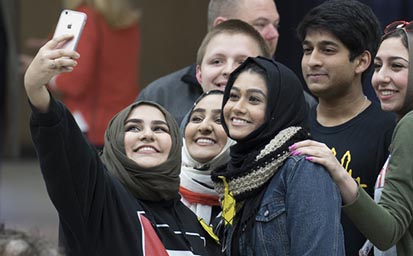
“WICHITA, KS – MARCH 5: A group of Muslim students take selfies before Republican presidential candidate Donald Trump made a speech at a campaign rally on March 5, 2016 in Wichita, Kansas. During the speech, after they voiced some protests, they were removed from the convention center. J Pat Carter/Getty Images/AFP”

Middle East Eye, March 22, 2016

Glaringly absent from American news media are opinion polls showing that Muslims are no more likely to accept violence than other groups

No sooner had the Belgian attacks happened, commentators on social media began linking the terror acts to the Islamic faith, with the hashtag #StopIslam trending on Twitter.

Empirical data show that Islamophobia, defined by Professor Todd Green as “an irrational fear, hostility or hatred of Muslims or Islam” is on the rise in American society.

Many Americans are increasingly scared of Muslims, and, given rising anti-Muslim hate crimes – the FBI says anti-Muslim hate crimes have increased fivefold since the September 11 terror attacks – many American Muslims are also growing more scared for their personal safety.

Given attacks by Muslim extremists – including the 11 September 2011 attacks – some fear of Muslim terrorists is obviously warranted. But much of Islamophobia borders on the absurd. Islamophobic statements, sentiments and policies tend toward exaggeration and overgeneralisation, and are divorced from empirical realities.

Recent statements made by Republican presidential frontrunner Donald Trump offer useful cases-in-point. In a recent CNN interview, Trump stated that “Islam hates us.” Trump also claimed last week that 27 percent of Muslims are radicals who are “very militant”.

No one knows where or how Trump’s campaign team came up with the 27 percent figure. He may have consulted with noted Islamophobe Brigitte Gabriel, who famously claimed that Muslim radicals represent “between 15 to 25 percent” of the global Muslim population. “You’re looking at 180 million to 300 million people dedicated to the destruction of Western civilisation,” Gabriel asserted. Prominent media personality Glenn Beck, meanwhile, has claimed that 10 percent of the world’s Muslims are terrorists.

So-called Islam experts Robert Spencer, Sam Harris, Pamela Geller and Ayan Hirsi Ali have been even more direct. All have claimed that Islam is a religion bent on violence. Spencer argued that “Traditional Islam is not moderate or peaceful” and that late al-Qaeda leader Osama Bin Laden was acting in ways that were “consistent with traditional understanding of the Qur’an.” Harris has said that “we are at war with Islam…we are absolutely at war with the vision of life that is prescribed to all Muslims in the Koran.” Geller argued that “the Quran is war propaganda” and Ali said that the West’s war on terror should not only be directed at radical Islam, but, rather, “Islam, period”.

Statements like these are reckless, and may help explain why more and more Americans believe that Islam itself is the problem, not just the extreme, minority interpretations offered up by the so-called Islamic State (IS) and al-Qaeda. A 2011 survey by the Public Religion Research Institute showed that 55 percent of Republicans and 40 percent of Democrats believed that Muslim extremists who commit violence against civilians are acting consistently with their faith. A 2015 Brookings survey, meanwhile, found that 61 percent of Americans hold unfavourable opinions of Islam.

Given all of this, it is perhaps unsurprising that many Americans support Trump’s November proposal for “a complete shutdown of Muslims entering the United States”. A strong majority of Republicans support Trump’s “temporary” Muslim ban proposal, including 78 percent of Republicans in Alabama, 76 percent in Arkansas, 76 percent in Mississippi and 74 percent in South Carolina.
Liberal Islamophobia

But it would be wrong to view Islamophobia as a strictly conservative phenomenon. Polling data indicate that 49 percent of Democrats hold unfavourable views of Islam. Also, Brookings Institution scholar Shadi Hamid has argued that US President Barack Obama, a Democrat, holds views that amount to “Islamic exceptionalism”. Hamid argues that Obama’s statements about Muslims suggest that he is “frustrated by Islam” and that he has bought into Samuel Huntington’s “clash of civilizations” thesis.

Moreover, American news media, including liberal outlets, have done a poor job contextualising stories about Muslims and Islam. A growing body of empirical research into American news media coverage of Islam reveals deeply problematic patterns – negative, stereotypical portrayals, almost no Muslim sources, and few mention of Muslims or Islam in the context of positive news. That American news outlets apply the “terrorism” description almost exclusively to Muslim-perpetrated violence cannot be lost on anyone paying attention.

Of all the recent research on Islamophobia, Professor Chris Bail’s work might be the most instructive – and also the most damning for American news outlets. Bail uses computerized content analysis to show that Islamophobic statements – released by a small group of anti-Muslim fringe groups – are much more likely to make their way into the American news cycle than statements made by Muslim advocacy groups denouncing terrorism. Bail’s research shows that while denunciations of terrorism by Muslim groups generally go unreported, Islamophobic statements drive news narratives.

Glaringly absent from American news media are opinion polls showing that Muslims are no more likely to accept violence than other groups. For instance, a 2011 Gallup World Violence poll showed that Muslims were just as likely as non-Muslims to reject vigilante acts of violence against civilians.

In America, polling data point even more sharply in this direction. A 2011 Gallup poll found that American Muslims were the least likely of all polled American religious groups to accept vigilante violence against civilians. In all, 26 percent of American Protestants, 27 percent of Catholics, 22 percent of Jews, 19 percent of Mormons, 23 percent of atheists, but just 11 percent percent of Muslims said that it is “sometimes justified” for an “individual person or a small group of persons to target and kill civilians”.

As for actual terrorists, the CIA estimates that there are around 30,000 Muslim jihadists in the entire world. A Kurdish leader has suggested that the CIA underestimates the jihadist threat, and claims that the total number is closer to 200,000. Even assuming the larger figure, jihadists represent a grand total of 0.01 percent of the world’s 1.8 billion Muslims.

American entertainment media have been part of the problem. Media scholar Jack Shaheen carried out a content analysis of more than 900 Hollywood movies featuring Arab or Muslim characters. Shaheen found Muslim characters are almost never cast in positive or neutral roles. The overwhelming majority of films that feature Arab or Muslim characters cast them as enemies, terrorists, violent, savage or backwards.

No one would suggest that American media and political discourse should completely eliminate mentions of Muslim-perpetrated terrorism. Al-Qaeda and ISIS are real threats and some attention, concern and fear are warranted. But, compared to other threats of violence, Muslim terrorism garners exaggerated attention in American news and politics.

In the 14 years since 1 January 2002, Muslim terrorists have killed 45 Americans in the United States, a smaller number than right-wing conservative terrorists have killed during the same time period. Also, since the start of 2002, there have been more than 200,000 firearm-related homicides in the United States, and hundreds of mass shooting.

More realistic, proportionate presentations would greatly improve American political life. However, given the extent to which the Islamophobia industry is funded, people shouldn’t hold their breath waiting for fairer, less sensational presentations.

– Dr Mohamad Elmasry is an Assistant Professor in the Department of Communications at the University of North Alabama.

The views expressed in this article belong to the author and do not necessarily reflect the editorial policy of Middle East Eye.

.

Seasonal Knowledge in the Gulf Project

arabdhow

This is to note that I have received a research grant from the Qatar Foundation for a study of indigenous knowledge of the seasons and time-telling in the Gulf. I have created a separate webpage to indicate progress through updates on the progress. This page is at https://tabsir.net/?page_id=2903

Webinar in Islamic Material Culture “The Rise of an Agricultural Empire”

tombs
Economy and Material Culture in the Early Islamic Empire
Bi-Weekly, Wednesday, 4-6 pm CEST Starting April 6, 2016

Islamic Material Culture

The Universität Bonn (Bethany Walker), the Ludwig-Maximilians-Universität in Munich (Andreas Kaplony), The Bard Graduate Center in New York (Abigail Balbale), and Universität Hamburg (Stefan Heidemann) are co-operating in setting up a series of webinars in Archaeology of the Middle East, Arabic Papyrology, Islamic Arts and material Culture, and Numismatics of the Middle East.

Why Agriculture?

Why agriculture and the Early Islamic Empire in material culture? Not least Bulliet’s book about the cotton boom (2009) in the Early Empire has stimulated discourse about agriculture and elite culture of the Early Islamic Empire. The webinar tutorial explores different aspects of this agriculture boom in case studies from Central Asia to the Iberian Peninsula. We see a continuation and improvement in efficiency of established forms of irrigation from Late Antiquity to the Early Islamic Empire. The new Muslim elites turned into a landholding class establishing estates and luxurious mansions. The new imperial metropolises created an unprecedented demand in foodstuffs, which was answered by bringnig more land under cultivation and introducing more efficient ways of production. Food had to be transported, and maritime and river routes were established. While some of these developments can be explored through text, material culture and archaeology allows new ways to see this boom in detail. Guest lecturers will include Corisande Fenwick (University College London), Abigale Balbale (The Bard Graduate Center, New York), Sören Stark, Institute for the Study of the Ancient World), and Kristoffer Damgaard (Carsten Niebuhr Institute, Copenhagen), and Bethany Walker (Universität Bonn).

The webinar is part of the ‘Webinar Initiative in Islamic Material Culture’ jointly organized by the Bard Graduate Center, New York, Universität Bonn, Ludwig-Maximilians-Universität, Munich, and Universität Hamburg.
Prerequisites for participation

Spoken and written proficiency in English language. The course is open to all advanced students in B.A., M.A., and PhD programs of Islamic studies, historians, art historians, and archaeologists of the Middle East. All students need a computer, a reliable internet connection, and a headset. In a personal online short skype interview in early April 2016, we will check whether all technical assets are working. Students from Hamburg have to sign up in the campus system ‘Stine’ and to contact Stefan Heidemann as early as possible to register and get the necessary introduction to the technology. Students from universities other than Universität Hamburg are welcome and have to apply with a short CV and a motivation letter in English until March, 15, 2016. These will be emailed to Prof. Stefan Heidemann at: stefan.heidemann@uni-hamburg.de. Preference is given to students from universities within the network of the webinar initiative “Islamic Material Culture”.

http://www.aai.uni-hamburg.de/voror/Personal/agricultural-empire-sommer-2016.html

Muslims in Medieval France

burial

Early Medieval Muslim Graves in France: First Archaeological, Anthropological and Palaeogenomic Evidence

Yves Gleize ,
Fanny Mendisco ,
Marie-Hélène Pemonge,
Christophe Hubert,
Alexis Groppi,
Bertrand Houix,
Marie-France Deguilloux,
Jean-Yves Breuil

Published in PLOS/ONE, February 24, 2016

Abstract

The rapid Arab-Islamic conquest during the early Middle Ages led to major political and cultural changes in the Mediterranean world. Although the early medieval Muslim presence in the Iberian Peninsula is now well documented, based in the evaluation of archeological and historical sources, the Muslim expansion in the area north of the Pyrenees has only been documented so far through textual sources or rare archaeological data. Our study provides the first archaeo-anthropological testimony of the Muslim establishment in South of France through the multidisciplinary analysis of three graves excavated at Nimes. First, we argue in favor of burials that followed Islamic rites and then note the presence of a community practicing Muslim traditions in Nimes. Second, the radiometric dates obtained from all three human skeletons (between the 7th and the 9th centuries AD) echo historical sources documenting an early Muslim presence in southern Gaul (i.e., the first half of 8th century AD). Finally, palaeogenomic analyses conducted on the human remains provide arguments in favor of a North African ancestry of the three individuals, at least considering the paternal lineages. Given all of these data, we propose that the skeletons from the Nimes burials belonged to Berbers integrated into the Umayyad army during the Arab expansion in North Africa. Our discovery not only discusses the first anthropological and genetic data concerning the Muslim occupation of the Visigothic territory of Septimania but also highlights the complexity of the relationship between the two communities during this period.

For the complete article, click here.

Arabic Papyrology Database

papyrology
Andreas Kaplony, H-Mideast-Medieval, Saturday, January 2, 2016

The Arabic Papyrology Database (APD) team wishes you a happy New Year. Our present: new, handy features implemented in the APD and many, many more documents . Please, check www.naher-osten.lmu.de/apd under

(a) “Documents”. For 2,571 published documents, we provide the full text of the document and information on the document, while for another 6,281 published and unpublished documents, we give information on the document only. We are proud to offer not only records from Egypt and the Middle East, but also a quite comprehensive list of Arabic documents from Sicily and Spain: click on “Origin” and choose Sicily or Spain. Weekly updates! – For full bibliographical details, check at www.naher-osten.uni-muenchen.de/apb.

(b) “Text”: This is our full text search tool. Many features, including search restricted by time, provenance, document type, etc.

(c) “Lexicon”: This site is completely new and allows you to access the lexicon of all implemented texts in several ways: Looking for a lemma, you will have an overview on all actual realizations, with hyperlinks giving you direct access. You might look for a root, a verbal stem, or a shape/morpheme type (e.g. fāʿil or faʿʿāl). Or try Word categories (functional categories) and Domains (semantic categories), independently or in combined searches.

We would be happy to have your feedback on the new features.

Best regards, Eva Youssef-Grob (evamira.youssef@uzh.ch), for the Arabic Papyrology Database team

Rules of Engagement

rules

8 Rules of Engagement Taught by the Prophet Muhammad

Extremism ‘experts’ are everywhere these days. Assertions thrive about what Shariah law allows, especially when it comes to warfare and ‘Jihad’. Two very unlikely bedfellows, Islamophobes and extremists, have taken up one allegation, that Islam is violent, and run with it. They both misquote Islamic sources to prove their shared fantasies, and to good effect, with media outlets falling over themselves to give them a platform. This convenient lie has become the Blood Libel of the Muslims, which is spread by various groups to achieve their own agendas.

So here is a list of actual rules of engagement taken from Islamic law, together with their original sources. This is what forms the basis of what Muslims believe and follow. These 8 laws expose the ‘Islam is violent’ line as lazy and shamefully dishonest.

N.B. War is unfortunately an inevitable part of civilization and at times countries need to respond to aggression. Islam allows the use of force to stop evil and bring security to a country’s citizens therefore a set of laws pertaining to war has been laid out by the Prophet Muhammad himself.

What follows are mainstream laws of Islam as taught by the orthodoxy of the religion. This is what the vast majority of Muslims around the world observe as their religion. It does not mean however, that all those who claim to be Muslim actually follow orthodox Shariah laws. Such groups and individuals would rightly be labelled as heretics for inventing new beliefs that run counter to explicit statements found in original sources of Islamic law. Continue reading Rules of Engagement →