All posts by tabsir

Iraq Study Day at Hofstra

The Middle Eastern and Central Asian Studies (MECA) Program at Hofstra University is hosting a day-long “Iraq Study Day” on Monday, April 27, 2009. The purpose of the program is to bring several distinguished scholars to campus to speak to the Hofstra community and general public about the making of modern Iraq and the ongoing occupation by American military forces. Although information on the current crisis is widely available in the media, students, faculty and the general public need to understand the historical context for the making of modern Iraq in the 20th century.

A general forum for the public will be held on the theme “Iraq: How the Past Shapes the Future” on Monday, April 27, 3-4:30 p.m., in the Monroe Lecture Center Theater, California Avenue, South Campus of Hofstra University. Directions to Hofstra are available here.

The participants in the panel are:

• Nida al-Ahmad, Political Science, New School for Social Research: “State Power in Ba’thist Iraq”
• Dr. Magnus Bernhardsson, History, Williams College (author of “Reclaiming a Plundered Past: Archaeology and Nation Building in Modern Iraq,” 2006)
• Dr. Eric Davis, Political Science, Rutgers University (author of “Memories of State: Politics, History and Collective Identity in Modern Iraq,” 2005)
• Dr. Reeva Simon, History, Yeshiva University (author of “The Creation of Iraq, 1914-1921,” 2004
• Dr. Bassam Yousif, Economics, Indiana State University (author of “The Paradox of Development under Dictatorship: Iraq 1950-2003,” 2006)

Continue reading Iraq Study Day at Hofstra

The Quran in an Historical Context


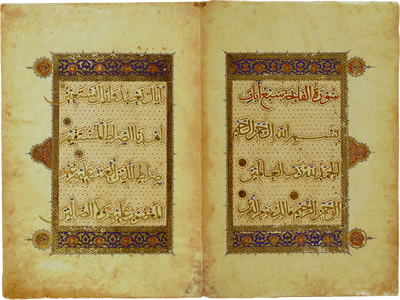
Sultan Baybars’ Qur’an Text

Alwan for the Arts Presents

The Quran in an Historical Context by Nasr Hamid Abu Zayed
Friday, April 24, 2009 6:30 P.M.
Free and Open to the Public

Religious texts are understandably ubiquitous and take on a life of their own, above and beyond the quotidian, above and beyond history, and are endowed with a sacred halo of omnipotence and omnipresence. However subjecting sacred texts to innovative forms of historical, hermeneutical or allegorical readings can be an immensely rich exercise in bringing out the multidimensional view inherent in the text and in our reception of its meaning. In this lecture, Nasr Hamid Abu Zayed will offer a survey of the most recent theories, controversies and discoveries in the field of Quranic studies as well as address by way of a historical and comparative reading the circumstances in which the Quran was formed and its relationship to the Bible. Continue reading The Quran in an Historical Context

Hanif Kureishi on Salman Rushdie

by Kenan Malik, Prospect, April 2009

… The novelist Hanif Kureishi, a friend of Rushdie’s since before the fatwa, has long chronicled the changing experience of immigrants in Britain, through novels like The Buddha of Suburbia and screenplays such as My Beautiful Laundrette. I talked to him recently about the impact of the campaign against The Satanic Verses on his writing and on British culture.

“Nobody,” Kureishi suggests, “would have the balls today to write The Satanic Verses, let alone publish it. Writing is now timid because writers are now terrified.”

Like Rushdie, Kureishi is a writer who came of literary age in the 1980s, exploring the relationship between race, culture, identity and politics in Thatcher’s Britain. But where Rushdie had been born in Bombay and his work deeply shaped by the politics and culture of the subcontinent, Kureishi was born in Bromley, south London, went to the same school as his hero David Bowie (although not at the same time), and his work is infused by the sounds and rhythms of the capital. Continue reading Hanif Kureishi on Salman Rushdie

Forensic Scriptures: Down by the Riverside

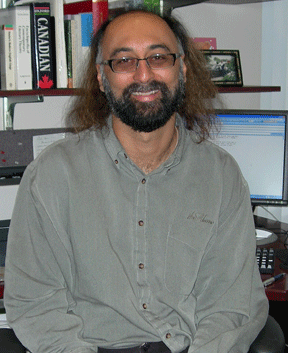
The following information is about a conference at the Riverside Church in Manhattan on May 15-17, 2009. Tabsir commentator and newly tenured professor Amir Hussein (pictured above) will be giving a presentation on Saturday, as noted below. Note that unlocking the key to these Forensic Scriptures is not free, but requires registration.

Forensic Scriptures presents the Qur’an as a sacred resource increasingly accessible to Jewish and Christian scholars and students of the Scriptures. It is a template of scriptural production from the last major culture to spring from the ancient Middle East, in which reliable information about scriptural development has never disappeared from view. To illustrate the model, Muslims believe Muhammad was illiterate and that nearly all Surahs of the Qur’an may have been written down by the women of his household, lead by Hafsah, who was entrusted with preservation of the Qur’an and transmission of it to the world. The Hadith presents conversations and actions of the Prophet as recorded by his Companions, male and female, including another wife, Ayisha. Recognition that such materials were penned by women does not rely on secondary sources or conjecture. Islamic primary sources, under rigorous re-evaluation by Islamic scholars today, have a potential to reveal whole new paradigms that may now be applied to Biblical texts, beginning with these historic Riverside symposia, supported by surrounding seminaries and by noted scholars. Continue reading Forensic Scriptures: Down by the Riverside

Visit the Topkapi for free

Given the economy, you may not be planning any trips this summer or anytime soon. But who would not like to take a tour of the Topkapi Palace in Istanbul? No problem, you can do it for free. Just go to this website (http://www.3dmekanlar.com/topkapi_palace.htm), download and start clicking away. And when you exhaust that, check out a number of major Islamic sites that are yours for digital pleasure.

A DenMarked Cartoonist


Kurt Westergaard says he is too old to be afraid.

Danish cartoonist remains defiant

BBC News, April 5, 2009
The row over publication of cartoons of the Prophet Muhammad in a Danish newspaper resurfaced this week as Turkey held up the appointment of Danish prime minister as the new Nato secretary general. But as the BBC’s Malcolm Brabant reports from Denmark, the impact of that 2006 controversy has never gone away for those closely involved.

Dusk was falling, the curtains were open and the house was hyggelig – a Danish word that means cosy, welcoming and enticing – with scores of candles flickering around the open-plan sitting room.

Dressed in his favourite “anarchist” colours of red and black, Kurt Westergaard sat down to a nourishing Nordic repast of black bread, plaice and prawns.

Unwinding after a day at the coalface of his profession, the bohemian grandfather with a seadog’s beard and Father Christmas trousers appeared to be the epitome of Scandinavian tranquillity. Continue reading A DenMarked Cartoonist

Yemen’s Alabaster Windows

Moonglow from Underground

Alabaster, one of the rarest and most ancient of lighting materials, has now been reinterpreted in a contemporary idiom.

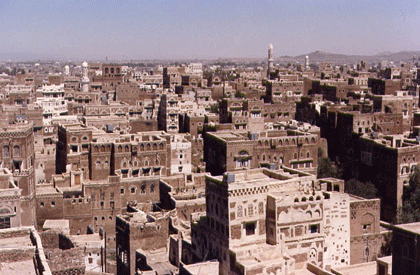
Used to illuminate Arabian palaces and tower-houses since 2,000 years ago, the subtle glow of alabaster – ‘moonlight stone’ – has been brought to light again by Abdulwahhab al-Sayrafi, master alabaster craftsman. His unique, hand-made range of alabaster windows, lamps and candleholders are perfect for today’s architecture and today’s interiors. Continue reading Yemen’s Alabaster Windows