All posts by tabsir

God, the Devil and Pakistan


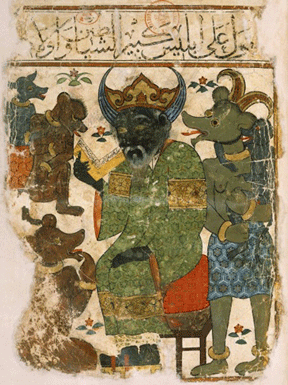
Iblis (the Devil) from The Book of Nativities (Kitâb al-Mawalid) by Abû Ma’shar, 15th Century.

by Suroosh Irfani, Daily Times (Pakistan), May 7, 2009

Jewish denial during the war is perilously instructive for Pakistan today: a country where the founding spirit of justice and democracy is blighted by falsehood and fear. Small wonder that last month, Prime Minister Gilani virtually ignored the seditious speech of Sufi Muhammad.

Noted Saudi novelist Turki al Hamad’s novel, Kharadib, has sold over 20,000 copies in the Arab world since publication in 1999. Al Hamad continues to live in the Saudi capital Riyadh, despite fatwas of Saudi clerics against him, and Al Qaeda branding him an apostate.

The reason? Hamad’s teenaged protagonist in the controversial novel dares to ponder the question of God and the devil.

King Abdullah, then the Crown Prince, reportedly offered Hamad bodyguards for his protection, while reputed Saudi scholar Sheikh Ali al Khudair, who initially censured Hamad, withdrew his fatwa in 2003.

The retraction suggests that the musings of Hamad’s protagonist on “religion, sex and politics, the three taboos in Saudi society” had triggered a rethink on an issue that Muslim luminaries like Jalaluddin Rumi (d.1273) had addressed, long before German writer Goethe cast the devil in new light in his epic poem Faust in the 19th century.

However, it remained for Allama Iqbal’s genius to bring together Goethe and Rumi in a discourse on the devil, burnishing wisdom of the past with his own insights on evil. The upshot of it all is a realisation that “evil is not mere darkness that vanishes when light arrives. This darkness has as positive an existence as light,” as Javed Iqbal, former Chief Justice of Lahore High Court, notes in “Devil in the triangle of Rumi, Iqbal and Goethe” in Iqbal Review. Continue reading God, the Devil and Pakistan

Portrait of a Bahraini Anthropologist


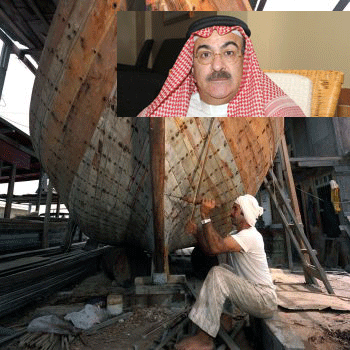
Bahraini dhow builder, photo by Abdulla Al Khan; insert shows Dr. Abdullah Yateem

A modern culture specialist
By Paul Balles, Bahrain This Month

What makes Dr. Abdullah Yateem a modern culture specialist? He’s an anthropologist who has taken a modern approach to studying cultures.

Many people don’t know what anthropology is or what anthropologists do unless they happen to have attended university and learned that they could take courses in the subject.

If they listened to British television critic Nancy Banks-Smith, they might have heard her say, “Anthropology is the science which tells us that people are the same the whole world over — except when they are different.”

Cultural anthropologist Ruth Benedict, with tongue in cheek, put it another way, “The purpose of anthropology is to make the world safe for human differences.”

From these comments, one might safely assume that anthropologists study almost anything related to the similarities and differences between cultures.

Anthropologists like Dr. Abdullah Yateem address questions such as: how can people who look different, talk differently and come from different cultures get along together in today’s world? (paraphrasing Clyde Kluckhohn). Dr. Yateem is not only an anthropologist who studies cultures. Currently, he’s Assistant Undersecretary for Press and Publications in the Ministry of Information. Continue reading Portrait of a Bahraini Anthropologist

Why hedonistic polygyny is against Islam


Mukhtaran Mai

Why hedonistic polygyny is against Islam

by A. Faizur Rahman

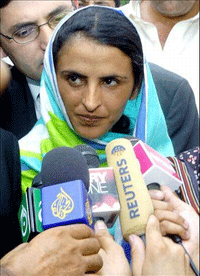
The marriage, under pressure, of Mukhtaran Mai, the courageous woman who stood up to the atavistic tribal laws of Pakistan after being honour-raped by a gang of human beasts, has brought into focus the enormity of the gender bias prevailing in Muslim societies, particularly through the misuse of the law of polygyny. Without doubt, Ms. Mai is a victim of both emotional and physical blackmail. That she is also a victim of medieval indoctrination can be deduced from her unqualified statement (“A controversial marriage in Pakistan,” The  Hindu, March 30, 2009) that taking a second wife is permitted in Islam. Therefore, it could be said with some conviction that it was the belief that her marriage was not un-Islamic (rather than the fear of jeopardising the marriages of three other women) that prompted her into marrying an already married man. For it is unbelievable that a woman of the mental strength of Ms. Mai could have succumbed to the threats of a cowardly blackmailer. Continue reading Why hedonistic polygyny is against Islam

Interrogating Interrogation in Iraq


Interrogation Results Prompt Scrutiny Of Methods

by Dina Temple-Raston, NPR, Morning Edition, April 30, 2009

This is a story about two interrogation programs — one run by the U.S. military, the other run by the CIA. The military program was focused on getting important al-Qaida suspects in Iraq to talk. The CIA operation zeroed in on important al-Qaida suspects from around the world. Both programs had similar goals, but they operated under very difficult rules.

Earlier this month, former CIA Director Michael Hayden was on Fox News defending the CIA’s enhanced interrogation program.

“The use of these techniques against these terrorists made us safer,” he said emphatically. “It really did work.” As Hayden and others see it, the U.S. had to use tough techniques — some called it torture — to battle al-Qaida.

Matthew Alexander is an advocate of a different kind of interrogation — one that builds rapport, like the kind of technique you see on television cop shows. Alexander was a military interrogator in Iraq and doesn’t see the need for rough questioning. Continue reading Interrogating Interrogation in Iraq

10 Conceptual Sins

“10 Conceptual Sins” in Analyzing Middle East Politics

by Eric Davis, from The New Middle East, January 28, 2009. For an Arabic translation of this post, click here.

Sin # 1: “Presentism.” Unfortunately, many of those who analyze Middle East politics, whether journalists, policy analysts, or academics, do not take history seriously. That is, they fail to situate Middle East politics in a historical context. If they did, they would gain many more insights into the political dynamics of the region.

Analysts would have realized why, for example, Iraqis showed little enthusiasm when American troops toppled Saddam Husayn’s regime in April 2003. This response did not indicate that Iraqis were ungrateful as the vast majority were relieved to see the end of Saddam’s regime. Rather, many Iraqis, who did have a historical consciousness, knew that the US had supported Saddam Husayn during the Iran Iraq War. Iraqis also remembered that, when President George Bush senior called upon them to rise up against Saddam Husayn in 1990, many took him at his word. However, not only did the US not intervene to help the rebels during the February-March 1991 uprising (Intifada), it gave permission for Iraqi helicopter gun ships to enter the fray which turned out to be critical in suppressing it. Continue reading 10 Conceptual Sins

Muslim Civilisations Abstracts (MCA)

Muslim Civilisations Abstracts (MCA)

Phase I

The first phase of the Muslim Civilisations Abstracts (MCA) is a substantial and comprehensive annotated bibliography of modern encyclopaedias about, and from, the Muslim world. These have been produced both by Muslims and non-Muslims, with different approaches to the organisation of knowledge and understanding of Muslim beliefs, civilisations and societies. It seems important that there should be a mutual appreciation both of these differences and of the extensive and systematic work that has been done in many countries to construct organised reference works and databases encompassing cumulated research.

Phase II

The MCA has launched the second stage of its project and requires the assistance of scholars to write abstracts on academic books. Continue reading Muslim Civilisations Abstracts (MCA)

An Ottoman Baghdad Portrait

The Library of Congress has archived thousands of illustrations and photographs online. In browsing through some of the collections, I came across the above image taken in Baghdad in 1872, when the city was under Ottoman control. The photographer was Pascal Sébah. According to the description, the three individuals shown are: (1): Arab of the Chammar (Shammar) tribe; (2): Arab of the Zobeid tribe; and (3): married Muslim woman of Baghdad.

The Walled City of Sanaa

The Walled City of Sanaa
by Ronald Lewcock

[Note: This is an excerpt from Ronald Lewcock;s 1986 UNESCO book. The book is available online in its entirety in pdf format at http://www.worditude.com/ebooks/unescopdf/sana_eng.pdf.]

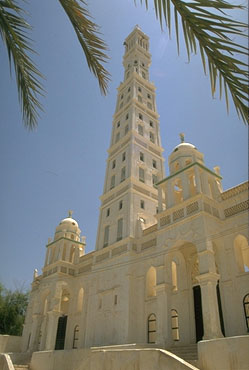
Viewing the old walled city of San‘a for the first time creates an unforgettable impression. And this vision of a childhood dream world of fantasy castles is not dispelled even on closer acquaintance. In the farmlands outside the city, on either side of the roads leading to it, buildings of all shapes – circular, rectangular, square – rise out of the flat highland plain to seemingly impossible heights constructed of apparently weak materials. Not merely does the stonework of the lower levels consist of rough rubble with loose mortar, but for most of their height the buildings are made of mud – layered mud, mud bricks of all sizes – and of mud-straw plaster, infinitely eroded by the monsoon rains until deep indentations mark the channels down which the autumnal torrents find their passage to the earth. Continue reading The Walled City of Sanaa