All posts by tabsir

Muslims for Progressive Values Conference

Muslims for Progressive Values cordially invites you to participate in our Third Annual National Conference, to be held from June 19 – 21, 2009 at Sarah Lawrence College in Bronxville, New York.

Join us for a spiritually uplifting and engaging weekend as we explore this year’s theme, “Building the Progressive Muslim Community.” The retreat will include a variety of skills-building workshops including media engagement, political advocacy, and discussions on spirituality as well as social activities. To learn more or register to attend the conference, please click here.

The 3rd annual Muslim for Progressive Values retreat “Building a Porgressive Muslim Community” is June 19-21 at Sarah Lawrence College, NY and the deadline for registration is May 31, 2009. Continue reading Muslims for Progressive Values Conference

Bashing the academic Left

by David Newman, The Jerusalem Post, April 14, 2009

For the past two years I represented Israel’s universities in the UK in the debate surrounding the proposed academic boycott. There were many who could not accept the fact that a professor with left-of-center views should fill this role. The Department of Politics at Ben-Gurion University where I work has been described by its detractors as being the most left-wing academic department in Israel. After all, they would argue, people like myself are part of the problem, not the cause, and as proof of their argument they would roll out the same two or three names of Israeli academics (most notably Ilan Pappe) who had taken the unprecedented step of actually supporting the boycott. The proposed boycott proved to be a great opportunity for some left-wing bashing rather than focusing on the real problem – the growth of anti-Israel sentiment among specific groups within the UK university faculty union.

The last few years have been “in season” for attacking the academic left, a form of academic McCarthyism that is hard to recollect going back 10 or 20 years. Most pernicious and consistent is the self-styled Campus Watch, created by the neo-con critic of the Israeli left, Daniel Pipes. It uses students and faculty to spy on those teaching courses on Israel and the Middle East. Anyone who so faintly utters a word of criticism is immediately labeled as such, including some of the best critical scholars of Israel today. Continue reading Bashing the academic Left

An Evening of Gulf Music


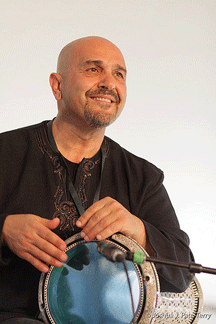
Souhail Kaspar

Alwan for the Arts Presents:

Concert: Master Percussionist Souhail Kaspar and Rachid Halihal: An Evening of Gulf Music

Souhail Kaspar – Percussion
Rachid Halihal – Voice and ‘Oud
and special guest artists

Saturday, May 16, 2009 9:00 pm
Doors open at 8:30 p.m.
$20/$15 students with I.D.
Purchase tickets online here: www.alwanforthearts.org/event/348

Watch/Listen to Souhail: youtube.com/watch?v=p6cByvRheZw

The term “Khaliji” has come to represent the culture of the Arab nations of the Persian/Arabian Gulf. The music of these nations has gained tremendous popularity throughout the Arab World in recent years. Continue reading An Evening of Gulf Music

Gender and Justice in Palestine


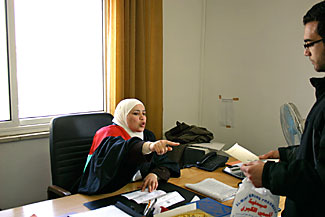
Khouloud el-Faqeeh argues a legal point in her West Bank office. In March, she became one of the two first female Islamic judges in the Middle East.

New female judge transforms Islamic court

Khouloud el-Faqeeh is part Judge Judy, part Sunday School teacher.
By Ilene R. Prusher,The Christian Science Monitor, May 10, 2009

Ramallah, West Bank:

Khouloud el-Faqeeh has shattered the glass ceiling of Islamic jurisprudence.

After years of pushing to break into the all-male ranks of sharia judges in the Palestinian territories, she finally secured a post after scoring among the best – along with another woman – in a recent test for new jurists. They are widely considered to be the first female sharia judges in the Middle East.

Now, Ms. Faqeeh is setting a new tone in her Ramallah courtroom, where defendants are often shocked to see a woman on the bench. With a style that’s part Judge Judy, part Sunday School teacher, she’s on a mission to change her society, case by case. But sometimes, even the most progressive intentions won’t overcome powerful social forces, such as those driving Miryam Abed-Nabi, a newlywed who came to court recently to finalize a divorce. Her husband – Fahmi Awadullah, a man twice her age – took her as a second wife just a few months ago. But the marriage infuriated his adult sons, who worried about their portion of his inheritance. Continue reading Gender and Justice in Palestine

Bremer vs. History: There Lies the Problem

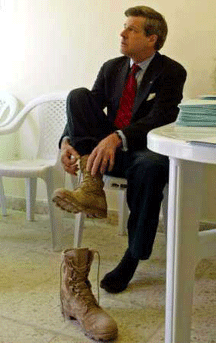
The Iraq War will not go away with a whimper. There are too many callous individuals with a vested interest in suicide bombing and too little real progress in everyday security and opportunity. The pundits, some swirling like vultures and others cooing like doves, are picking apart the pieces of the Bush administration’s bungling. One of the main players, who probably was not booted out too soon, was Paul Bremer, the Old West style sheriff of Iraq from May, 2003 until June, 2004. Among the more controversial decisions made under Bremer was the dissolution of the Iraqi Army. It is hard to find anyone these days who thinks this was a good idea, given that it was an army of conscripts who were quite likely to follow orders and help restore order. But Bremer is cashing in on the pundit circuit. Here is an interview given to the newspaper Asharq Alawsat. Some of the insights are enlightening. For instance, the military found Saddam by getting information freely given by an insurgent with no waterboarding in sight. But on other matters, Bremer lives up to the old saw that history is a pack of lies agreed upon. The only problem is that few people, and certainly few historians, will agree with Bremer. There, of course, lies the problem.

Asharq Al-Awsat Talks to Paul Bremer (Part One)

By Talhah Jibril, Asharq Alawsat, May 12, 2009

Washington, Asharq Al-Awsat – Paul Bremer was the de-facto Governor of Iraq between 11 May 2003 and 28 June 2004 in his role as the head of the Coalition Provisional Authority. As US Administrator of Iraq Bremer was the chief executive authority in the country and was effectively in charge of all Iraqi civil administration following the collapse of Saddam Hussein’s regime, and prior to the creation of the Iraqi Interim government. Bremer’s stewardship of Iraq was plagued with controversy, particularly his decision to disband the Iraqi army, as well as his implementation of the policy of Debathification. Critics have attributed the strength of the insurgency and the worsening situation in Iraq during this period to some of his policies. Continue reading Bremer vs. History: There Lies the Problem

Advice for the former Vice President

The Old Faithful of Nonsense

By Eugene Robinson, The Washington Post, Tuesday, May 12, 2009

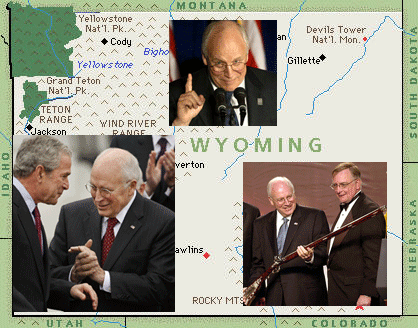
Can’t we send Dick Cheney back to Wyoming? Shouldn’t we chip in and buy him a home where the buffalo roam and there’s always room for one more crazy old coot down at the general store?

For the final act of his too-long public career, Cheney seems to have decided to become an Old Faithful of self-serving nonsense. His latest in a series of eruptions came Sunday on “Face the Nation,” when he continued to press his revisionist case for torture — and, for good measure, counseled his beloved Republican Party to marginalize itself even further from public opinion and common sense. Continue reading Advice for the former Vice President

Tarim, Islamic cultural capital for 2010


Al-Midhar mosque, Tarim, Hadramawt, Yemen

by Abdulaziz Oudhah, Yemen Observer, May 7, 2009

The Islamic Educational Scientific and Cultural Organization (ISESCO) chose Tarim as an Islamic cultural Capital for 2010, after an agreement was reached during a meeting of Islamic Cultural Ministers in Algiers in 2004. A number of Islamic, Arab, Asian, and African towns were nominated in the process to choose three towns each year to be recognized as Islamic culture capitals.

ISESCO General Manger Abdulaziz al-Tawijri, said that the Islamic capitals program aims to promote the spread of Islamic culture, renew its content, perpetuate its message, and revive the cities’ glorious culture and civilization. The capitals are chosen according to specific standards, which consider the role that they have played in serving Islamic culture, art, science, and knowledge throughout their history. The legacy of these cultural capitals is important to the construction of present and future memory, which is inspired by Islamic civilization. Continue reading Tarim, Islamic cultural capital for 2010

Emirati Youth in a Rapidly Changing Society

by el-Sayed el-Aswad, United Arab Emirates University

The UAE has developed amenable ways of synchronizing localism with globalism. It is hard to erase specificities that create a misleading portrait of a single global culture. However, Emirati local culture transforms and appropriates aspects of the global into a unique system of local social meaning. The young generations of the Emirates, for instance, have succeeded in assimilating outside influences without deserting their heritage. They have expressed their pride generated by their ability to combine both local culture and modern, global ways of life. They speak Arabic with Emirati dialects, eat indigenous food, use incense and wear traditional costumes (including veils for women) so as to symbolically identify themselves with their traditional society, but, at the same time, they speak English and employ symbols signifying western ‘global’ modernity, such as using computers, eating Western fast food, consuming expensive perfumes, and driving extravagant four wheel-drive cars. However, it can be argued that symbols of modernity do not fundamentally alter people’s beliefs, values, or culture. Continue reading Emirati Youth in a Rapidly Changing Society