All posts by tabsir

The War Within


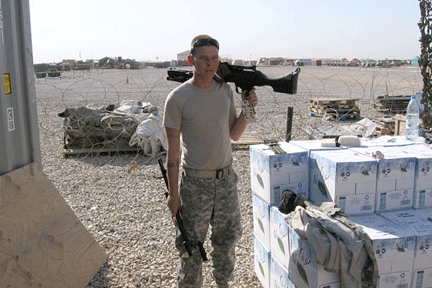
Sgt. Blaylock in Iraq

On Dec. 9, 2007, Sergeant Blaylock, heavily intoxicated, lifted a 9-millimeter handgun to his head during an argument with his girlfriend and pulled the trigger. He was 26.

“I have failed myself,” he wrote in a note found later in his car. “I have let those around me down.”

Economics trumps politics, even though the two are always in bed together. The bailouts on Wall Street and the impending end of unemployment handouts on Main Street have occupied the news channels, while the back roads of Iraq have receded in the wishful rear-view thinking about the war. But along comes a New York Times video report that brings it all back. The video documents the suicide of Sgt. Jacob Blaylock, who was haunted by the death of two close friends, to the point of posting dark poems on his Facebook page. Suicides, despite the comedic Mash theme are not painless. For the full article on the issue of suicides of returned Iraqi war veterans, click here.

What Students are Reading in Dayton

Book about Islam required reading for UD freshmen

By Dave Larsen, Dayton Daily News, July 26, 2009

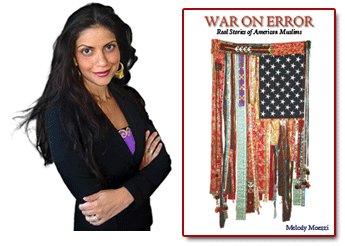
More than 1,700 incoming University of Dayton students are required to read “War on Error: Real Stories of American Muslims” before they arrive on campus Aug. 22 for first-year orientation.

The book, an award-winning collection of essays about young American Muslims, was written by Melody Moezzi, a 1997 graduate of Centerville High School and an American Muslim of Iranian descent.

UD is a Marianist Catholic university.

Moezzi’s book will serve as the basis for a series of student dialogues on the issue of diversity and differences, said Kathleen Webb, UD dean of libraries. Continue reading What Students are Reading in Dayton

Pew Survey on Muslim Views of Obama

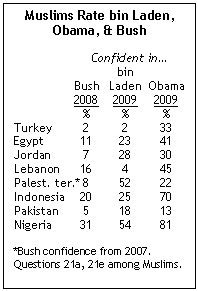
[Webshaykh’s note: On July 23 the Pew Global Attitudes Project issued a report on its survey conducted May 18 to June 16 in 24 countries, including the Palestinian territories. The full report is available as a pdf download and there is a slide presentation available as well. Here is part of the online summary of the report.]

The image of the United States has improved markedly in most parts of the world, reflecting global confidence in Barack Obama. In many countries opinions of the United States are now about as positive as they were at the beginning of the decade before George W. Bush took office. Improvements in the U.S. image have been most pronounced in Western Europe, where favorable ratings for both the nation and the American people have soared. But opinions of America have also become more positive in key countries in Latin America, Africa and Asia, as well. Continue reading Pew Survey on Muslim Views of Obama

Terms of Engagement, Taliban Style

Taliban issues new code of conduct

Al-Jazeera, July 27, 2009

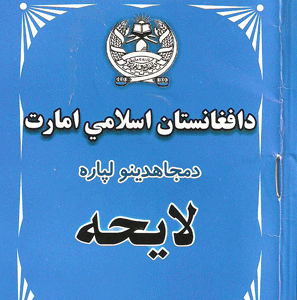
The Taliban in Afghanistan has issued a book laying down a code of conduct for its fighters.

Al Jazeera has obtained a copy of the book, which further indicates that Mullah Omar, the movement’s leader, wants to centralise its operations.

The book, with 13 chapters and 67 articles, lays out what one of the most secretive organisations in the world today, can and cannot do.

It talks of limiting suicide attacks, avoiding civilian casualties and winning the battle for the hearts and minds of the local civilian population.

James Bays, our correspondent in Afghanistan, said every fighter is being issued the pocket book entitled “The Islamic Emirate of Afghanistan Rules for Mujahideen”. Continue reading Terms of Engagement, Taliban Style

Loaves, Fishes and Tharid


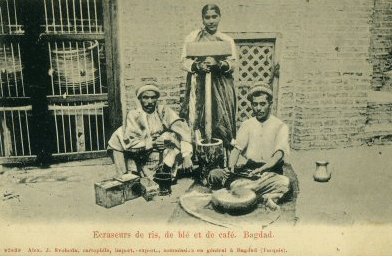
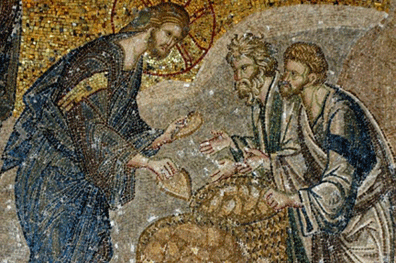
Multiplication of the Loaves and Fishes, St. Savior in Chora, Istanbul

One of the miracles attributed to Jesus is the feeding of the multitude with a mere five loaves of bread and two fishes (probably not large as the one that swallowed Jonah). The Gospel of Mark (6:30-44). In this story about five thousand were fed with a dozen baskets leftover. Who could top that among the prophets? Well, it turns out that a similar legend is recorded for the Prophet Muhammad. But instead of bread and fish the main dishes were tharid (a bread and meat dish), and dates. The famous early linguist Qutrub (died 206/821) is attributed with the following poem:

And there was a dish of tharid, food for one person:
with it he sated the crowd, while the crowd was witnessing it. Continue reading Loaves, Fishes and Tharid

Waking from its sleep

[Webshaykh’s Note: This week’s Economist has a special section on the Arab World that is well worth reading. Here is the teaser online.]

from The Economist print edition, July 23, 2009

WHAT ails the Arabs? The United Nations Development Programme (UNDP) this week published the fifth in a series of hard-hitting reports on the state of the Arab world. It makes depressing reading. The Arabs are a dynamic and inventive people whose long and proud history includes fabulous contributions to art, culture, science and, of course, religion. The score of modern Arab states, on the other hand, have been impressive mainly for their consistent record of failure.

They have, for a start, failed to make their people free: six Arab countries have an outright ban on political parties and the rest restrict them slyly. They have failed to make their people rich: despite their oil, the UN reports that about two out of five people in the Arab world live on $2 or less a day. They have failed to keep their people safe: the report argues that overpowerful internal security forces often turn the Arab state into a menace to its own people. And they are about to fail their young people. The UNDP reckons the Arab world must create 50m new jobs by 2020 to accommodate a growing, youthful workforce—virtually impossible on present trends. Continue reading Waking from its sleep