All posts by tabsir

Hashish in the Muslim World

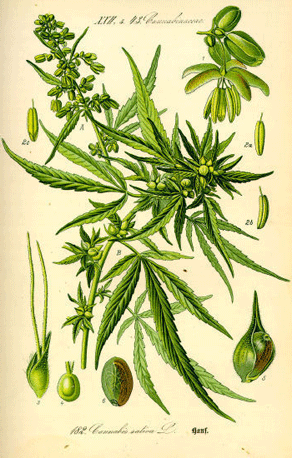
Webshaykh’s note: In the process of researching the medical aspects of the chewing of qât (Catha edulis) leaves in Yemen, I consulted an important study published almost forty years by the distinguished historian Orientalist (in the best sense — and there is a best sense — of the word) Franz Rosenthal. This was his The Herb: Hashish versus Medieval Muslim Society (Leiden: Brill, 1971). Appearing at a time when hashish had become a household word in America, Rosenthal sorts through legal, medical and literary sources to provide a historical overview of the issues surrounding the use of hashish, the plant known as qinnab in Arabic (Cannabis sp). This is a valuable resource, but also worth a good read to get a sense of how an addictive socially popular drug was viewed for almost the last full millennium. Fortunately for those of us who cannot afford massive libraries, this book is available as a Google Book online. I quote from the conclusion.]

Hashish, the Individual, and Society

In conclusion we must state again that our knowledge is very limited. The gaps are tremendous. The nature of the information we do have is not easily assessed. Its applicability to the realities prevailing over the immense extension in time and space of medieval Islam is often suspect. Partisanship pro or con, coupled with a seemingly widespread ignorance of hard facts, obscures everything. Statistics naturally are non-existent.

Our sources give the impression of a westward march of hashish that had its serious beginnings int he twelfth century and gathered speed during the thirteenth century. Continue reading Hashish in the Muslim World

Iranians in The Mist

Demystifying Iran

by Noor Iqbal, Foreign Policy in Focus, July 29, 2009

Post-election turmoil in Iran has brought the country closer to the top of America’s foreign policy concerns. More importantly, though, it has piqued the interests of the American public. Green is the new black, Moussavi and Khamenei have become household names, and tweeting about Iranian politics has never been more popular.

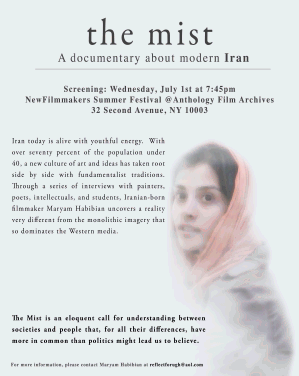
But what is Iran like beyond its politics and the Western media hype? Iranian-born filmmaker Maryam Habibian tackles this question in her most recent documentary, The Mist. The film delves into the lives of young artists, poets, playwrights, and intellectuals in Iran whose creative energy flourishes alongside fundamentalist traditions. It explores the balance they reach between artistic expression and the limitations of a conservative political regime. Habibian shows her viewers another side to Iran, one that has been largely overlooked by conventional media. She is committed to showing her audience that a society cannot be defined solely by its political system and that when it comes to Iran, we are not facing a clash of civilizations.

Her film was recently screened in New York City as part of the NewFilmmakers Summer Festival.

NOOR IQBAL: What motivated you to make this film? Continue reading Iranians in The Mist

Love Trumps Religion in Yemen


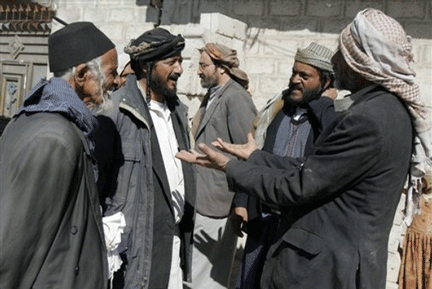
Yemeni Jews and Muslims talk at the village of Kharef, 50 miles, 80 kilometers, north of the capital Sanaa, Yemen, Monday, Dec. 15, 2008. Photograph by Mohammad al-Qadhi, AP

Complete Story of Jewish Liya’s Islam, Divorce and Marriage

Yemen Post, July 26, 2009

Over the recent period, the issues of Jewish minority have been hitting the titles in media outlets and their news is widely covered at local and international levels.

These news stories range from “Ninawa” embracing Islam and getting married to “Hani Saran”, forced migration of “Al Salem Jews” from Sa’ada and granting them apartments in the Sana’a Tourism City after being threatened by Houthis, killing incident of Masha Ya’aish at the hands of a former military pilot to the two-time marriage of “Liya” bint Sa’eed in a week and later her elopement with her Muslim husband to the nearby Arhab tribe and later on to the Al-Souk Al-Jadid in Amran’s Kharef area. Continue reading Love Trumps Religion in Yemen

A Photographer among the Syrian Bedouin


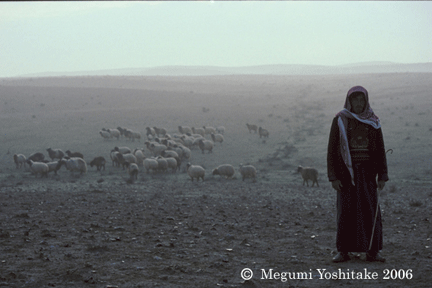
Morning Mist

A Life with a Bedouin family in Syria — from the Far East to the Middle East —

by Megumi YOSHITAKE, JAPAN

At the age of 15 the story of T. E. Lawrence [Lawrence of Arabia] captured my heart and mind. Ever since, I have yearned after deserts and been enchanted by the Arab world, and wanting to convey the essence of these places in my own way is what caused me to choose photography as my path.

I first visited Syria in 1987, and have spent part of every year from 1995 onwards living with a family of Bedouin in the Syrian Desert. Initially I was single, but visited again on my honeymoon after getting married and introduced my husband. I returned once more in 2004, this time bringing along my 16-month-old son. The time I have spent photographing the Bedouin — amounting to some 14 years — is unique among Japanese and rare even worldwide.


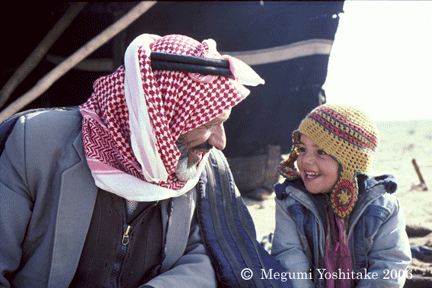
A Bedouin father and his daughter

To read the full story and look at the gallery of photographs, click here.

The Propaganda Value of a Detained Journalist


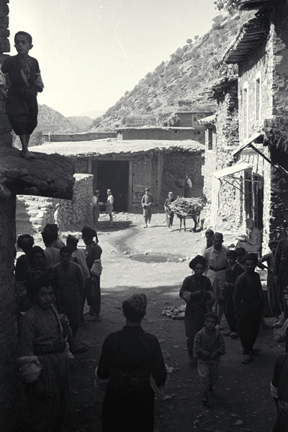
A street in Tawila, a Kurdish village near the border with Iran. Iraq, 1950, Photo by Wilfred Thesiger

by William O. Beeman, New America Media, August 06, 2009

New America Media Editor’s Note: New America Media correspondent Shane Bauer is one of three Americans presumed to be detained by the Iranian government near the Iran-Iraq border last weekend. Commentator William O. Beeman writes that their situation raises profound political questions.

“In the wrong place at the wrong time” is an apt description for three Americans currently being detained in Iran. They will likely be released, but not before Iranian authorities have wrung maximal publicity over their situation, painting them as Western intelligence operatives. The process could take months.

The timing for this event could not be more inopportune. Iran is on high emotional alert. It is flush with righteous indignation and paranoia vis-à-vis Western nations. It has undergone a contentious election where opponents of President Ahmadinejad were accused of collaboration with Western powers. Understanding the current state of mind in Iran is crucial to predicting the fate of the three travelers. Continue reading The Propaganda Value of a Detained Journalist

Rumi-nations on Houris

Houris
by Rumi, translated by William C. Chittick

If anyone asks you about houris, show your face and say, “Like this.”

If anyone speaks to you about the moon, rise up beyond the roof and say, “Like this.”

When someone looks for a fairy princess, show your face to him.

When someone talks of musk, let loose your tresses and say, “Like this.”

If someone says to you, “How do clouds part from the moon?”

Undo your robe, button by button, and say, “Like this.”

If he asks you about the Messiah, “How could he bring the dead to life?”

Kiss my lips before him and say, “Like this.” Continue reading Rumi-nations on Houris

Sociology of Islam and Muslim Societies Newsletter


Charles Kurzman, Department of Sociology, University of North Carolina

The Sociology of Islam and Muslim Societies website is an important resource for anyone interest in the study of Islam from a sociological perspective. The current summer issue is available online at the main website. In the current edition, Charles Kurzman has an introduction well worth reading. He observes,

The sociology of Islam and Muslim societies is “hot,” for all the wrong reasons. It is not because globalization has drawn the world closer together, or because sociology is internationalizing its focus beyond its historical interest in Western Europe and North America. No, the sociology of Islam is “hot” because of the common but inaccurate association of Islam with terrorism and international conflict. The world wants to know why we are seeing such violence in the name of Islam, and sociologists — along with other social scientists — are expected to have answers. Violence and stereotypes related to Muslims are, sadly, good for business in the sociology of Islam. Continue reading Sociology of Islam and Muslim Societies Newsletter